Straddle vs Strangle Option Strategy: Which One to Use
The difference between a straddle and a strangle is the strikes. A straddle uses a call and a put at the same at-the-money strike; a strangle uses an out-of-the-money call and put at different strikes. Bought, both bet on a big move in either direction: the straddle costs more but needs a smaller move. Sold, both bet on a quiet market: the strangle collects less but gives more room.
Straddle vs strangle at a glance
| Straddle | Strangle | |
|---|---|---|
| Strikes | Same (ATM) for call and put | Different: OTM call above, OTM put below |
| Premium | Higher | Lower |
| Long: move needed to profit | Smaller | Larger |
| Long: maximum loss | Total premium (larger) | Total premium (smaller) |
| Short: profit zone | Narrow | Wider |
| Short: premium collected | Higher | Lower |
| Short: risk | Unlimited | Unlimited |
| Sensitivity to time decay and IV | Higher | Lower |
The two strategies, explained
Straddle
Buy (or sell) one at-the-money call and one at-the-money put, same strike, same expiry. With NIFTY at 25,000: the 25,000 CE and the 25,000 PE. Read the full guide to the short straddle and the long straddle.
Strangle
Buy (or sell) one out-of-the-money call and one out-of-the-money put, same expiry, different strikes. With NIFTY at 25,000: for example the 25,300 CE and the 24,700 PE. See the strangle guide for strike selection.
A worked NIFTY example
NIFTY is at 25,000 (all premiums are examples, not live prices):
- ₹450 straddle cost: 25,000 CE ₹230 + 25,000 PE ₹220
- ₹215 strangle cost: 25,300 CE ₹110 + 24,700 PE ₹105
- 65 NIFTY lot size
| Long straddle | Long strangle | |
|---|---|---|
| Cost per lot | 450 × 65 = ₹29,250 | 215 × 65 = ₹13,975 |
| Upper breakeven | 25,000 + 450 = 25,450 | 25,300 + 215 = 25,515 |
| Lower breakeven | 25,000 − 450 = 24,550 | 24,700 − 215 = 24,485 |
| Max loss | ₹29,250 (if NIFTY expires at 25,000) | ₹13,975 (anywhere from 24,700 to 25,300) |
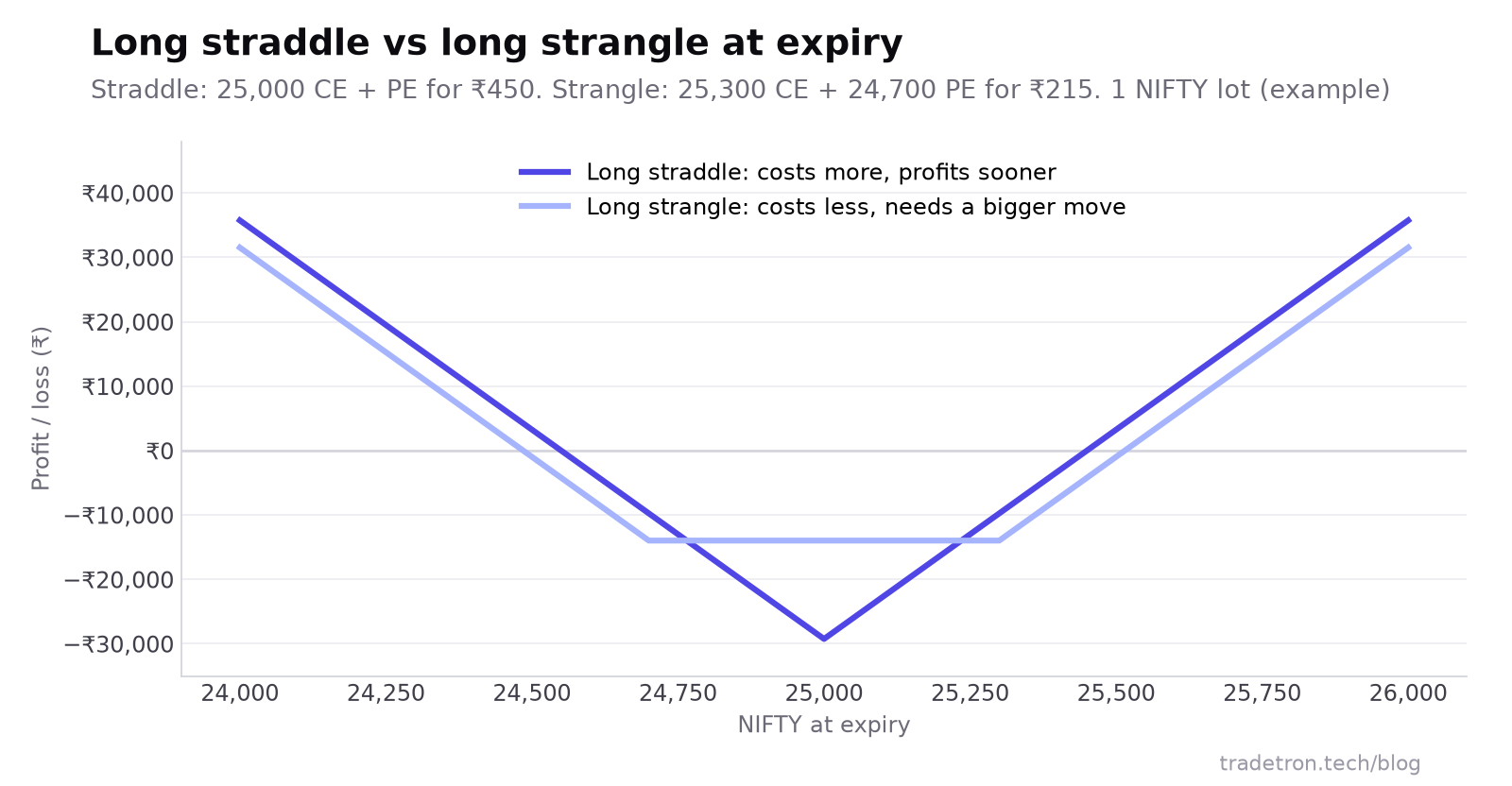 The straddle risks more and profits sooner; the strangle risks less and needs a bigger move
What each one makes or loses at expiry, per lot:
| NIFTY at expiry | Long straddle | Long strangle | Short straddle | Short strangle |
|---|---|---|---|---|
| 25,000 (no move) | −₹29,250 | −₹13,975 | +₹29,250 | +₹13,975 |
| 25,300 | −₹9,750 | −₹13,975 | +₹9,750 | +₹13,975 |
| 25,600 | +₹9,750 | +₹5,525 | −₹9,750 | −₹5,525 |
| 26,000 | +₹35,750 | +₹31,525 | −₹35,750 | −₹31,525 |
Three things stand out:
- If nothing happens, the straddle buyer loses twice as much as the strangle buyer; the straddle seller earns twice as much.
- On a moderate move (to 25,300), the strangle buyer is still at the maximum loss, while the straddle buyer has recovered most of it. A strangle seller still earns the full premium here.
- On a big move, both buyers profit, and the straddle a little more. Both sellers take large losses.
When to use a straddle
Long straddle: you expect a big move soon, direction unknown, and want the nearest breakevens. Examples: results for a stock, the Budget, RBI policy, election outcomes. Be aware that implied volatility rises before such events, so the straddle costs more then, and IV often falls right after.
Short straddle: you expect the market to stay very close to the current level, IV is high and likely to fall, and you will manage the position with stops or hedges.
When to use a strangle
Long strangle: you expect a very large move and want a cheaper ticket, accepting that a moderate move won't be enough.
Short strangle: you expect a range rather than a pin, and want more room for error than a straddle gives. It's one of the most common option-selling structures on NIFTY.
- Big move expected, want the best chance of profiting from it? Long straddle.
- Very big move expected, want to spend less? Long strangle.
- Market expected to stay almost still, IV high? Short straddle, with stops or wings.
- Market expected to stay in a range? Short strangle, with stops or wings.
Risks to respect
- Time decay works against long straddles and strangles every day; the straddle, with more time value, loses faster in money terms.
- Volatility changes can move the premium even without a price move. Buying ahead of an event often means buying expensive volatility.
- Unlimited risk on short versions. A gap or a trending day can cost several times the premium collected. Hedge with wings to create an iron butterfly or iron condor and cap the loss.
- Expiry calendar. NIFTY weekly options expire on Tuesday; BANK NIFTY, FINNIFTY and MIDCPNIFTY are monthly only. Weekly positions decay and swing faster.
Frequently asked questions
What is the main difference between a straddle and a strangle?
A straddle uses the same at-the-money strike for the call and the put. A strangle uses an out-of-the-money call and an out-of-the-money put at two different strikes. Both use the same expiry.
Which is cheaper, a straddle or a strangle?
A strangle. Its options are out of the money, so they cost less. In the NIFTY example, the straddle costs ₹450 per unit and the strangle ₹215.
Which is better for beginners, a straddle or a strangle?
For buyers, a long strangle risks less money but needs a bigger move; a long straddle costs more but breaks even sooner. Sellers should start with hedged versions (iron butterfly or iron condor) rather than naked straddles or strangles.
Which is riskier to sell, a straddle or a strangle?
Both have unlimited risk when sold without hedges. A short straddle has a narrower profit zone, so it moves into loss sooner, but collects more premium to cushion it. A short strangle has more room but less cushion.
When should I use a straddle instead of a strangle?
Use a long straddle when you expect a large move and want the nearest breakevens. Use a short straddle when you expect the market to stay very close to the current level. Use strangles when you expect a bigger move (long) or a wider range (short).
Can I backtest straddles and strangles?
Yes. On Tradetron you can backtest both on historical data with the same entry time, stops and exits, and compare how each would have behaved over the same period.