Iron Condor Option Strategy: A Complete Guide with NIFTY Example
The iron condor is a neutral options strategy with four legs: you sell an out-of-the-money (OTM) call and an OTM put, and buy a further OTM call and put as protection. You receive a net credit, profit if the underlying stays between the two sold strikes, and your maximum loss is capped by the bought options.
How an iron condor makes and loses money, and why its win rate and exits decide the outcome, in 3 minutes. हिन्दी में देखें: Iron condor समझिए: credit, सीमित risk, और ज़रूरी win rate, 3 मिनट में

How the iron condor works
An iron condor is two credit spreads placed on either side of the current price:
- A bear call spread above the market: sell an OTM call, buy a call further out.
- A bull put spread below the market: sell an OTM put, buy a put further out.
The two sold options collect premium. The two bought options cost less than that, so you start with a net credit. As long as the underlying stays between the short strikes until expiry, all four options expire worthless and you keep the credit. If it breaks out on either side, the bought "wing" on that side stops the loss from growing past a fixed amount.
Premiums in this article are example figures, chosen to make the arithmetic clear. They are not live prices.
Iron condor payoff, max profit, max loss and breakevens
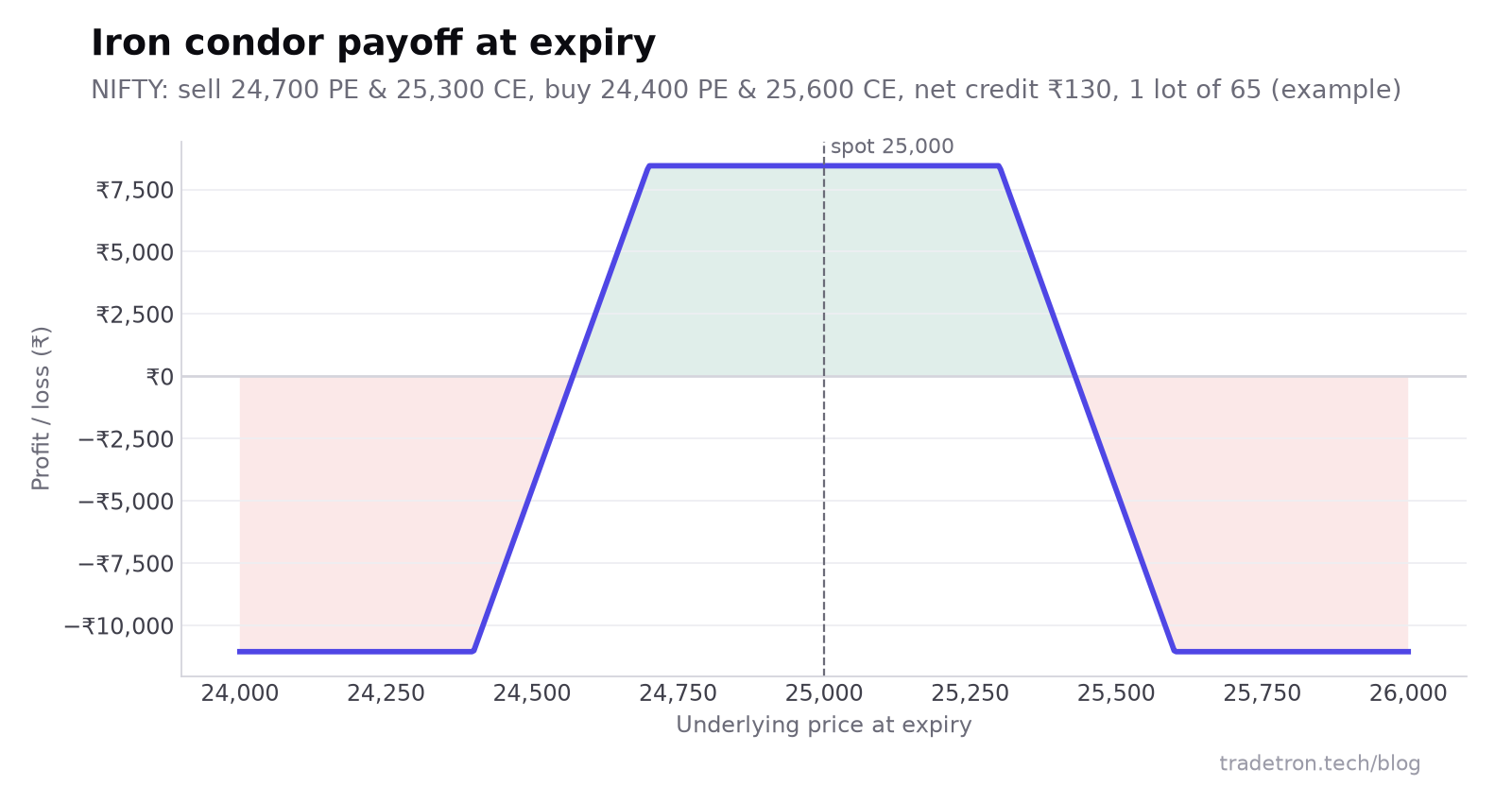 The iron condor's payoff: a flat top, two slopes and two floors
| Formula | Example | |
|---|---|---|
| Net credit | Premium of sold options − premium of bought options | (110 + 105) − (40 + 45) = ₹130 |
| Maximum profit | Net credit × lot size | 130 × 65 = ₹8,450 |
| Maximum loss | (Spread width − net credit) × lot size | (300 − 130) × 65 = ₹11,050 |
| Upper breakeven | Short call strike + net credit | 25,300 + 130 = 25,430 |
| Lower breakeven | Short put strike − net credit | 24,700 − 130 = 24,570 |
At these numbers, the break-even win rate is 11,050 ÷ (8,450 + 11,050), about 57%, before costs and assuming every trade runs to its maximum profit or loss. Real trades usually exit earlier, which changes both sides of that sum.
Iron condor vs short strangle vs iron butterfly
| Strategy | Legs | Risk | Profit zone | Credit |
|---|---|---|---|---|
| Short strangle | Sell OTM call + OTM put | Unlimited | Wide | Medium |
| Iron condor | Short strangle + bought wings | Capped | Wide | Lower |
| Short straddle | Sell ATM call + ATM put | Unlimited | Narrow | Highest |
| Iron butterfly | Short straddle + bought wings | Capped | Narrow | High |
An iron condor is, in effect, a short strangle with insurance. The wings cost part of the premium, but they cap the loss and reduce the margin the exchange requires, often substantially. If you want to compare the unhedged versions first, see straddle vs strangle.
When to use an iron condor
- The market is range-bound and you expect it to stay that way until expiry.
- Implied volatility is high or falling. Higher IV pays more for the same strikes, and a fall in IV helps all four legs move your way.
- No big event before expiry. Results, the Budget or policy decisions can push the price through a short strike in one move.
- You want defined risk. You know the worst case before you place the trade.
How to choose strikes and width
- Pick the short strikes by distance or by delta. Many traders sell strikes with a delta around 0.15–0.25, or a set number of points from spot. Further away means a higher chance of profit but a smaller credit.
- Pick the width. The distance between the short and long strike on each side sets the maximum loss. Wider wings collect more credit but risk more.
- Keep it balanced or skew it. Equal distances make the condor neutral. Placing one side closer expresses a mild directional view.
- Check the reward-to-risk. If the credit is a small fraction of the width, a single loss can wipe out many winners.
Managing an iron condor once it's on
- Take profit early. Many traders close at 50–70% of the maximum profit instead of waiting for expiry, when gamma risk is highest.
- Use a loss limit. For example, exit if the position loses 1.5× to 2× the credit received, or if the underlying touches a short strike.
- Adjust the untested side. When the market moves towards one side, some traders roll the other (untested) spread closer to collect more premium. This reduces the loss but also narrows the profit zone.
- Exit before expiry if a short strike is threatened. Being slightly in the money at expiry can turn a small loss into the full loss quickly.
How to create an iron condor on Tradetron
You can build an iron condor in Tradetron's Option Wizard in a few steps, without code.
- Log in to Tradetron and open Create → Option Wizard. You can pick a pre-built strategy or click Create Own Strategy.
- Name the strategy and choose the underlying, for example NIFTY 50.
- Choose the type. Select Intraday if you want positions squared off the same day, or a positional type to hold until your exit conditions.
- Add the four legs: sell an OTM call and an OTM put (the example above sells strikes 300 points, or 6 strikes, from ATM), and buy a call and a put another 300 points further out as wings. Choose the expiry and number of lots for each.
- Set the target and stop-loss for each leg or for the whole strategy.
- Backtest the strategy on historical data, then deploy it.
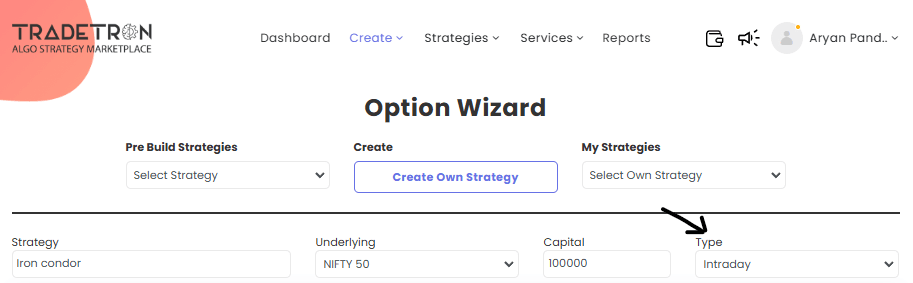 Option Wizard: name, underlying and type
For finer control, such as exits on combined P&L, re-entry after a stop or adjustments when a short strike is tested, you can open the strategy in the full builder and add Exit, Repair Once or Repair Continuous conditions. Our guide to Repair Once and Repair Continuous explains how adjustments work.
Frequently asked questions
What is an iron condor in options?
An iron condor is a four-leg options strategy: sell an out-of-the-money call and put, and buy a further out-of-the-money call and put of the same expiry. It earns a net credit and profits if the underlying stays between the two sold strikes.
What is the maximum profit and loss of an iron condor?
Maximum profit is the net credit received. Maximum loss is the width of one spread minus the net credit, multiplied by the lot size. With 300-point spreads and a ₹130 credit on NIFTY, that is ₹8,450 maximum profit and ₹11,050 maximum loss per lot.
How do you calculate iron condor breakevens?
Add the net credit to the short call strike for the upper breakeven, and subtract it from the short put strike for the lower breakeven.
When should you use an iron condor?
When you expect the underlying to stay in a range until expiry, implied volatility is high or likely to fall, and no major event is scheduled before expiry.
What happens if the price moves outside the range?
You start losing once the price passes a breakeven. The loss keeps growing until the price reaches the bought strike on that side; beyond that, the bought option offsets further losses, so the loss stays at the maximum.
Is an iron condor better than a short strangle?
It has lower risk but a lower credit. The bought wings cap the loss and reduce margin, while a short strangle collects more premium but has unlimited risk. Many traders prefer the condor because a single gap can't take more than the known maximum loss.
Can I adjust an iron condor on Tradetron while it's running?
Yes. You can add Repair conditions to roll or adjust legs when the market moves, and exit conditions for profit targets and loss limits, so the adjustments run by rule instead of by hand.