NIFTY Option Hedging Strategy: Protective Puts, Collars and More
A NIFTY option hedging strategy uses NIFTY options, most often a bought put, to offset losses on a position you already hold if the index moves against you. If your portfolio gains when NIFTY rises, you buy a NIFTY put: when the index falls, the put gains and cushions the loss. The cost is the premium, paid whether or not the fall comes.
What is hedging with NIFTY options?
Hedging means taking a second position that moves opposite to your existing one, so a loss on one is partly offset by a gain on the other. For a general introduction, see what hedging is and how to automate it.
A NIFTY option hedge has three parts:
| Part | What it is | Example |
|---|---|---|
| The exposure | What you're protecting | A stock portfolio that tracks NIFTY, a long NIFTY futures position, or a bought call |
| The hedge | The option that gains when the exposure loses | A NIFTY put bought below the current level |
| The cost | What you pay for protection | The put's premium × lot size |
NIFTY options are European-style and cash-settled: an in-the-money option is settled in cash at expiry, with no delivery and no early exercise.
How many lots do you need?
Beta measures how much your portfolio moves for a 1% move in NIFTY. A diversified large-cap portfolio is often close to 1; a portfolio of high-beta midcaps can be well above it.
- ₹16,25,000 portfolio value (beta 1)
- 25,000 × 65 = ₹16,25,000 of exposure per NIFTY lot
- 1 lot needed to hedge it
If the same portfolio had a beta of 1.3, you would need 16,25,000 × 1.3 ÷ 16,25,000 = 1.3 lots, rounded to 1 (slightly under-hedged) or 2 (over-hedged). NIFTY's lot size is 65 from the January 2026 series; check the current figure before sizing.
NIFTY option hedging strategy with example
Illustrative example. The figures are for explanation only and are not live market prices or a recommendation.
A trader holds a ₹16,25,000 portfolio that moves roughly in line with NIFTY 50 (beta ≈ 1). NIFTY is at 25,000. The trader buys 1 lot of the NIFTY 24,700 put (300 points, about 1.2%, below spot), three weeks to expiry, at ₹110.
- ₹7,150 hedge cost (₹110 × 65)
- 24,700 level below which the put starts paying
- 24,590 level where the put pays back its own cost (24,700 − 110)
| NIFTY at expiry | Portfolio | Put | Net result | Without hedge |
|---|---|---|---|---|
| 24,000 (−4%) | −₹65,000 | +₹45,500 − ₹7,150 = +₹38,350 | −₹26,650 | −₹65,000 |
| 24,700 (−1.2%) | −₹19,500 | −₹7,150 | −₹26,650 | −₹19,500 |
| 25,200 (+0.8%) | +₹13,000 | −₹7,150 | +₹5,850 | +₹13,000 |
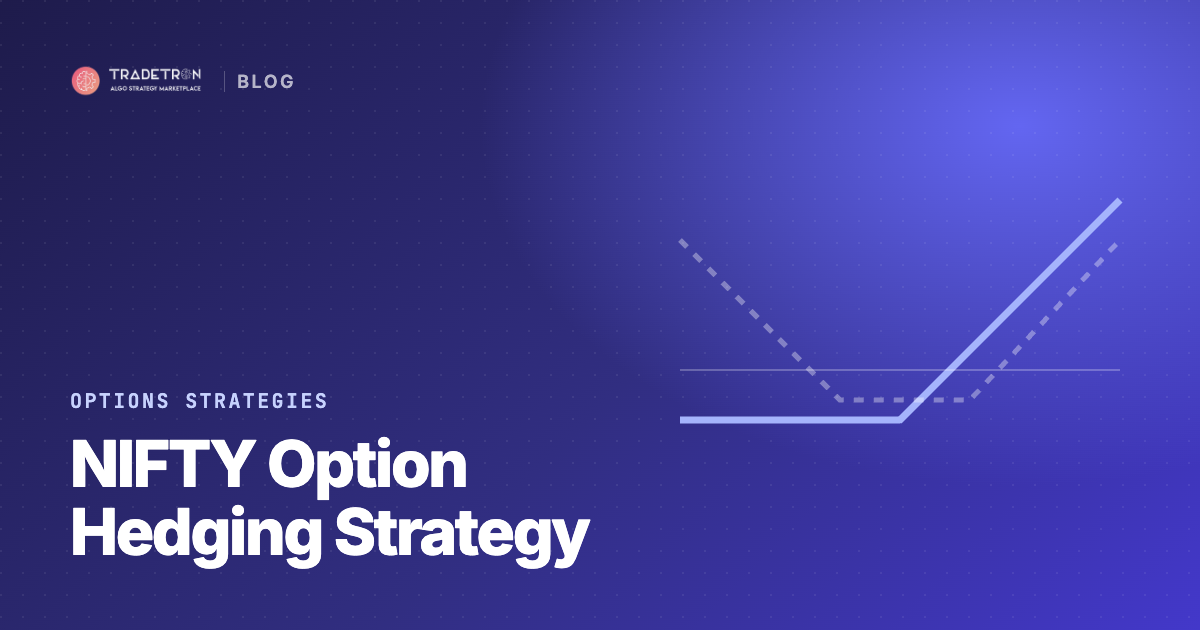
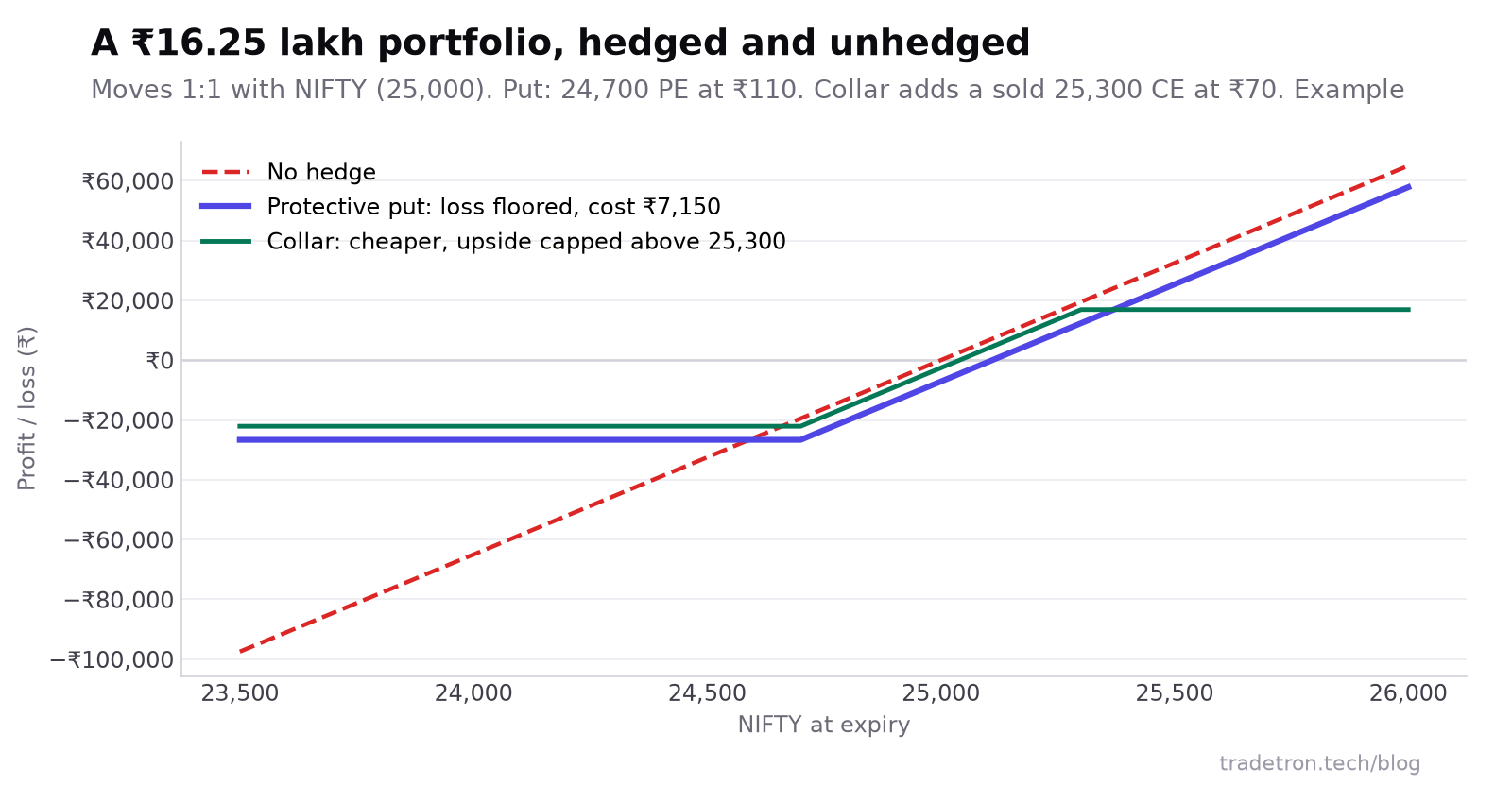 The put puts a floor under the loss; the collar raises the floor and lowers the ceiling
Three things to notice:
- The loss is floored. However far NIFTY falls, the hedged loss at expiry stays at about ₹26,650: the first 300 points of the fall plus the premium.
- Small falls aren't covered. Between 25,000 and 24,700 the put pays nothing at expiry; you lose on the portfolio and the premium.
- If NIFTY rises, you pay for insurance you didn't use. That's the trade-off of every hedge.
These figures are before costs. Brokerage, exchange charges, GST, stamp duty and STT all apply, and STT on an option settled in the money at expiry is the one most often overlooked. Check current rates with your broker.
Making the hedge cheaper
Collar
Sell an out-of-the-money call against the same exposure and use its premium to fund the put. In the example, selling the 25,300 call at ₹70 brings in ₹4,550, cutting the hedge's net cost from ₹7,150 to ₹2,600. The worst case improves to about −₹22,100, but gains above 25,300 are given up: the best case is about +₹16,900.
Put spread
Buy the 24,700 put and sell a further OTM put, say the 24,200. The sold put reduces the cost, but protection stops below 24,200. It suits a hedge against a moderate fall rather than a crash.
Further-out or longer-dated puts
A put further from spot costs less but starts paying later. A longer expiry costs more but needs rolling less often and decays more slowly per day.
Common NIFTY option hedging strategies
| Strategy | Construction | Best for |
|---|---|---|
| Protective put | Buy an OTM NIFTY put against long exposure | Limiting downside on a portfolio or long position |
| Collar | Buy an OTM put + sell an OTM call | Cheaper protection when you accept capped upside |
| Put spread hedge | Buy an OTM put + sell a further OTM put | A cheaper hedge for a limited fall |
| Futures hedge | Buy a put against long futures (or a call against short futures) | Capping the loss on a leveraged futures position |
| Covered call | Sell an OTM call against a long position | Earning premium to offset holding costs; not downside protection |
| Hedged option selling | Buy wings against short options | Turning short straddles and strangles into iron butterflies and condors |
If you sell options, buying wings is the most important hedge of all: see the iron condor guide and the short straddle guide.
What affects the cost of a NIFTY hedge
- Strike distance. A put closer to spot costs more but pays sooner.
- Time to expiry. Longer-dated puts cost more in total, but less per day.
- Implied volatility. When markets are stressed, IV rises and hedges get expensive, which is exactly when people want them. Hedging when IV is calm is cheaper.
- Time decay. An OTM put is all time value. Every day it isn't needed, it loses some of it. That is the cost of insurance, not a sign the hedge failed. See how option premium is calculated.
NIFTY vs BANK NIFTY for hedging
| NIFTY options | BANK NIFTY options | |
|---|---|---|
| Underlying | NIFTY 50: broad market | NIFTY Bank: banking and financial stocks |
| Lot size (from Jan 2026) | 65 | 30 |
| Expiries | Weekly and monthly | Monthly only |
| Use for hedging | Diversified portfolios | Portfolios concentrated in bank stocks |
A BANK NIFTY put won't hedge a diversified portfolio well, and a NIFTY put won't precisely hedge a bank-heavy one. Match the hedge to what you hold.
Risk management and common mistakes
- Size the hedge to the actual exposure, using the lot formula and beta, not a round number.
- Match the hedge's expiry to the risk period. A put that expires before the event leaves you unprotected.
- Budget for decay. Decide in advance how much premium per month you're willing to spend on protection.
- Roll by rule, not by feel. Re-buying the hedge around news by hand adds timing risk.
- Don't turn the hedge into a trade. Selling the put early because "the market looks fine" leaves you unhedged at the moment it matters.
Frequently asked questions
What is a NIFTY option hedging strategy?
It is the use of NIFTY options, usually a bought put, to offset potential losses on an existing position if the index falls. You pay a premium in exchange for a floor under your loss.
What is the simplest example of hedging with NIFTY options?
Buying an out-of-the-money NIFTY put against a long portfolio or long NIFTY futures position. This is called a protective put.
How many NIFTY lots do I need to hedge my portfolio?
Multiply your portfolio value by its beta, then divide by NIFTY's level times the lot size (65). A ₹16.25 lakh portfolio with a beta of 1, with NIFTY at 25,000, needs one lot.
Does hedging with NIFTY options remove all risk?
No. A hedge reduces the size of a possible loss but doesn't eliminate it. An out-of-the-money put leaves the first part of a fall unprotected, the premium is a cost, and a portfolio that doesn't track NIFTY closely won't be fully hedged.
What is a collar, and how is it different from a put hedge?
A collar adds a sold out-of-the-money call to a protective put. The call's premium reduces or covers the put's cost, but your gains above the call's strike are capped.
Is it better to hedge with weekly or monthly NIFTY options?
Weekly puts cost less per contract but decay quickly and must be rolled often. Monthly or longer-dated puts cost more upfront but decay more slowly per day and cover a longer risk window. The right choice depends on how long you need protection.
Can a NIFTY option hedge be automated?
Yes. Strike selection, lot sizing and roll timing can be built as rules on Tradetron, backtested on historical data, and run Live Offline before going live.