Short Straddle: The Classic Strategy to Profit from Time Decay
A short straddle means selling an at-the-money (ATM) call and an ATM put with the same strike and expiry. You collect both premiums up front and profit from time decay if the underlying stays close to the strike. Your maximum profit is the premium collected; your risk is a large move in either direction, which can make losses far larger than that premium.
How a short straddle makes and loses money, and how wings cap the risk, in 3 minutes. हिन्दी में देखें: Short straddle समझिए: reward, असली risk, और hedge, 3 मिनट में

How a short straddle works
With NIFTY at 25,000, you sell the 25,000 call and the 25,000 put of the same expiry. Both options are at the money, so both are made almost entirely of time value. Every day the market stays near 25,000, that time value decays, and both options get cheaper. Since you sold them, falling prices are your profit.
All premiums in this article are example figures for illustration, not live market prices.
Short straddle payoff at expiry
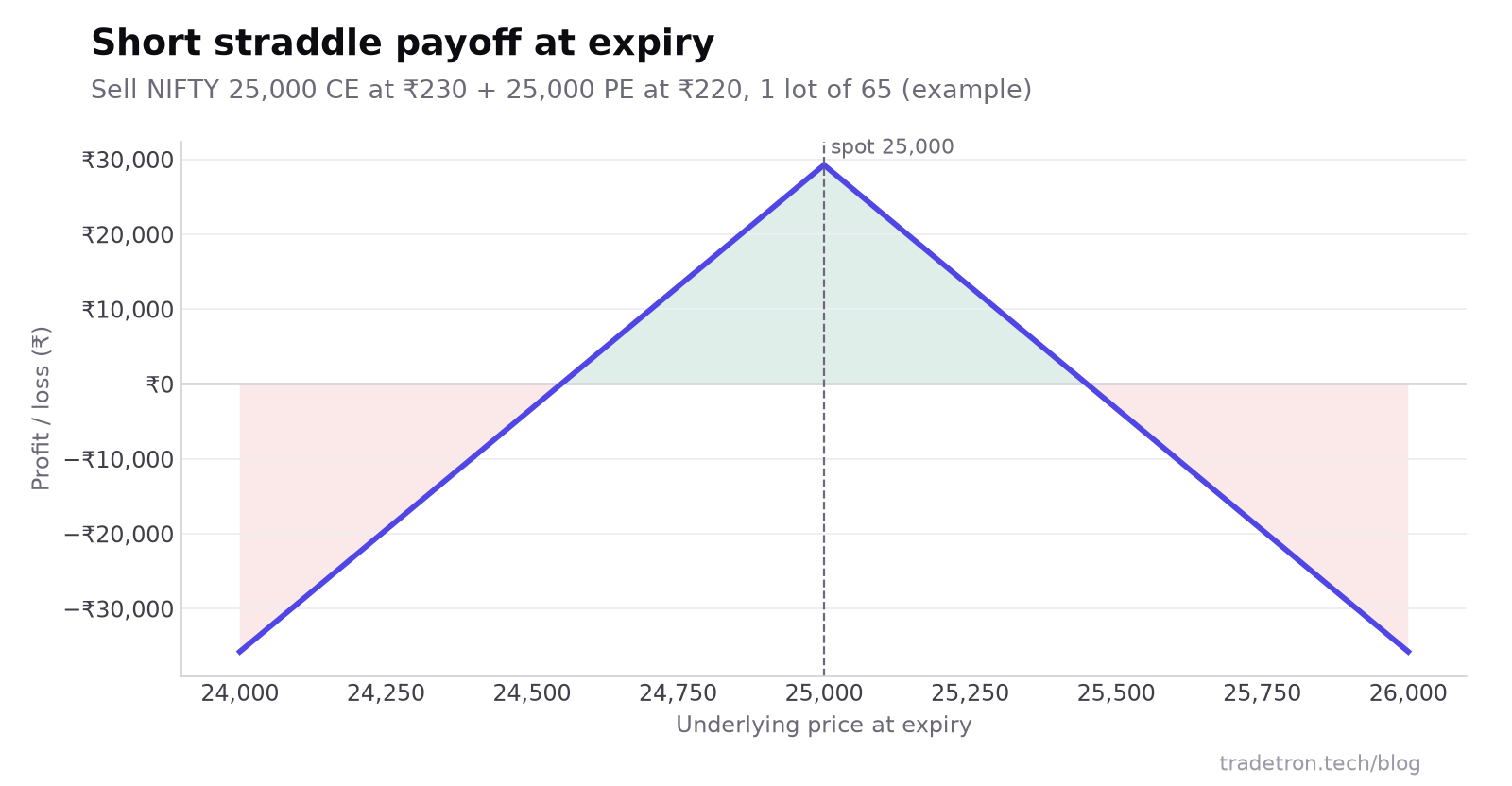 Payoff of a short straddle at expiry: a tent with unlimited loss on both slopes
| Formula | Example | |
|---|---|---|
| Maximum profit | Total premium × lot size | ₹450 × 65 = ₹29,250 |
| Upper breakeven | Strike + total premium | 25,000 + 450 = 25,450 |
| Lower breakeven | Strike − total premium | 25,000 − 450 = 24,550 |
| Maximum loss | Unlimited above; very large below | At 26,000: (1,000 − 450) × 65 = −₹35,750 |
The tent shape tells you something important. Profit falls one point for every point NIFTY moves away from the strike. The profit zone is the total premium wide on each side, so the more premium you collect (usually when IV is high), the wider the zone.
When traders use a short straddle
- Range-bound markets. The underlying has been moving sideways with no clear trend.
- High implied volatility that is expected to fall. Premiums are rich, and a drop in IV makes both options cheaper even if the price doesn't move. This is common right after a big event has passed.
- No scheduled event before expiry. Results, the Union Budget, RBI policy and election results can all cause gaps. Selling straddles into them is selling at a price set for exactly that risk.
- Close to expiry. Time decay is fastest in the last days, which is why many traders sell straddles in expiry week.
The Greeks behind a short straddle
| Greek | Position | What it means for you |
|---|---|---|
| Theta | Positive | You earn time decay every day the market stays still |
| Vega | Negative | You gain if IV falls and lose if IV rises |
| Gamma | Negative | Losses speed up as the market moves away from the strike |
| Delta | Near zero at entry | Direction neutral at first, but becomes directional quickly after a move |
Negative gamma is the part beginners underestimate. Close to expiry an ATM straddle can swing from comfortable profit to a sizeable loss within an hour of a sharp move.
The risks, and how to manage them
| Risk | What happens | How traders manage it |
|---|---|---|
| Sharp move | One leg goes deep in the money, losses grow point for point | Per-leg stop-loss, or a stop on the combined premium |
| Gap opening | Overnight news opens the market far from your strike, past your stop | Trade intraday, or hold only with hedges |
| IV spike | Both options get more expensive even without much movement | Avoid selling ahead of events; size smaller |
| Margin | Unhedged short options need high margin | Buying hedges reduces the margin requirement |
Common ways to control a short straddle
- Per-leg stop-loss. Exit a leg if its premium rises by a fixed percentage, for example 25–40% above the price you sold it at. The other leg keeps decaying.
- Combined stop. Exit both legs if the total premium of the two rises above a level, or if the strategy's loss crosses a fixed rupee amount.
- Buy wings. Buy an out-of-the-money call and put a few hundred points away. This turns the straddle into an iron butterfly with a capped loss.
- Time exit. Close everything at a fixed time, such as 3:15 pm, so you never carry a naked position overnight by accident.
- Re-entry rules. After a stop, some traders re-sell at the new ATM strike once the market settles. Decide in advance how many times, so a trending day can't eat the account.
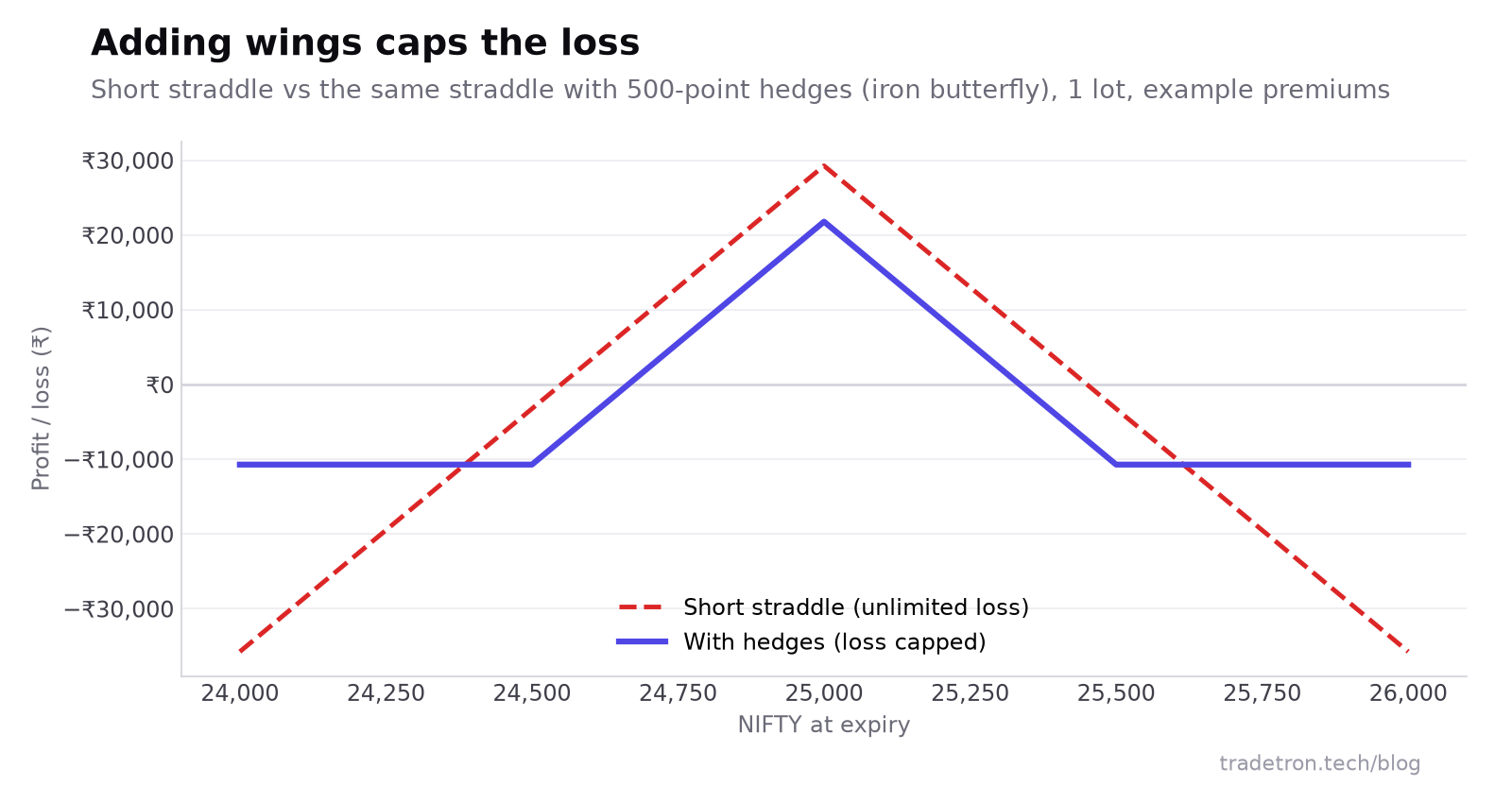 Buying wings gives up some premium but puts a floor under the loss
In the example above, buying the 25,500 call for ₹60 and the 24,500 put for ₹55 costs ₹115, so the net credit drops from ₹450 to ₹335. In exchange, the worst case at expiry becomes (500 − 335) × 65 = ₹10,725 per lot instead of an open-ended loss. For more on this structure, see the iron condor guide and what hedging is.
Short straddle vs short strangle
A short strangle sells an out-of-the-money call and put instead of ATM options. It collects less premium but gives the market more room before losses start. A straddle earns more if the market sits still; a strangle survives more movement. Our straddle vs strangle comparison goes through both side by side, and the strangle guide covers strike selection.
Test it before you trade it
A short straddle wins often and loses big, so a few trades tell you very little. Backtest the exact rules (entry time, strike choice, stop size, re-entries and exit time) over a long period that includes volatile months, then look at the worst day and the deepest drawdown, not just total profit. Our guide to why backtests don't match live trading covers slippage and other gaps worth allowing for.
Frequently asked questions
What is a short straddle?
A short straddle is an options strategy where you sell an at-the-money call and an at-the-money put with the same strike and expiry. You collect both premiums and profit if the underlying stays near the strike until you exit or until expiry.
What is the maximum profit and loss of a short straddle?
The maximum profit is the total premium collected, earned only if the underlying expires exactly at the strike. The maximum loss is unlimited on the upside and very large on the downside, because one of the sold options keeps gaining value as the market moves.
How do you calculate the breakeven of a short straddle?
Add the total premium to the strike for the upper breakeven, and subtract it for the lower one. Selling the 25,000 straddle for ₹450 gives breakevens of 25,450 and 24,550.
When is the best time to sell a straddle?
Traders usually sell straddles when implied volatility is high and expected to fall, the market is range-bound, and no major event falls before expiry. Many enter after the first 15–30 minutes of trading, once the opening volatility settles.
Is a short straddle safe?
No options-selling strategy is safe in the sense of having limited risk unless you hedge it. A short straddle can lose many times the premium in a sharp move. Stop-losses, hedges, small size and time exits make the risk manageable, not zero.
What is the difference between a short straddle and an iron butterfly?
An iron butterfly is a short straddle plus a bought out-of-the-money call and put. The extra options cost some premium, but they cap the maximum loss and usually reduce the margin needed.
Can I automate a short straddle?
Yes. On Tradetron you can set the entry time, strikes, per-leg stop-losses, re-entries and exit time as rules, backtest them, and run the strategy Live Offline before connecting a broker.