How to Calculate Option Premium: Formula and Examples
To calculate an option premium, add its two parts: intrinsic value (how much the option is in the money) and time value (what buyers pay for the chance of a bigger move before expiry). For a call, intrinsic value is spot minus strike; for a put, strike minus spot; never below zero. Time value is whatever the market price adds on top.
How an option premium splits into intrinsic value and time value, with a NIFTY example, in 3 minutes. हिन्दी में देखें: Option premium कैसे calculate करें, 3 मिनट में

What is an option premium?
The option premium is the price of an option contract: what the buyer pays and the seller receives for the right (but not the obligation) to buy or sell the underlying at the strike price before or on expiry.
Premiums are quoted per unit of the underlying. To get the money that actually changes hands, multiply by the lot size.
- ₹120 quoted premium of a NIFTY option (example)
- 65 NIFTY lot size
- ₹7,800 what one lot costs the buyer (₹120 × 65)
The buyer's maximum loss is that premium. The seller keeps it if the option expires worthless, but takes on the risk of a large move against them.
The formula: intrinsic value + time value
Intrinsic value
Intrinsic value is what the option would be worth if it expired right now.
| Option | Intrinsic value | In the money when |
|---|---|---|
| Call (CE) | Spot − Strike, or 0 if negative | Spot is above the strike |
| Put (PE) | Strike − Spot, or 0 if negative | Spot is below the strike |
So with NIFTY at 25,000:
- The 24,800 call has ₹200 of intrinsic value (25,000 − 24,800).
- The 25,200 call has none: it is out of the money.
- The 25,200 put has ₹200 of intrinsic value (25,200 − 25,000).
Time value (extrinsic value)
Time value is the rest of the premium:
It is what the buyer pays for the possibility that the option becomes more valuable before expiry. It depends on how much time is left, how volatile the underlying is expected to be, and, to a small degree, interest rates. At expiry, time value is zero and the premium equals intrinsic value.
How to calculate an option premium, step by step
- Find the moneyness. Compare the strike with the current spot (for index options, traders often compare with the futures price too).
- Calculate intrinsic value. Call: spot − strike. Put: strike − spot. If the answer is negative, intrinsic value is 0.
- Read the market premium from the option chain.
- Subtract to get time value. Time value = premium − intrinsic value.
- Multiply by the lot size to see the money involved per lot.
The chart below shows how the split changes across strikes. Deep in-the-money calls are mostly intrinsic value. At-the-money calls carry the most time value. Far out-of-the-money calls are cheap, and all of their price is time value.
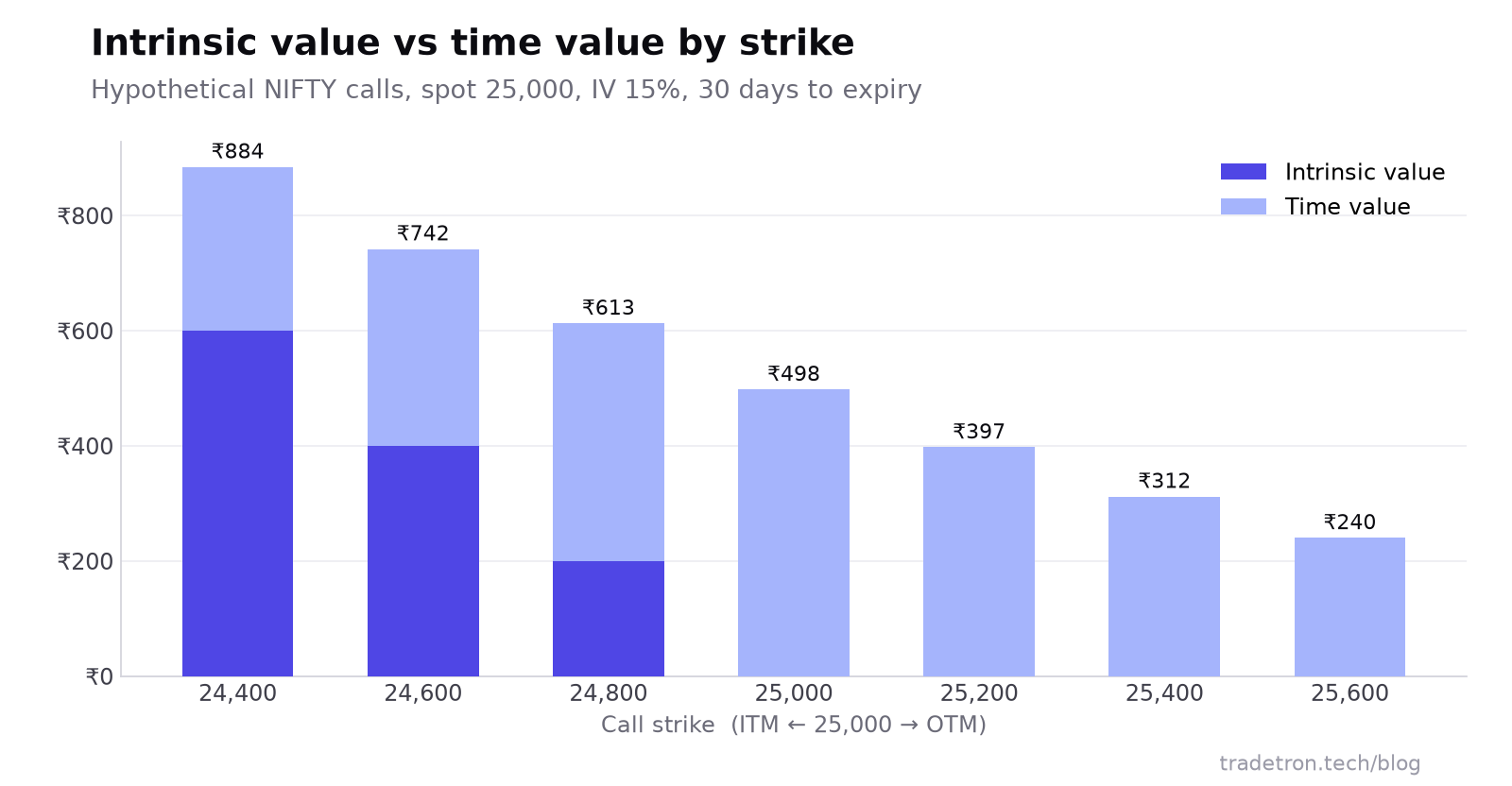 Intrinsic and time value of NIFTY calls at different strikes (model prices, hypothetical inputs)
Five factors that move an option premium
| Factor | Effect on call premium | Effect on put premium |
|---|---|---|
| Underlying price rises | Up | Down |
| More time to expiry | Up | Up |
| Higher implied volatility | Up | Up |
| Higher interest rates | Slightly up | Slightly down |
| Dividend expected before expiry (stocks) | Down | Up |
1. Underlying price and strike
This sets intrinsic value. How fast the premium changes with the underlying is measured by delta: an at-the-money option has a delta near 0.5, so it moves roughly ₹0.50 for each ₹1 move in the underlying.
2. Time to expiry
More time means more chance of a big move, so longer-dated options cost more. As expiry approaches, time value falls, and it falls faster near the end. This is theta, or time decay.
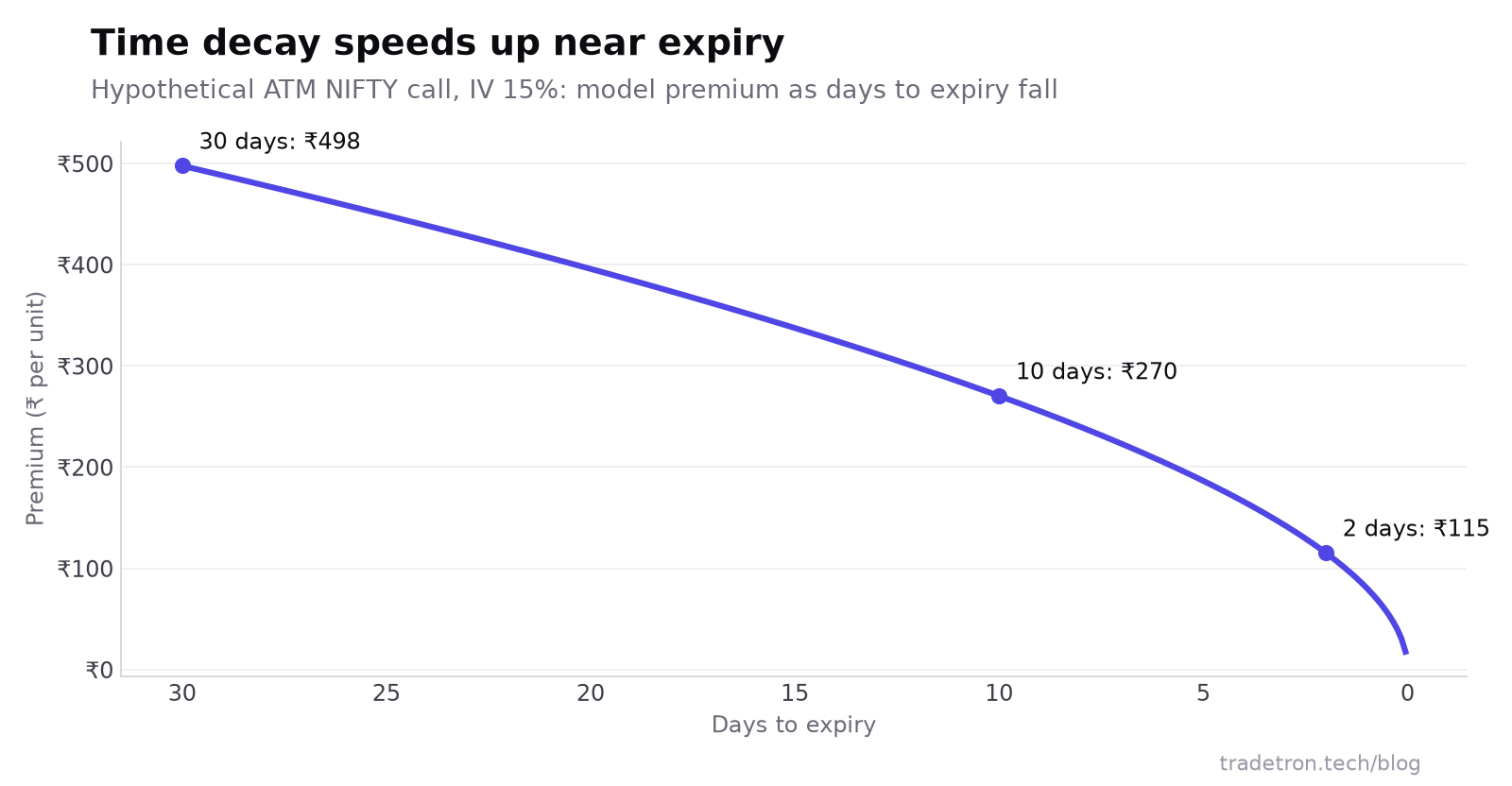 Time decay of an at-the-money option: slow at first, fast near expiry (model prices)
3. Implied volatility
Implied volatility (IV) is the market's estimate of how much the underlying will move. Higher IV means a higher premium for both calls and puts. Sensitivity to IV is vega. IV often rises before events (results, budget, policy meetings) and falls right after, which can shrink premiums even when the underlying moves the way the buyer expected. Read more in the best indicators for options trading.
4. Interest rates
Higher rates make calls slightly more expensive and puts slightly cheaper, because buying a call instead of the underlying ties up less money. The effect is small for short-dated options. This is rho.
5. Dividends
For stock options, an expected dividend lowers the stock price on the ex-date, so it reduces call premiums and increases put premiums. Index options feel this only through the index constituents.
Calculating the theoretical premium with Black-Scholes
The intrinsic + time value method splits a premium you can already see. To estimate what a premium should be, traders use a pricing model. The most common is Black-Scholes, built for European options, which is the style used for options on NSE.
It needs five inputs:
| Input | Symbol | Example |
|---|---|---|
| Spot price | S | 25,000 |
| Strike price | K | 25,000 |
| Time to expiry (in years) | T | 30/365 = 0.0822 |
| Interest rate (government bond yield) | r | 6.5% (assumed) |
| Volatility | σ | 15% |
The call formula:
C = S × N(d1) − K × e^(−rT) × N(d2)
where d1 = [ln(S/K) + (r + σ²/2) × T] ÷ (σ × √T), d2 = d1 − σ × √T, and N( ) is the standard normal cumulative distribution (NORM.S.DIST in Excel).
In practice you don't run this by hand: option chain tools and calculators do it. What matters is reading it backwards. If the market price is higher than the model price at your volatility estimate, the market is pricing in more movement than you are. That market-implied number is the IV you see on the option chain.
Why premium calculation matters for your trades
- Buyers need the underlying to move far enough, fast enough, to beat the time value they paid. In the call example above, NIFTY has to rise above 25,413 (24,800 + 613) by expiry just to break even.
- Sellers are paid for time value. Knowing how much of the premium is time value tells you what you can earn if nothing happens, and how much the position can lose if something does.
- Spreads and hedges are priced from the difference between premiums, so a strategy like a short straddle or an iron condor is really a bet on how time value and IV will behave.
Frequently asked questions
How do you calculate the premium of an option?
Add intrinsic value and time value. Intrinsic value is spot minus strike for a call, or strike minus spot for a put, with a minimum of zero. Time value is the market premium minus intrinsic value. To estimate a fair premium from scratch, use a model such as Black-Scholes.
What is the formula for option premium?
Option premium = intrinsic value + time value. For a theoretical price, the Black-Scholes call formula is C = S × N(d1) − K × e^(−rT) × N(d2), using the spot price, strike, time to expiry, interest rate and volatility.
How is the total premium paid calculated in India?
Multiply the quoted premium by the lot size and the number of lots. One NIFTY lot (65 units) at a premium of ₹120 costs ₹7,800, before brokerage, taxes and exchange charges.
Can I calculate option premium without Black-Scholes?
Yes. You can split any traded premium into intrinsic and time value with simple subtraction. Black-Scholes (or a similar model) is only needed to estimate what a premium should be before you see the market price.
What is time decay in options?
Time decay (theta) is the daily fall in an option's time value as expiry approaches. It is slow when expiry is far away and speeds up in the last days, which is why near-expiry options can lose value quickly even if the underlying doesn't move.
Is a call premium the same as a put premium at the same strike?
No. Even with the same strike and expiry, calls and puts usually have different premiums because their intrinsic values differ, interest rates affect them in opposite directions, and implied volatility often differs between strikes. Put-call parity links the two prices.
Why does the premium fall even when the market moves in my favour?
Usually because of time decay, a drop in implied volatility, or both. If the move is small and IV falls (common after an event), the loss of time value can outweigh the gain in intrinsic value.