Best Indicators for Options Trading, and How to Use Them
The best indicators for options trading fall into two groups. Options-specific indicators, implied volatility (IV), open interest (OI) and the put-call ratio (PCR), tell you whether options are cheap or expensive and where traders are positioned. Price indicators, RSI, moving averages, Bollinger Bands and MACD, tell you the direction and strength of the move. You need one from each group.
The best indicators for options in 3 minutes: IV, OI, PCR, and how to combine them without fooling yourself. हिन्दी में देखें: Options trading के best indicators, 3 मिनट में

Why options traders need different indicators
A stock trader makes money if the price moves the right way. An options trader needs three things to go right: the direction, the size of the move, and the time it takes. You can be right about direction and still lose money on a bought option if the move is too small, too slow, or if volatility falls after you buy.
That is why the list below starts with indicators that only exist in the options market. A classic chart indicator can't tell you whether the premium you are paying is reasonable.
| Indicator | Type | What it tells you | Best used for |
|---|---|---|---|
| Implied volatility (IV) | Options | How expensive options are | Choosing to buy or sell premium |
| Open interest (OI) | Options | Where positions are building | Support/resistance levels, confirming trends |
| Put-call ratio (PCR) | Options | Overall positioning in puts vs calls | Sentiment, contrarian signals |
| RSI | Momentum | Overbought / oversold | Timing entries, spotting exhaustion |
| Moving averages (SMA/EMA) | Trend | Direction of the trend | Filtering trades by trend |
| Bollinger Bands | Volatility | Price range relative to recent volatility | Squeezes, mean reversion |
| MACD | Trend + momentum | Momentum shifts | Crossover entries |
1. Implied volatility (IV)
Implied volatility is the market's estimate of how much the underlying will move until expiry, worked backwards from the option's price. It is the single most important number in an option's premium after the strike and the spot price.
The chart below uses the Black-Scholes model to price the same at-the-money NIFTY call at different IV levels. Nothing else changes, yet the premium almost doubles when IV goes from 10% to 20%.
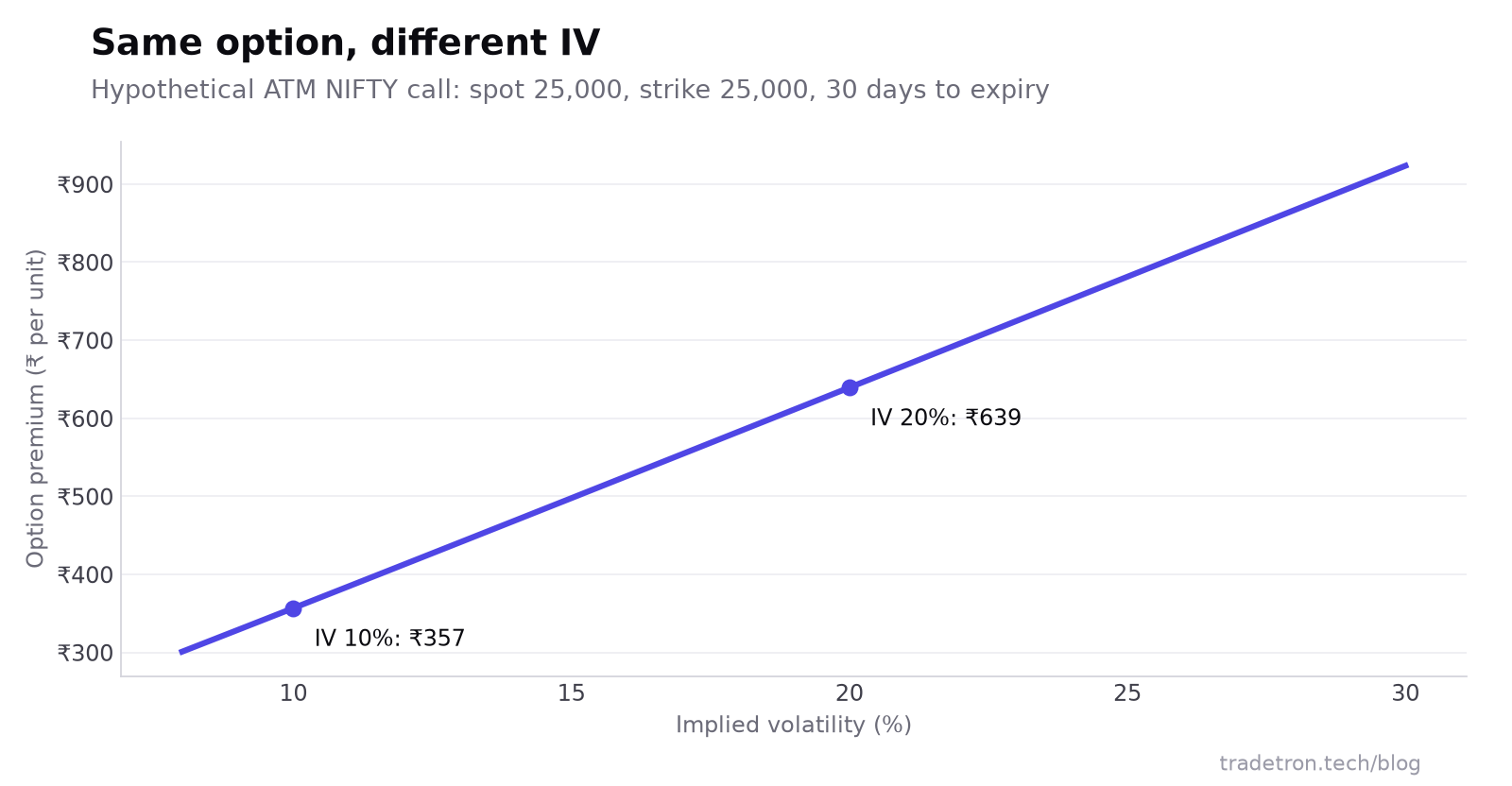 Model premium of one ATM NIFTY call at different implied volatilities (hypothetical inputs)
How traders use IV:
- High IV: premiums are rich. Selling strategies (short straddles, strangles, iron condors) collect more, but the market expects bigger moves.
- Low IV: premiums are cheap. Buying strategies (long calls, puts, long straddles) cost less, and a rise in IV helps them.
- IV crush: IV often drops sharply after an event such as results or a policy announcement. A buyer can be right on direction and still lose as the premium deflates.
For the index as a whole, India VIX is the quick read: NSE calculates it from NIFTY option prices, so it is essentially the market's implied volatility for NIFTY.
On Tradetron, the Iv keyword returns the implied volatility of a specific option, for example the option traded in leg 1 of Set 1's entry, and Atmiv returns the IV of the at-the-money option for an underlying.
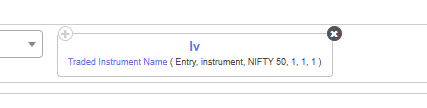 The Iv keyword reading the IV of the option your strategy traded
2. Open interest (OI)
Open interest is the number of option contracts that are open (not yet closed or expired) at a strike. Volume counts trades during the day; OI counts positions that stay open.
- Rising price + rising OI: new positions support the move. The trend has participation.
- Rising price + falling OI: the move is driven by positions being closed, often short covering. It can fade.
- Strikes with the highest OI are watched as levels. The call strike with the largest OI is often read as resistance, the put strike with the largest OI as support, because option writers there defend those levels.
On Tradetron, Max OI Strike returns the strike with the highest open interest for an index, expiry and option type (CE or PE). Max OI Instrument returns that option contract itself, and Total OI returns the total open interest for an index's calls or puts. These work on index options (NIFTY, BANKNIFTY, FINNIFTY, MIDCPNIFTY and SENSEX).
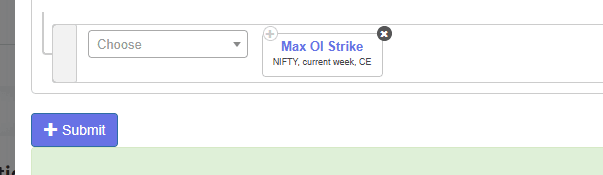 Max OI Strike: the NIFTY call strike with the highest open interest
3. Put-call ratio (PCR)
PCR divides the open interest of all puts by the open interest of all calls for an index and expiry.
- PCR = Put OI ÷ Call OI
- Above 1 more puts open than calls
- Below 1 more calls open than puts
PCR is read in two opposite ways, which is why it should never be used alone. Many traders treat a high PCR as bullish, because heavy put writing suggests sellers expect the market to hold up. Others read extreme values as a contrarian signal: when everyone is positioned one way, the move may be mostly done. What matters is the change in PCR and how extreme it is compared with its usual range for that index.
On Tradetron the PCR keyword returns the OI-based put-call ratio for an index and expiry. The condition below enters only when NIFTY's current-week PCR is 1.2 or higher.
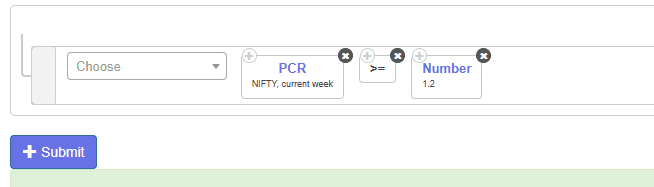 A PCR filter on NIFTY's current-week options
4. Relative Strength Index (RSI)
RSI measures the speed of recent price changes on a scale of 0 to 100, usually over 14 periods.
- Above 70: the move is stretched to the upside (overbought).
- Below 30: stretched to the downside (oversold).
- Crossing 50: a simple momentum filter. Above 50 favours calls or put-selling, below 50 favours puts or call-selling.
The trap is treating 70 as an automatic sell signal. In a strong trend RSI can stay above 70 for days. RSI works better as a filter ("only sell calls when RSI is above 70 and price is below its 20-day average") than as a trigger on its own.
Video: building an RSI-based momentum strategy on Tradetron.
5. Moving averages (SMA and EMA)
A moving average smooths price to show the trend. The simple moving average (SMA) weights every bar equally; the exponential moving average (EMA) gives recent bars more weight, so it turns faster.
- 200-day average: the long-term trend line. NIFTY above it is generally treated as a bull phase, below it as a bear phase.
- 50-day average: the medium-term trend.
- 9 or 20-period EMA: short-term and intraday direction.
- Crossovers: a fast average crossing above a slow one (for example the 9 EMA over the 21 EMA) is a common entry trigger.
For options, moving averages are most useful as a trend filter: sell puts or buy calls only when price is above the average, and the reverse when it is below.
 NIFTY above its 200-day EMA: a simple trend filter
Video: building a moving-average (SMA) crossover strategy on Tradetron. The steps are the same for an EMA: pick EMA instead of SMA.
6. Bollinger Bands
Bollinger Bands draw a band two standard deviations above and below a 20-period SMA. Because the width depends on volatility, the bands widen in fast markets and narrow in quiet ones.
- Squeeze: when the bands narrow sharply, volatility is low and a bigger move often follows. Option buyers watch squeezes because premiums are cheap before the expansion.
- Band touches: in a sideways market, a close outside the upper band often reverts toward the middle. In a trending market, price can "walk the band" for a long time.
Tradetron has Upper Bolinger, Lower Bolinger and Bolinger Band width keywords, so you can test for a touch or for a squeeze directly. More in our Bollinger Bands strategy guide.
 Price at or above the upper Bollinger Band on 15-minute candles
7. MACD
MACD is the difference between the 12- and 26-period EMAs. A 9-period EMA of that difference is the signal line.
- Bullish crossover: MACD crosses above the signal line.
- Bearish crossover: MACD crosses below the signal line.
- Histogram: the gap between the two. A shrinking histogram warns that momentum is fading before the crossover happens.
To catch a crossover in a rule, compare the previous bar with the one before it: MACD above signal on the last completed candle, and below it on the candle before. That is exactly what the condition below does on NIFTY's 15-minute chart.
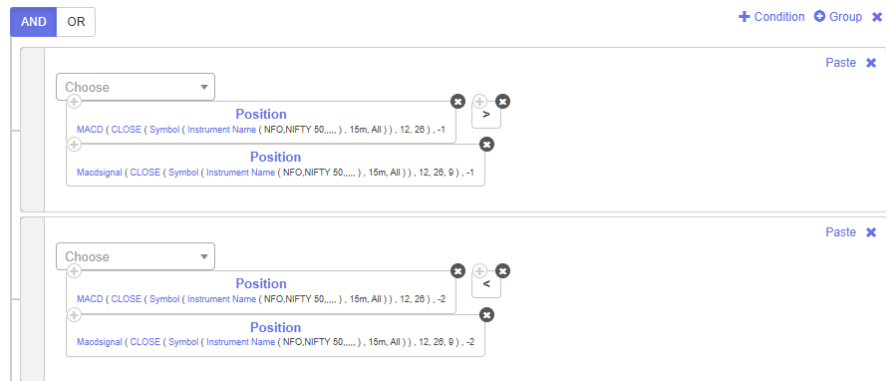 A MACD bullish crossover written as two conditions
Which chart type is best for options trading?
The indicator matters more than the chart, but the chart changes what you see.
| Chart | What it shows | Good for |
|---|---|---|
| Candlestick | Open, high, low and close of each period | Most options traders; patterns like hammer, doji, engulfing |
| Heikin Ashi | Averaged candles that smooth out noise | Staying in a trend, fewer false reversals |
| Renko | Fixed-size bricks that ignore time | Clean trend and breakout signals |
Candlesticks are the default for intraday options because they show the full price range. Heikin Ashi and Renko filter noise, but their prices are calculated, not actual traded prices, so always check the real LTP before placing an order. Read more about Renko charts.
How to combine indicators without fooling yourself
- Start with the trade type. Buying premium or selling it? Check IV first. If IV is near the top of its range, lean towards selling; near the bottom, buying.
- Add one trend filter. A moving average or MACD decides whether you trade calls or puts, or which side you sell.
- Add one timing or positioning check. RSI for stretched moves, or OI/PCR to confirm the level you are trading around.
- Write the exits before the entry. A stop on the premium, a target, and a time exit. Indicators help you enter; exits decide what you keep.
- Test the combination on past data. Every extra filter cuts the number of trades. Check that the rule still trades often enough to be worth running.
Related reading: how option premium is calculated, the best indicators for intraday trading, and the short straddle, a strategy that lives or dies by implied volatility.
Frequently asked questions
What is the best indicator for options trading?
There is no single best one. Implied volatility is the most important options-specific indicator because it tells you whether premiums are expensive or cheap. Pair it with one trend indicator, such as a moving average or MACD, to decide direction.
Which indicator is best for option buying?
Buyers need a strong move soon, so they look for low IV (cheap premiums), a Bollinger Band squeeze (volatility about to expand) and a clear trend signal such as a moving-average crossover. Rising IV after you buy works in your favour.
Which indicator is best for option selling?
Sellers want premiums that are rich and a market that stays within a range. High IV compared with its own history, a sideways trend, and strikes beyond the highest-OI levels are common filters for option sellers.
Is RSI good for options trading?
Yes, as a filter. RSI above 70 or below 30 shows a stretched move, but in strong trends RSI can stay overbought or oversold for a long time. Use it with a trend filter instead of as a stand-alone signal.
How do I read the put-call ratio?
PCR is put open interest divided by call open interest. Above 1 means more puts are open than calls. Traders read it both as a sign of put-writer support and as a contrarian signal at extremes, so compare it with its usual range and use it to confirm another signal.
Which time frame is best for options indicators?
It depends on how long you hold. Intraday option traders often use 5- or 15-minute candles, swing traders use daily charts, and IV is usually compared over weeks or months. Use the same time frame for entries and exits.