The 4 Investment Strategies: Growth, Value, Income and Momentum

The four classic investment strategies are growth investing (companies growing earnings fast), value investing (companies priced below what they're worth), income investing (assets that pay regular dividends or interest) and momentum investing (stocks that are already rising). Each looks for a different kind of return, carries a different risk, and suits a different kind of investor.
The four strategies at a glance
| Growth | Value | Income | Momentum | |
|---|---|---|---|---|
| Looks for | Fast earnings or revenue growth | Price below intrinsic value | Regular dividends or interest | Stocks that are already rising |
| Key metrics | Earnings and sales growth, return on equity | P/E, P/B, cash flow vs price | Dividend yield, payout ratio, interest | 6- or 12-month return, moving averages |
| Main risk | Paying too much; growth slows | "Value trap": cheap for a reason | Dividend cuts; rates rise | Sharp trend reversals |
| Holding style | Long term | Long term, patient | Long term | Rebalanced monthly or quarterly |
| Suits | Long horizon, high risk tolerance | Patient, research-minded | Those who want cash flow | Disciplined, rules-based investors |
1. Growth investing
The idea: buy companies whose earnings are growing much faster than the market, and hold them while growth continues. Growth companies often reinvest profits instead of paying large dividends.
What growth investors check:
- Revenue and earnings growth over several years, not one quarter.
- Return on equity and on capital: is growth profitable?
- The size of the opportunity: can it keep growing for years?
The risk: growth stocks usually trade at high valuations. If growth slows even slightly, the price can fall sharply as the market resets its expectations.
2. Value investing
The idea: buy companies trading below their intrinsic value, the worth of their assets and future cash flows, and wait for the market to recognise it. Associated with Benjamin Graham and Warren Buffett.
What value investors check:
- Low P/E or price-to-book compared with the company's history and peers.
- Strong balance sheet: manageable debt, steady cash flow.
- A "margin of safety": buying far enough below value to absorb mistakes.
The risk: a stock can be cheap because the business is declining. Value investors also need patience: undervalued stocks can stay undervalued for years.
3. Income investing
The idea: own assets that pay regular cash: dividend-paying stocks, bonds, REITs and InvITs. The return comes from the payouts plus any price change.
What income investors check:
- Dividend yield: annual dividend ÷ share price. A ₹20 dividend on a ₹500 stock is a 4% yield.
- Payout ratio: the share of profit paid as dividends. Very high payouts can be hard to sustain.
- Track record: has the company kept paying through bad years?
The risk: dividends can be cut, and a very high yield often means the price has fallen because the market expects trouble. Bond and REIT prices also fall when interest rates rise. Read more in our dividend stocks guide.
4. Momentum investing
The idea: buy what has been rising and avoid or sell what has been falling, on the observation that trends tend to persist for a while. It is rule-driven by nature.
A typical momentum rule set:
- Take a universe, for example NIFTY 200 stocks.
- Rank them by their return over the last 6 or 12 months.
- Hold the top 10–20, often only if each is above its 200-day moving average.
- Rebalance monthly or quarterly: sell stocks that drop out of the top group, buy the new entrants.
The risk: momentum can reverse sharply when markets turn, and frequent rebalancing adds costs and short-term capital gains tax.
Momentum ideas are built from trend indicators such as moving averages, crossovers and Supertrend. This Tradetron video shows how a crossover rule is written in the strategy builder:
Two more you'll hear about
- Index (passive) investing: buy the whole market through an index fund or ETF instead of picking stocks. Low cost and no stock-selection risk.
- Rupee-cost averaging (SIP): invest a fixed amount every month regardless of price, so you buy more units when prices are low. It is a way of investing, which can be combined with any of the four strategies.
Which investment strategy is right for you?
Time horizon matters as much as the strategy itself:
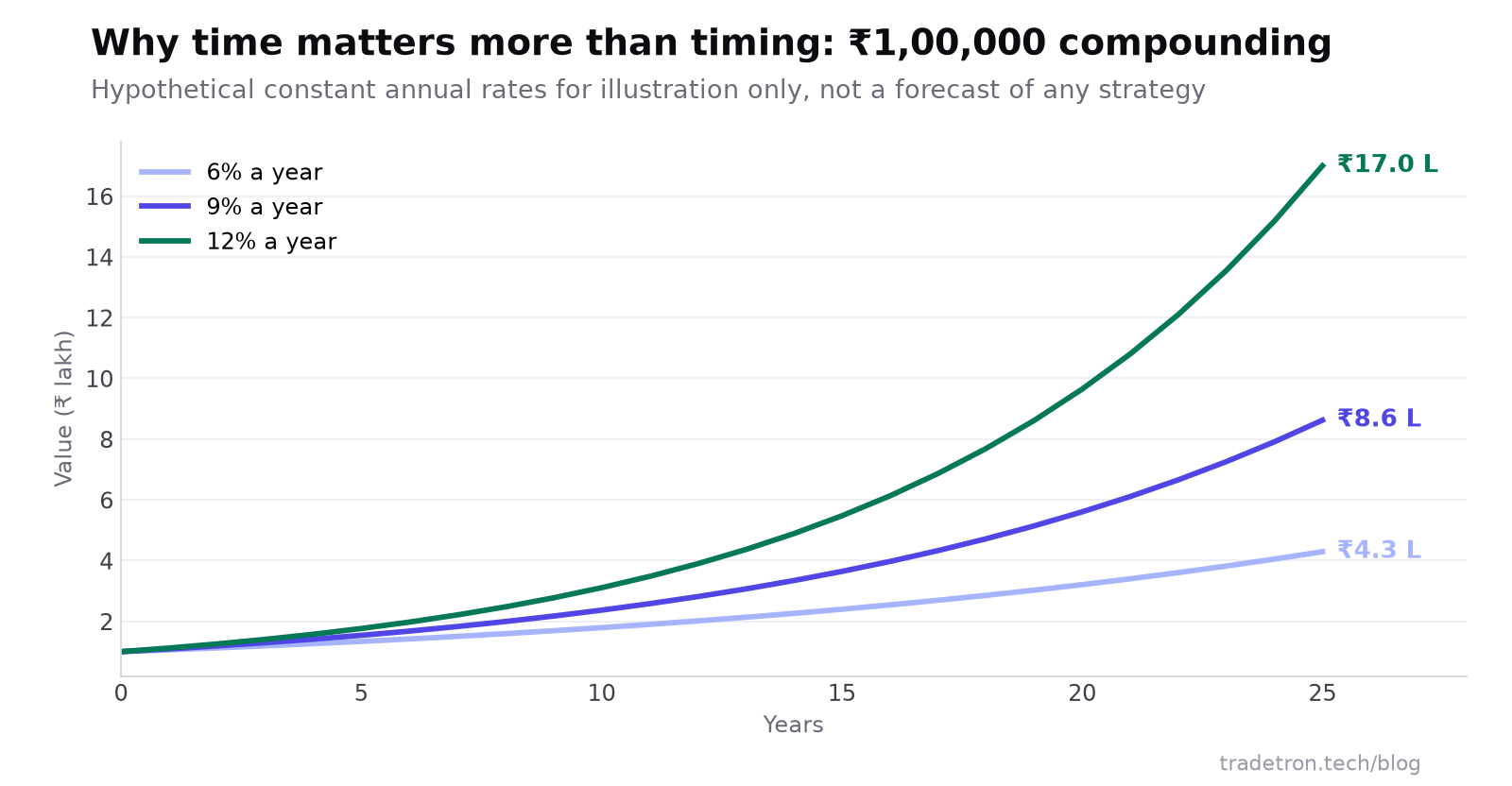 Compounding at illustrative rates; real returns vary year to year and can be negative
Many investors combine them: a core in index funds, a slice in value or growth stocks, and a rules-based momentum or income portfolio alongside.
Pros of having a defined strategy
- Every buy and sell has a reason you can check
- You can measure whether it works over time
- Less reacting to news and tips
- Easier to stay invested through bad periods
Cons and limits
- Each strategy has long stretches of underperformance
- Switching strategies after a bad year destroys the benefit
- Research and rebalancing take time or tools
- Past results of any strategy may not repeat
Run an investment strategy by rules
Related: trading vs investing, systematic portfolio management and what an ETF is.
Frequently asked questions
What are the 4 investment strategies?
Growth investing, value investing, income investing and momentum investing. Growth buys fast-growing companies, value buys undervalued ones, income focuses on dividends and interest, and momentum buys assets that are already rising.
Which investment strategy is best for beginners?
Many beginners start with index funds through a monthly SIP, then add one strategy they understand. Income and value investing are slower-moving; momentum needs strict rebalancing discipline.
What is the difference between growth and value investing?
Growth investors pay higher valuations for companies expected to grow fast. Value investors buy companies trading below their estimated worth and wait for the price to catch up. Growth bets on the future; value bets on a gap between price and value today.
Is momentum investing risky?
It can fall sharply when trends reverse, and frequent rebalancing adds costs and taxes. Rules such as a trend filter and fixed rebalance dates help manage it, but don't remove the risk.
Can I combine investment strategies?
Yes. A common approach is an index-fund core with smaller allocations to growth, value or momentum. Keep each part's rules and results separate so you can judge them.
Can investment strategies be automated?
Rules-based strategies such as momentum or dividend portfolios can be. On Tradetron, Stockbag strategies hold and rebalance a basket by your rules, and you can backtest them and run them Live Offline first.