Trading Without Investment: Is It Possible and How to Start?
Trading without investment is possible only for learning and practice. Every real trade on NSE or BSE needs your own money, either to buy the shares or as margin. What you can do without investing is learn the market, test strategies on historical data, and run them in a simulated mode with live prices, so you risk nothing until you're ready.

What "trading without investment" really means
People search for this phrase with three different ideas in mind:
| What they mean | Is it possible? | What to know |
|---|---|---|
| Practise trading without risking money | Yes | Simulators, backtesting and test modes are free or low-cost |
| Make real profits without putting in money | No | Every real position needs your capital or margin |
| Get "free capital" from a broker or app | Be careful | In India these offers usually come from unregulated forex or binary apps |
The honest answer: you can build trading skill without investment, but you can't build trading income without it.
Why real trading always needs money
When you buy shares, you pay for them. When you trade futures or sell options, the exchange requires margin, a deposit that covers possible losses. Even buying a single NIFTY option costs the premium × the lot size (65 units). If the premium is ₹100, one lot costs ₹6,500.
Leverage doesn't change this. Intraday leverage lets you take a bigger position with less money, but your losses are on the full position, and they come out of your own capital.
Legitimate ways to trade without investing money
1. Learn the basics first (free)
Before any simulated trade, learn how orders, margins, charges and the main instruments work. NSE, BSE, SEBI's investor education pages and broker learning portals are free. Our guide to learning trading for free lays out an order to learn things in.
2. Practise in a simulator
Many brokers and platforms offer virtual-money trading with live or delayed prices. It is useful for learning order types, how fast prices move and how options premiums react, without any loss.
The limit: it is easy to be disciplined with virtual money. Fear and hope only show up with real money.
3. Backtest your strategy on historical data
A backtest runs your rules on years of past data and shows every trade the rules would have taken: how often they won, how big the losses were, how deep the worst losing streak was. It answers "would this have worked?" before you spend a rupee.
4. Run your strategy in a live test mode
The step between a backtest and real money is running the strategy on today's live prices without sending real orders. You find out whether the rules behave as expected in current markets, at the times you expect, on the instruments you expect.
5. Learn from strategies others have built
Studying how experienced traders structure entries, exits and risk is free. On strategy marketplaces you can read how a strategy works before deciding anything. Copying someone's trades with real money still needs your capital, so treat it like any other investment decision. Copy trading for beginners covers the risks.
Simulated trading vs real trading
Pros
- No money at risk while you learn
- Test as many strategies as you like
- Learn order types, margins and charges without paying for mistakes
- Build a track record of following your own rules
Cons
- No real emotions, so discipline looks easier than it is
- Fills can look better than reality (no slippage or partial fills in many simulators)
- Results can create false confidence
- It doesn't teach you how you react to a real losing streak
From zero to real money: a step-by-step path
- Learn the basics. Instruments, order types, margin, costs (brokerage, STT, exchange charges, GST, stamp duty).
- Write one strategy down. Entry, exit, stop loss, position size, and when you won't trade.
- Backtest it on several years of data, including bad periods.
- Run it in test mode for a few weeks on live prices and compare the results with the backtest.
- Open a demat and trading account with a SEBI-registered broker when you're ready.
- Start with a small amount you can afford to lose, and cap the loss per trade at 1–2% of it.
- Review every week. Did you follow the rules? Did results match the test? Only add capital when both answers are yes.
How small is "small"?
A common rule is to risk no more than 1–2% of your trading capital on a single trade. That keeps any one mistake cheap while you learn:
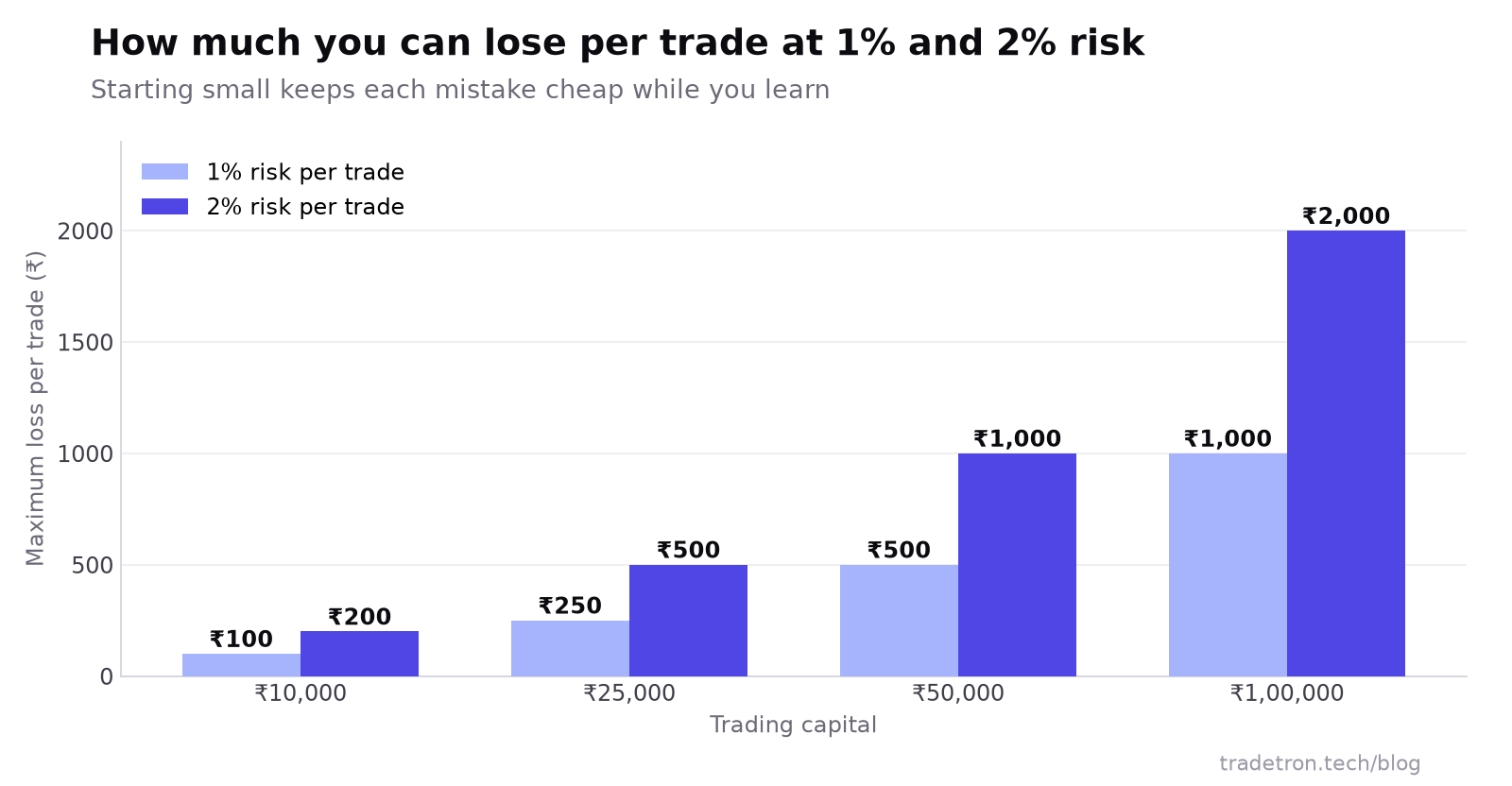 Maximum loss per trade = capital × risk %
Test without investment on Tradetron
Next, read is trading easy or hard for an honest look at what to expect, and how to deploy a strategy on Tradetron when you are ready.
Frequently asked questions
Can I start trading without any investment?
You can start learning and practising without investment, using simulators, backtests and test modes. Real trades on an exchange always need your own money, either to buy the instrument or as margin.
Is zero-investment trading real?
Not as a way to earn money. Offers of free trading capital or profits without investment usually come from unregulated apps, often offshore forex or binary-option platforms. Check that any broker is SEBI-registered before you open an account.
What is the minimum amount needed to start trading in India?
There is no official minimum. In the cash market you can buy a single share. F&O needs much more because of lot sizes and margin. Start with an amount you can afford to lose while you learn.
Is simulated trading useful?
Yes, for learning mechanics and testing whether a strategy's rules work as intended. It doesn't test how you react to real losses, so start small when you move to real money.
Can I test an algo strategy without real money?
Yes. On Tradetron you can backtest a strategy on historical data and run it Live Offline, where it runs on live prices and records every trade but sends nothing to the exchange.
Do I need a demat account to practise trading?
No. Simulators, backtesting and test modes don't need a demat account. You need a demat and trading account with a SEBI-registered broker only to place real trades.