Positional Trading Strategy: Complete Guide for Indian Traders

A positional trading strategy holds trades for weeks to months to capture a larger trend in Indian stocks, indices or F&O. It sets a trend signal on daily or weekly charts, a stop loss wide enough to survive normal pullbacks, a position size based on that stop, and an exit when the trend breaks. In India the instrument you choose (delivery shares, futures or options) changes the costs, the leverage and how often you must roll.

Positional vs intraday and swing trading
| Intraday | Swing | Positional | |
|---|---|---|---|
| Holding period | Within the day | Days to weeks | Weeks to months |
| Signal timeframe | 5–15 minute | Daily, hourly | Daily, weekly |
| Typical stop | 0.5–2% | 3–8% | 8–20% |
| Trades per year | Hundreds | Dozens | A handful to a few dozen |
| Costs as a share of returns | High | Medium | Low |
For the general idea, strategies and tips, see our position trading guide. This guide is about building one for Indian markets.
Step 1: Choose the instrument
The same view ("NIFTY will trend up for the next two months") can be traded three ways, with very different risk:
| Delivery shares / ETF | Futures | Buying options | |
|---|---|---|---|
| Capital | Full value | Margin, a fraction of the value | Premium only |
| Leverage | None | High | Built in |
| Expiry | None | Monthly; roll to hold longer | Fixed; time decay every day |
| Worst case | Price falls to your stop (or gaps past it) | Losses on the full contract value | Lose the premium |
| Best for | Most positional traders | Experienced traders, hedging | Defined-risk directional views |
The difference is easiest to see at expiry:
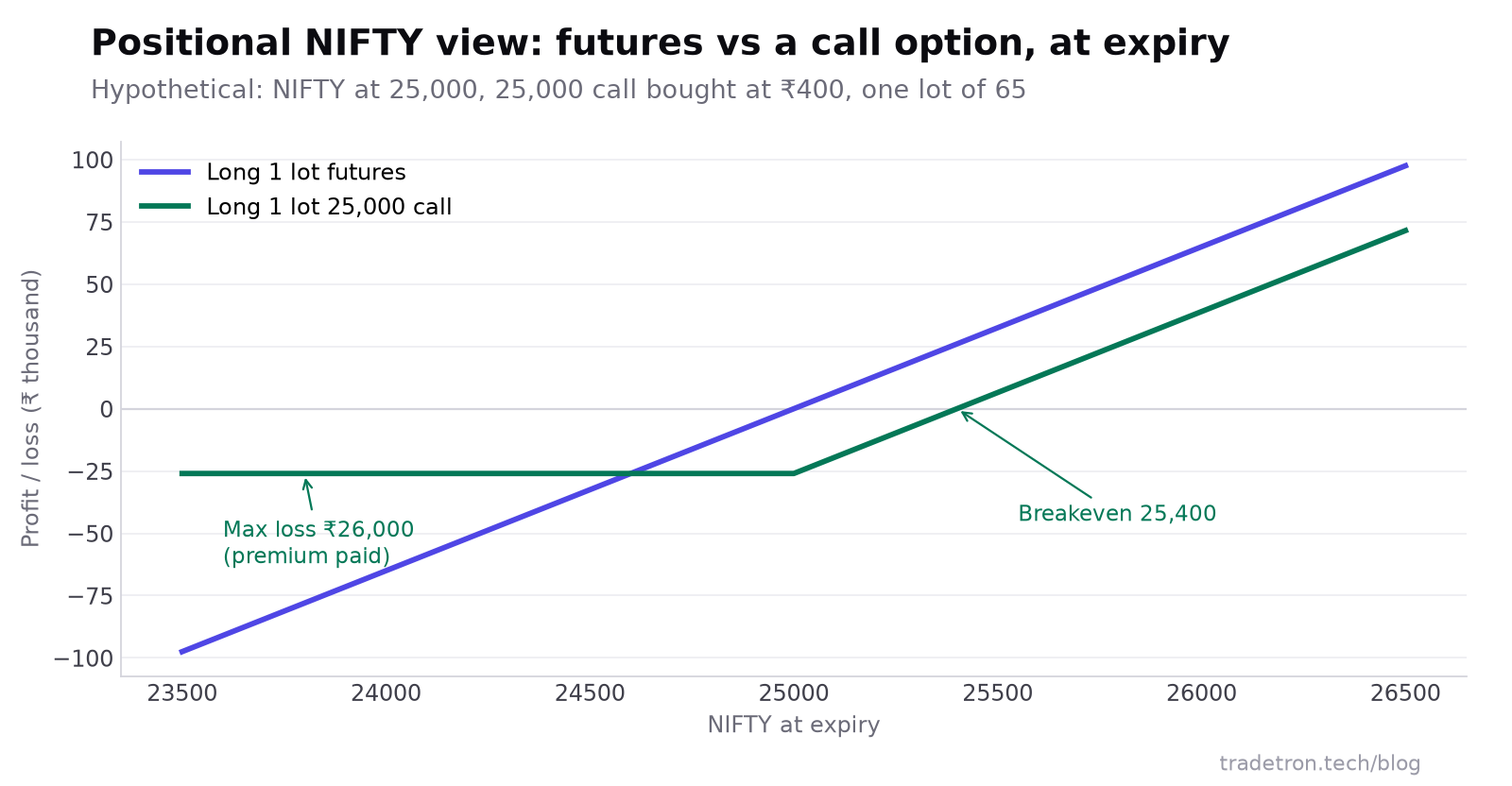 Futures move one-for-one with NIFTY; a bought call caps the loss at the premium but needs a bigger move to profit
Step 2: Understand expiry and rollover
Since 2025, all NSE derivatives expire on Tuesday. Each exchange has only one weekly index expiry (NIFTY 50 on NSE, SENSEX on BSE). BANK NIFTY, FINNIFTY, MIDCPNIFTY and stock F&O are monthly only, expiring on the last Tuesday of the month.
A positional futures trade that lasts longer than the current contract has to be rolled: close the expiring contract and open the same position in the next month, usually in the last few days before expiry, when the next month has good liquidity. Each roll costs brokerage, charges and the price difference between the two contracts.
Step 3: Define the rules
A complete positional strategy answers every one of these:
- Universe: e.g. NIFTY 100 stocks, or NIFTY futures only.
- Market filter: trade long only when NIFTY closes above its 200-day moving average.
- Entry signal: a daily close above the 50-day high, or a 50-day average crossing above the 200-day.
- Initial stop: below the breakout level or 2–3 × the 14-day ATR from entry.
- Position size: risk 1% of capital per trade ÷ stop distance.
- Trailing exit: close below the 50-day average, or a trailing stop that only moves up.
- Portfolio caps: at most 8 positions, at most 2 per sector.
- Rollover rule (futures only), and a rule for results and big events.
Step 4: Know your costs and taxes
Positional trading's big advantage over intraday is that costs are a small share of each trade. They still matter:
- Delivery trades: STT is 0.1% on both buy and sell, plus exchange charges, GST, stamp duty and DP charges when you sell.
- Futures and options: lower STT rates, but charges apply on every roll.
- Tax on delivery shares: gains on listed shares held 12 months or less are short-term capital gains (taxed at 20%); held longer, long-term gains above ₹1.25 lakh a year are taxed at 12.5%. F&O profits are treated as business income.
A complete example: NIFTY 100 trend strategy
This is an illustration of the structure, not a recommendation. Before trading it, backtest it on at least a full market cycle, including a falling year, and look at the worst drawdown and the longest stretch without a new high.
Step 5: Backtest, then test live
A positional strategy produces few trades a year, so a short backtest proves very little. Look at:
- Number of trades: with fewer than 30–50, results are mostly luck.
- Maximum drawdown: could you sit through it? If not, reduce size.
- Results by year: a strategy that made all its money in one year is fragile.
- Costs and slippage: include them, especially for futures rolls.
Then run it on live prices without real orders for a while, to catch rule mistakes before they cost money. Nine reasons a backtest doesn't match live trading lists what to watch for.
Manual vs automated positional trading
| Manual | Automated | |
|---|---|---|
| Checking signals | You scan charts every evening | Rules are checked on every update |
| Stops | Easy to "give it one more day" | Executed when hit |
| Rollovers | Easy to forget | Scheduled by rule |
| Many positions | Hard to track | Same effort for 1 or 20 |
| Judgement | Can override rules | Only does what the rules say |
Build a positional strategy on Tradetron
Also useful: swing trading explained, the 7% stop-loss rule and what futures and options are.
Frequently asked questions
What is a positional trading strategy?
It is a set of rules for holding trades for weeks to months to capture a trend: a market filter, an entry signal, a stop loss, a position size and an exit rule. It uses daily or weekly charts and ignores intraday moves.
Is positional trading better in stocks or futures?
Delivery stocks are simpler for most traders: no leverage, no expiry and no rollover. Futures add leverage and need a monthly roll, which suits experienced traders who size positions by the full contract value.
How do positional traders handle F&O expiry?
They roll the position: close the expiring contract and open the next month's, usually a few days before expiry. Since NSE contracts expire on Tuesdays and most are monthly, the roll typically happens in the last week of the month.
How much stop loss should a positional trade have?
Wide enough to survive normal pullbacks in a trend, often 8–20% or 2–3 × the 14-day ATR. Then size the position so that hitting the stop costs around 1–2% of your capital.
How is positional trading taxed in India?
Gains on delivery shares held up to 12 months are short-term capital gains; held longer, they are long-term capital gains with an annual exemption. F&O profits are business income. Rates change with budgets, so check current rules with a tax adviser.
Can I automate a positional trading strategy?
Yes. On Tradetron you can set daily indicator entries, stop losses and trailing exits per position, add rollover conditions for F&O, backtest the rules and run them Live Offline before trading with a broker.