Trading vs Investing: Key Differences and Which Suits You
Trading vs investing comes down to time and what you are betting on. Trading means buying and selling over minutes to weeks to profit from price moves, using charts, rules and strict stop losses. Investing means owning businesses or funds for years and letting earnings growth and compounding do the work. Trading needs more time, skill and discipline, and costs and taxes take a bigger bite.
The key differences
| Trading | Investing | |
|---|---|---|
| Time horizon | Minutes to weeks (sometimes months) | Years to decades |
| What drives returns | Price moves, momentum, volatility | Earnings growth, dividends, compounding |
| Main analysis | Technical: charts, indicators, price action | Fundamental: business quality, valuation |
| Decisions | Many, often during market hours | Few, mostly about what to own and when to rebalance |
| Time needed | Daily, sometimes the whole session | A few hours a month |
| Typical instruments | Stocks, futures, options, ETFs | Stocks, mutual funds, ETFs, bonds |
| Leverage | Common (intraday margin, F&O) | Usually none |
| Exit | Stop loss, target or time | When the reason for owning it changes, or a goal is reached |
| Costs | High relative to returns if trading often | Low |
| Tax on gains (India) | Short-term rates; intraday and F&O as business income | Long-term rates after 12 months on listed equity |
What trading looks like
A trader asks: where is the price likely to go in the next hours, days or weeks, and what will I do if I'm wrong? Every trade has an entry, a stop loss and a target. Styles range from scalping and intraday to swing and positional trading; our types of trading guide compares them.
- Strength: can make money in rising, falling and sideways markets; capital isn't locked up for years.
- Weakness: needs an edge that survives costs, and the discipline to follow rules through losing streaks.
What investing looks like
An investor asks: will this business, or this market, be worth more in five or ten years? They buy, hold through volatility, and review occasionally. Approaches include index funds and SIPs, and the four classic investment strategies: growth, value, income and momentum.
- Strength: time does much of the work; few decisions, low costs, lower tax on long-term gains.
- Weakness: you have to sit through falls of 20–40% without selling, and it can take years for results to show.
Why costs and taxes matter more for traders
Every trade pays brokerage, STT, exchange charges, GST and stamp duty. Each is small, but they're paid on every trade:
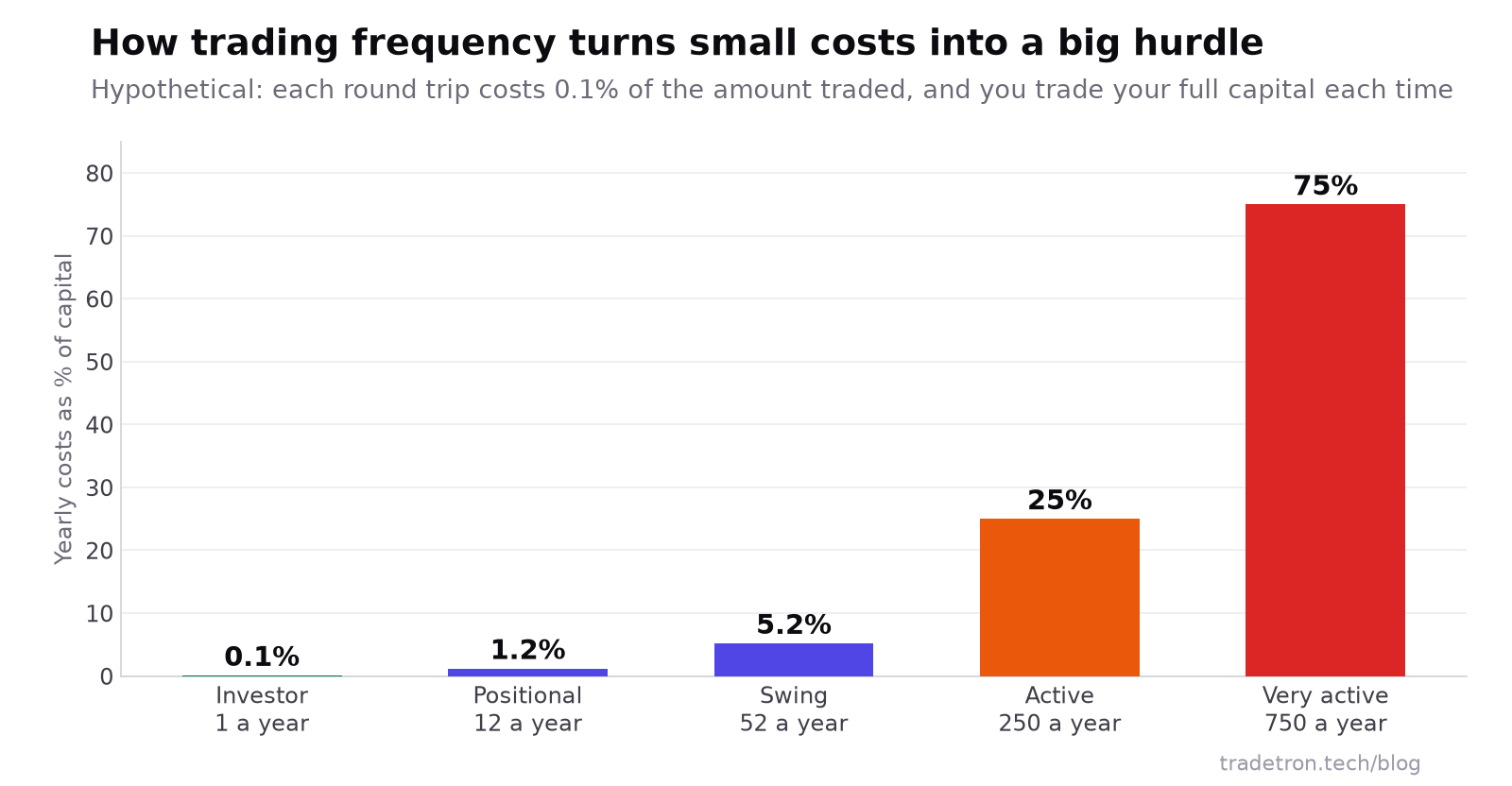 Yearly costs = cost per round trip × number of round trips (hypothetical)
Taxes add another gap (rules for FY 2025-26):
- Listed shares held over 12 months: long-term capital gains above ₹1.25 lakh a year taxed at 12.5%.
- Held 12 months or less: short-term gains taxed at 20%.
- Intraday equity: treated as speculative business income, taxed at your slab rate.
- F&O: treated as non-speculative business income, taxed at your slab rate.
Rates change with budgets; check current rules with a tax adviser.
Which one is right for you?
| If you… | Lean towards |
|---|---|
| Have a full-time job and little time in market hours | Investing, or slower trading styles run by rules |
| Want to build long-term wealth for goals years away | Investing |
| Enjoy markets, have time, and can follow strict rules | Trading, starting small |
| Panic when a holding falls 20% | Smaller positions, more diversified investing |
| Can't stand watching a loss and doing nothing | Trading with defined stop losses |
A simple way to combine them
- Build the core first: a long-term investment portfolio, for example index funds or ETFs through a SIP.
- Set a trading budget you can afford to lose, often a small share of your total capital.
- Trade with written rules and a stop loss on every position.
- Review results separately. If the trading account isn't beating a simple index investment after costs and taxes over a reasonable period, scale it down.
Rules for both, on Tradetron
Discipline is the common thread: investors need to keep buying through falls, traders need to take every stop. Rules that run on their own help with both.
Before you choose, read is trading easy or hard and stock trading tips for beginners.
Frequently asked questions
What is the main difference between trading and investing?
Time horizon and what drives the return. Traders hold for minutes to weeks and profit from price moves; investors hold for years and profit from the growth of businesses and compounding.
Is trading riskier than investing?
Usually, yes. Traders often use leverage, make many decisions and pay more in costs and taxes. SEBI's studies found most individual F&O and intraday traders lost money. Investing in diversified funds carries market risk but fewer ways to make mistakes.
Which gives better returns, trading or investing?
Neither is better by default. Trading returns depend on having a tested edge that survives costs, which most traders don't. Investing returns depend on the market and time. Past returns of either don't predict future ones.
Can I do both trading and investing?
Yes. Keep separate capital and rules for each, build the long-term portfolio first, and limit trading to an amount you can afford to lose.
Is intraday trading investing?
No. Intraday positions are closed the same day, so they're trading. For tax purposes in India, intraday equity profits are treated as speculative business income, not capital gains.
Should a beginner start with trading or investing?
Most beginners are better off starting with investing, for example index funds through a SIP, while learning trading with small amounts or in a test mode. Trading skill takes time to build; compounding needs time to work.