Stock Trading for Beginners in India: 10 Essential Tips

To start stock trading in India, open a demat and trading account with a SEBI-registered broker, learn the basic order types, and begin with a small amount in a few liquid stocks. The essentials for beginners are simple to state and hard to follow: have a written plan, decide your stop loss before you buy, risk only a small slice of capital per trade, and avoid tips and leverage until you have a tested approach.
Trading vs investing: know which you're doing
Trading means buying and selling over days, weeks or within a day to profit from price moves. Investing means holding good businesses or funds for years. Both use the same account, but they need different rules, and mixing them up is a classic beginner mistake: a losing "trade" quietly becomes a "long-term investment". Read trading vs investing if you're unsure which you want.
How to start stock trading in India
- Choose a SEBI-registered broker. Compare brokerage, platform, and the charges they publish. Check registration on SEBI's website.
- Open demat and trading accounts. You'll need your PAN, Aadhaar, a bank account and a signature; KYC is usually completed online.
- Add funds from your linked bank account.
- Learn the order types (below) on the broker's platform before you trade.
- Pick a few liquid stocks you understand, for example from the NIFTY 50.
- Place a small first trade with a stop loss decided in advance.
- Keep a journal of every trade: why you entered, where you planned to exit, what actually happened.
The order types every beginner should know
| Order | What it does | When to use it |
|---|---|---|
| Market | Buys or sells at the best available price now | Liquid stocks when getting filled matters more than price |
| Limit | Buys or sells only at your price or better | Most of the time; avoids paying more than you meant to |
| Stop-loss (SL) | Becomes a limit order when a trigger price is hit | To exit automatically if a trade goes wrong |
| Stop-loss market (SL-M) | Becomes a market order at the trigger | When you must get out, even at a worse price |
You'll also choose a product type: delivery (CNC) to hold shares in your demat, or intraday (MIS) to close the same day. Intraday positions left open are squared off automatically by the broker near the close; see square off explained.
10 essential stock trading tips for beginners
1. Write a plan before you trade
Answer three questions in writing: why am I buying, where will I take profit, and where will I admit I'm wrong? If you can't answer them, don't place the trade.
2. Decide your stop loss before you buy
A stop loss decided after the price starts falling usually never gets placed. A simple, well-known example is the 7% rule: sell any stock that falls 7–8% below your buy price.
3. Risk 1–2% of capital per trade
Size each position so that hitting the stop costs only a small part of your account.
4. Keep losses small, because big ones are hard to recover
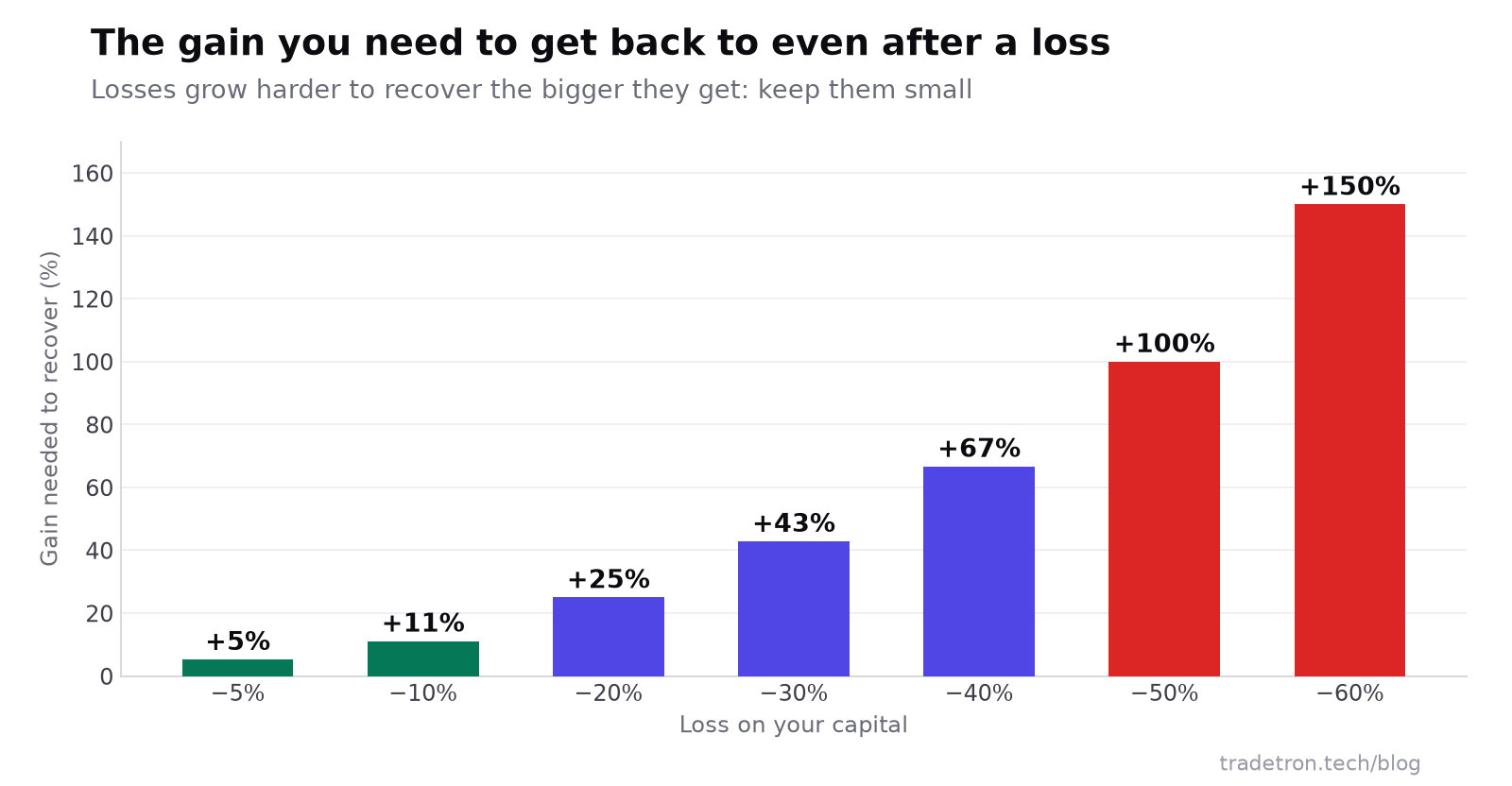 Gain needed to recover = loss ÷ (100% − loss)
5. Start with liquid, large-cap stocks
Large, heavily traded stocks have tight bid-ask spreads and fewer surprise gaps. Penny stocks and thinly traded small caps can move 20% on a rumour, and you may not be able to sell when you want to.
6. Don't trade on tips
Telegram groups, social media "calls" and unsolicited stock messages are how many beginners lose money, and some are outright pump-and-dump schemes. If someone promises returns, that alone is a red flag: SEBI-registered advisers are not allowed to.
7. Avoid leverage and F&O until you're consistent
Intraday leverage and futures and options magnify losses as well as gains. SEBI's study published in September 2024 found that about 9 in 10 individual F&O traders made a net loss between FY22 and FY24. Learn on cash-market stocks first.
8. Know your costs
Every trade pays some mix of brokerage, STT, exchange charges, GST, stamp duty and, on delivery sales, DP charges. For frequent traders these add up quickly. Check your broker's charge list and include costs when you judge whether a strategy works.
9. Diversify, but don't over-diversify
Holding five bank stocks is close to one trade. Spread positions across sectors, but keep the number small enough to track, often 5–10 for a beginner.
10. Review, don't react
Review your journal weekly. Look for patterns: are losses coming from ignoring stops, trading too often, or trading after a loss? Change your rules after a review, never in the middle of a trade.
Pros of starting with stock trading
- No expiry and no leverage needed in the cash market
- You can start with a small amount and a few shares
- Prices and company information are public and easy to follow
- Builds habits you'll need for any other market
Cons to be ready for
- Costs and taxes reduce returns, especially if you trade often
- Losing streaks happen even with good rules
- Emotional mistakes are the norm at the start
- Learning takes months, not weeks
Mistakes beginners make most often
- Buying because a stock "has fallen a lot" and must be cheap.
- Averaging down on a losing trade instead of taking the stop.
- Booking small profits quickly and holding losers for months.
- Putting too much of the account into one idea.
- Overtrading out of boredom or to win back a loss.
- Treating a trade as an investment once it is losing.
Learning resources
- SEBI investor education (investor.sebi.gov.in) and the exchanges' investor sections: free and reliable.
- Broker learning portals: structured beginner modules on markets and analysis.
- Books: The Intelligent Investor by Benjamin Graham for investing principles; a basic book on technical analysis for trading.
- This blog: how to learn trading for free, types of trading and NSE vs BSE.
Make your rules run themselves
Frequently asked questions
How do I start stock trading in India as a beginner?
Open a demat and trading account with a SEBI-registered broker using your PAN, Aadhaar and bank details, add funds, learn market, limit and stop-loss orders, and start with a small amount in a few liquid stocks with a stop loss on each trade.
How much money do I need to start stock trading?
There is no minimum. You can buy a single share of a stock, so a few thousand rupees is enough to learn the mechanics. Start with an amount you can afford to lose while you learn.
Which stocks are best for beginners?
Liquid large-cap stocks, such as those in the NIFTY 50, are easier for beginners because they have tight spreads and fewer sudden gaps. Pick businesses you understand, and avoid penny stocks and tip-driven picks.
Is stock trading risky?
Yes. Prices can fall sharply and most short-term traders lose money, especially with leverage. Risk can be managed with stop losses, small position sizes and avoiding leverage, but it can't be removed.
Can I trade stocks without a demat account?
You need a trading account to place orders and a demat account to hold shares you buy for delivery. Brokers in India open the two together, and you need both to trade normally.
What is the difference between intraday and delivery trading?
Intraday (MIS) positions must be closed the same day and use broker margin. Delivery (CNC) trades put the shares in your demat account, and you can hold them for as long as you like.