How to Learn Trading for Free: A Step-by-Step Guide
You can learn trading for free by following a fixed order: learn how the market works, learn to read charts, learn risk management, write down one strategy, backtest it on past data, then run it in a test mode on live prices. Free courses, exchange and SEBI material, and videos cover the theory. The practice steps are free too. Real money comes last, and in small amounts.

The free learning path at a glance
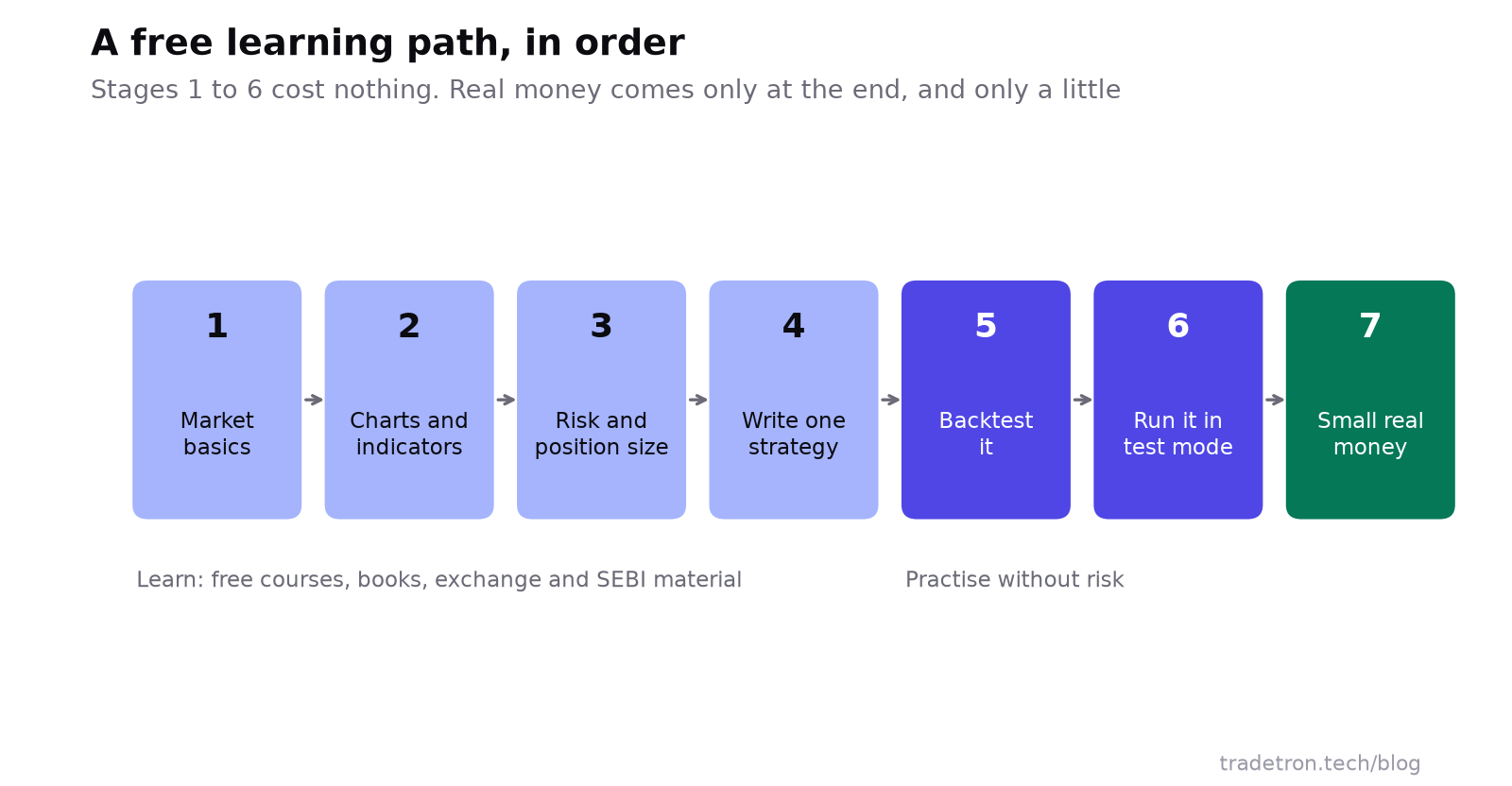 Learn in this order; each step builds on the one before
Step 1: Learn how the market works
Before charts or strategies, understand the plumbing. You should be able to explain each of these in a sentence:
- Exchanges and regulator: NSE and BSE are the exchanges; SEBI regulates them, brokers and advisers. Read NSE vs BSE if the difference isn't clear.
- Accounts: a demat account holds your shares; a trading account places orders through a SEBI-registered broker.
- Instruments: shares, ETFs, futures and options. Start with what futures and options are before touching F&O.
- Order types: market, limit, stop-loss (SL and SL-M).
- Costs: brokerage, STT, exchange charges, GST and stamp duty. They decide whether a frequent-trading strategy can work at all.
- Settlement and market hours: equity trades settle on T+1; the normal NSE equity session runs 9:15 am to 3:30 pm.
Step 2: Learn to read charts and a few indicators
Learn candlestick charts, support and resistance, trends, and volume. Then learn three or four indicators well instead of twenty badly: a moving average, RSI, VWAP and ATR are a solid set. Our guide to the best indicators for intraday trading explains what each one is for.
Then decide what kind of trader you want to be. Intraday, swing and positional trading need different time and temperament. The types of trading guide compares them.
Step 3: Learn risk management before strategies
This is the step most beginners skip, and the one that decides whether they last. Learn:
- Risk per trade: many traders cap it at 1–2% of capital.
- Stop losses: decided before entry, never moved further away. The 7% rule is a simple example.
- Position sizing: shares = money you're willing to lose ÷ distance to your stop.
- Loss math: a 50% loss needs a 100% gain to recover.
Step 4: Write down one strategy
Pick one market and one simple idea, and write it as rules a stranger could follow:
| Rule | Example |
|---|---|
| Instrument | NIFTY 50 stocks, or NIFTY futures |
| Entry | 20-day high breakout on a daily close |
| Stop loss | 2 × ATR below entry |
| Exit | Close below the 20-day EMA |
| Size | Risk 1% of capital per trade |
| No-trade rules | No new entries on results day |
If a rule needs judgement ("when the market looks strong"), it isn't finished yet.
Step 5: Backtest it on past data
A backtest applies your rules to historical prices and lists every trade they would have taken. Look at more than total profit: the number of trades, the worst losing streak, the deepest drawdown, and whether results hold across different years. Read how to backtest your trading strategy for what to check in a report.
Step 6: Run it in a test mode on live prices
A backtest tells you what would have happened. A test run on live prices shows what happens now: whether signals fire when you expect, whether fills and costs are realistic, and how you feel watching it. Run it for a few weeks and compare it with the backtest.
Step 7: Start with small real money
Only now open an account with real money, and start with an amount you can afford to lose. Keep a journal: why you took each trade, and whether you followed your rules. Increase size only after a stretch where you followed the rules and results looked like your tests.
Free resources worth your time
| Resource | What it's good for |
|---|---|
| SEBI investor education (investor.sebi.gov.in) | Rules, investor rights, avoiding frauds |
| NSE and BSE investor sections | How the exchanges, products and settlement work |
| Broker learning portals | Structured beginner modules on markets and F&O |
| TT Uni | Tradetron's learning hub: free recorded courses and live cohorts on building, testing and running strategies |
| Tradetron on YouTube | Platform walkthroughs and strategy-building sessions |
| This blog | Market basics, indicators, risk and strategy guides |
Practise steps 4 to 6 on Tradetron
Before you start, read is trading easy or hard for a realistic picture, and trading without investment for what you can and can't do without capital.
Frequently asked questions
Can I learn trading for free in India?
Yes. SEBI's investor education site, the exchanges' resources, broker learning portals, TT Uni and YouTube cover the theory at no cost, and you can practise with backtests and test modes without risking money.
How long does it take to learn trading?
Learning the basics takes a few weeks. Building a strategy you trust, testing it and trading it small usually takes months. There is no shortcut, and anyone selling one should be avoided.
What should a beginner learn first in trading?
How the market works: exchanges, accounts, order types, costs and settlement. Then charts and a few indicators, then risk management, and only then a strategy.
Can I practise trading without real money?
Yes. You can backtest a strategy on historical data and run it in a test mode on live prices. On Tradetron, Live Offline runs the strategy and records every trade without sending anything to the exchange.
Is it better to learn intraday or long-term trading first?
Most beginners find swing or positional trading easier to learn, because decisions are slower and costs per trade matter less. Intraday trading needs fast decisions and strict discipline.
Do I need to know coding to learn algo trading?
No. Tradetron's strategy builder is no-code: you set conditions and positions from menus. Coding helps for advanced custom logic but is not required to start.