Types of Trading in the Indian Stock Market: Which Suits You?
The main types of trading in the Indian stock market are intraday trading, scalping, BTST, swing trading and positional trading, which differ by how long you hold a position. Futures and options are instruments you can trade in any of those styles, and algorithmic trading is a way of running any of them by rules. The right type depends on your time, capital and tolerance for risk.

The trading types at a glance
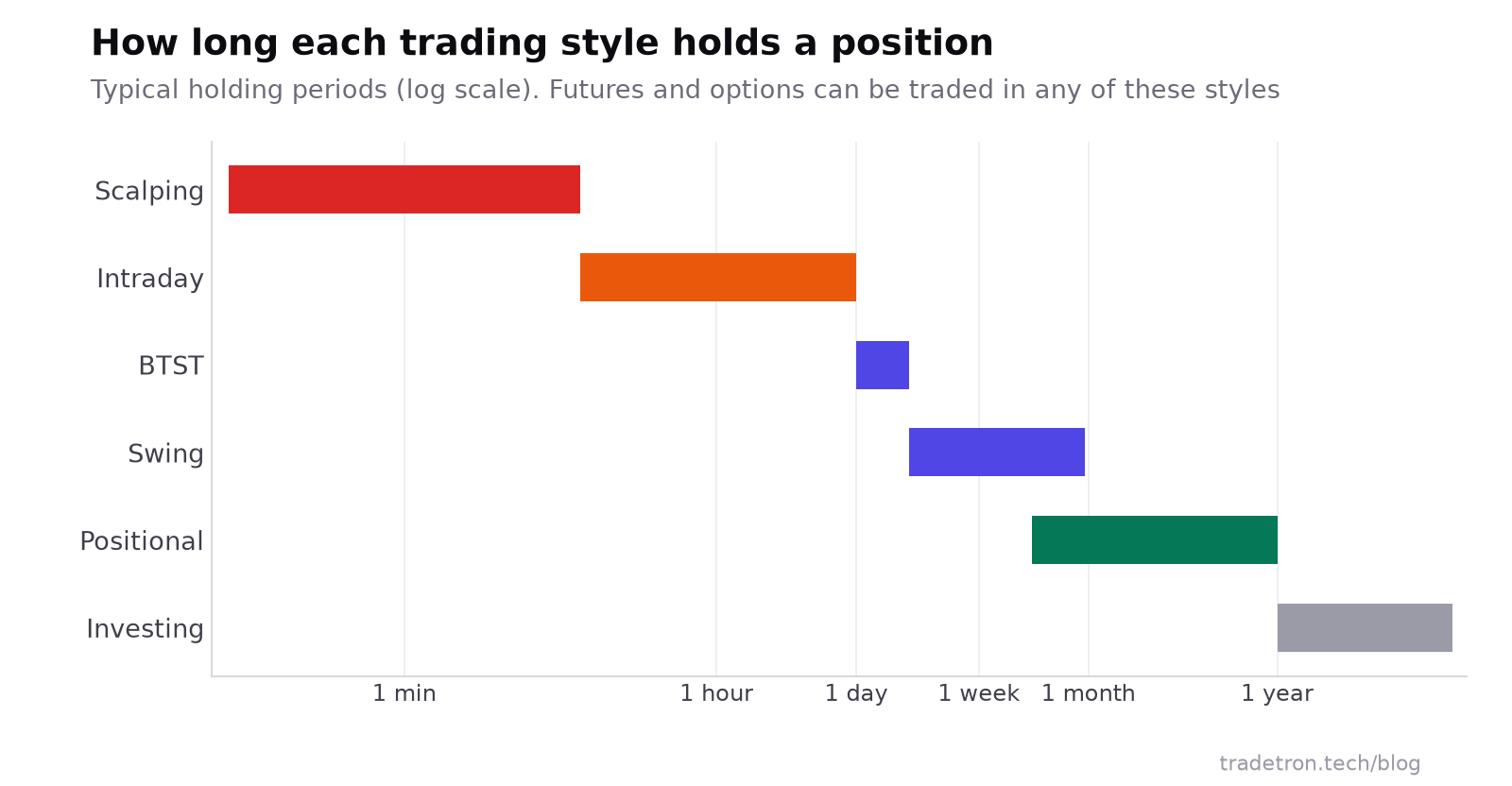 Typical holding periods by trading style
| Type | Holding period | Screen time | Typical charts | Main risk |
|---|---|---|---|---|
| Scalping | Seconds to minutes | All session | 1-minute, tick | Costs and slippage eat small gains |
| Intraday | Within the day | Most of the session | 5- and 15-minute | Fast losses, overtrading |
| BTST | Overnight, 1–2 days | Around the close and next open | Daily, 15-minute | Overnight gaps, settlement risk |
| Swing | Days to weeks | 30–60 minutes a day | Daily, hourly | Gaps, holding through news |
| Positional | Weeks to months | A few hours a week | Daily, weekly | Long drawdowns, capital locked up |
1. Intraday trading
What it is: buying and selling within the same trading day. Every position is closed before the market shuts at 3:30 pm, or your broker squares it off.
- Best for: people who can watch the market during trading hours.
- Tools: VWAP, short EMAs, RSI, opening-range levels. See the best indicators for intraday trading.
- Pros: no overnight gap risk; quick feedback on every idea; intraday margin needs less capital per trade.
- Cons: costs add up fast; decisions under time pressure; leverage makes losses fast too.
2. Scalping
What it is: very short trades, from seconds to a few minutes, aiming for small moves many times a day in highly liquid instruments.
- Best for: experienced traders with low costs, fast execution and strict rules.
- Pros: little exposure to big moves; many opportunities in a day.
- Cons: the profit per trade is close to the cost per trade, so a little slippage turns winners into losers. Manual scalping is exhausting. More in our scalping guide.
3. BTST and STBT
BTST (buy today, sell tomorrow): you buy shares today and sell them the next trading day, before or around the time they reach your demat account. It is used to hold a strong closing move for one night.
- Pros: catches overnight moves without a long hold.
- Cons: overnight gap risk. If the seller in your original purchase fails to deliver, the exchange runs an auction and the shares you sold may not arrive, so some brokers restrict BTST in certain stocks.
STBT (sell today, buy tomorrow): you can't short shares overnight in the cash market (an undelivered short is auctioned and penalised). Traders who want an overnight short do it with futures or options instead.
4. Swing trading
What it is: holding for a few days to a few weeks to catch one "swing" in price, a move from support to resistance or one leg of a trend.
- Best for: people with a job who can spend some time after market hours.
- Tools: daily charts, moving averages, breakouts, RSI pullbacks, ATR-based stops.
- Pros: less screen time; bigger moves per trade, so costs matter less.
- Cons: you hold through overnight news and gaps; stops need to be wider.
Read what swing trading means for setups and examples.
5. Positional trading
What it is: holding for weeks to months to ride a bigger trend. It sits between swing trading and investing and often combines a trend signal with a basic fundamental filter.
- Best for: patient traders with limited time.
- Pros: lowest screen time; few trades and low costs; can catch large trends.
- Cons: long periods of sitting through pullbacks; capital is tied up; needs wide stops.
Our positional trading strategy guide and position trading guide go deeper.
Futures and options: instruments, not styles
Futures and options (F&O) are derivatives you can trade intraday, swing or positionally. They are worth understanding separately because they behave differently from shares.
Futures trading
A futures contract lets you buy or sell an index or stock at a set price on a future date, with only a margin deposit up front. You can go long or short with equal ease.
- Pros: leverage, easy shorting, useful for hedging a portfolio.
- Cons: leverage cuts both ways. A small move against you can cost a large share of your margin.
Options trading
An option gives the buyer the right, but not the obligation, to buy (call) or sell (put) at a fixed strike price until expiry. Buyers pay a premium; sellers collect it and take on the risk.
- Pros: buyers' loss is limited to the premium paid; many strategies (spreads, straddles, iron condors) for different market views.
- Cons: time decay works against buyers; unhedged selling can lose far more than the premium collected; pricing depends on volatility and the Greeks.
Algorithmic (systematic) trading: a way to run any style
Algorithmic trading is not a holding period. It means writing your rules precisely ("if A and B, buy X quantity with a stop at Y") and letting software execute them. It works for every style above:
- Intraday: time-based entries, indicator triggers, automatic square-off at a set time.
- Swing and positional: end-of-day signals, stops and trailing stops that run while you're at work.
- Options: multi-leg entries, adjustments and a strategy-level stop loss.
The benefit is consistency: no hesitation, no moving stops, no skipped trades. The rules still need to be good, so backtesting comes first. New to the idea? Start with what algo trading is.
How to choose the right type of trading
- Count your hours. Free during market hours: intraday is possible. A day job: swing or positional, or automate.
- Check your capital. Small accounts are usually better in cash stocks, where you can buy a few shares, than in F&O lots.
- Know your temperament. If overnight gaps keep you awake, stay intraday. If fast decisions stress you, go longer.
- Pick one style and one market for at least a few months. Switching styles after every losing week teaches you nothing.
- Write rules and test them before trading real money, whatever the style.
| If you are… | Consider | Avoid at first |
|---|---|---|
| A beginner with a job | Swing or positional in cash stocks | Scalping, naked option selling |
| Free in market hours, some experience | Intraday with strict stops and a time exit | Over-leveraged F&O |
| Comfortable with derivatives | Hedged options strategies, futures with stops | Unhedged positions held through events |
| Short on time, want consistency | Rule-based strategies run automatically | Trading on tips |
Run any trading style by rules on Tradetron
Still deciding between trading and investing? Read trading vs investing.
Frequently asked questions
What are the main types of trading in the stock market?
By holding period: scalping, intraday, BTST, swing and positional trading. Futures and options are derivative instruments you can trade in any of those styles, and algorithmic trading is a way of executing any of them by fixed rules.
Which type of trading is best for beginners?
For most beginners, swing or positional trading in cash-market stocks, with a stop loss on every trade. It needs less screen time, involves fewer decisions and no leverage, and costs matter less than in intraday trading.
What is the difference between intraday and swing trading?
Intraday positions are opened and closed the same day, so there is no overnight risk. Swing trades are held for days or weeks to catch a larger move, which means accepting overnight gaps in exchange for bigger moves and less screen time.
Is BTST trading safe?
It carries overnight gap risk, and because you sell shares before they reach your demat account, a delivery failure by the original seller can lead to an auction. Treat it as a short-term trade with its own stop loss, not as a low-risk shortcut.
Which type of trading is the most profitable?
No style is more profitable by nature. Results depend on the strategy, costs, risk control and discipline. Shorter styles have more trades and higher costs; longer styles have fewer trades and bigger swings in between.
Can I do more than one type of trading?
Yes, many traders run a positional portfolio alongside a separate intraday strategy. Keep the capital, rules and records for each separate so one doesn't hide the other's results.