SquareOff Trading: Meaning, Benefits and How to Build a Strategy

To square off a trade means to close an open position by taking the opposite trade: sell what you bought, or buy back what you sold short. SquareOff trading is the intraday habit of closing every position before the market shuts, so nothing is carried overnight. If you don't square off an intraday (MIS) position yourself, your broker does it automatically near the close.

What does square off mean?
Every position is closed by its opposite:
| You opened by… | You square off by… | Example |
|---|---|---|
| Buying shares | Selling the same quantity | Buy 100 shares at ₹500, sell 100 at ₹510: +₹1,000 |
| Short-selling shares (intraday only) | Buying back the same quantity | Sell 100 at ₹500, buy back at ₹490: +₹1,000 |
| Buying a futures or options lot | Selling the same contract | Buy 1 NIFTY call lot, sell 1 lot of the same strike and expiry |
| Selling an option | Buying the same option back | Sell 1 lot of a put, buy back 1 lot |
Your profit or loss is fixed only when you square off. Until then it is "unrealised" and changes with every tick. (Examples above are hypothetical and before costs.)
Square off vs carry forward
When you place an order, the product type decides whether you must square off today:
| Product | Typical name at brokers | Square off needed? |
|---|---|---|
| Intraday equity | MIS | Yes, the same day |
| Delivery equity | CNC | No, shares go to your demat |
| F&O carry forward | NRML | No, until expiry |
An intraday short in the cash market is only possible because it is squared off the same day. If it isn't, you can't deliver shares you don't own, and the exchange auction that follows can be expensive.
How broker auto square-off works
Brokers close any open MIS positions automatically in the last part of the session, typically somewhere between about 3:15 and 3:25 pm. The exact time varies by broker and segment, and many brokers charge a fee per auto-squared order. Auto square-off happens at market price, so in a fast market the fill can be worse than you'd get yourself.
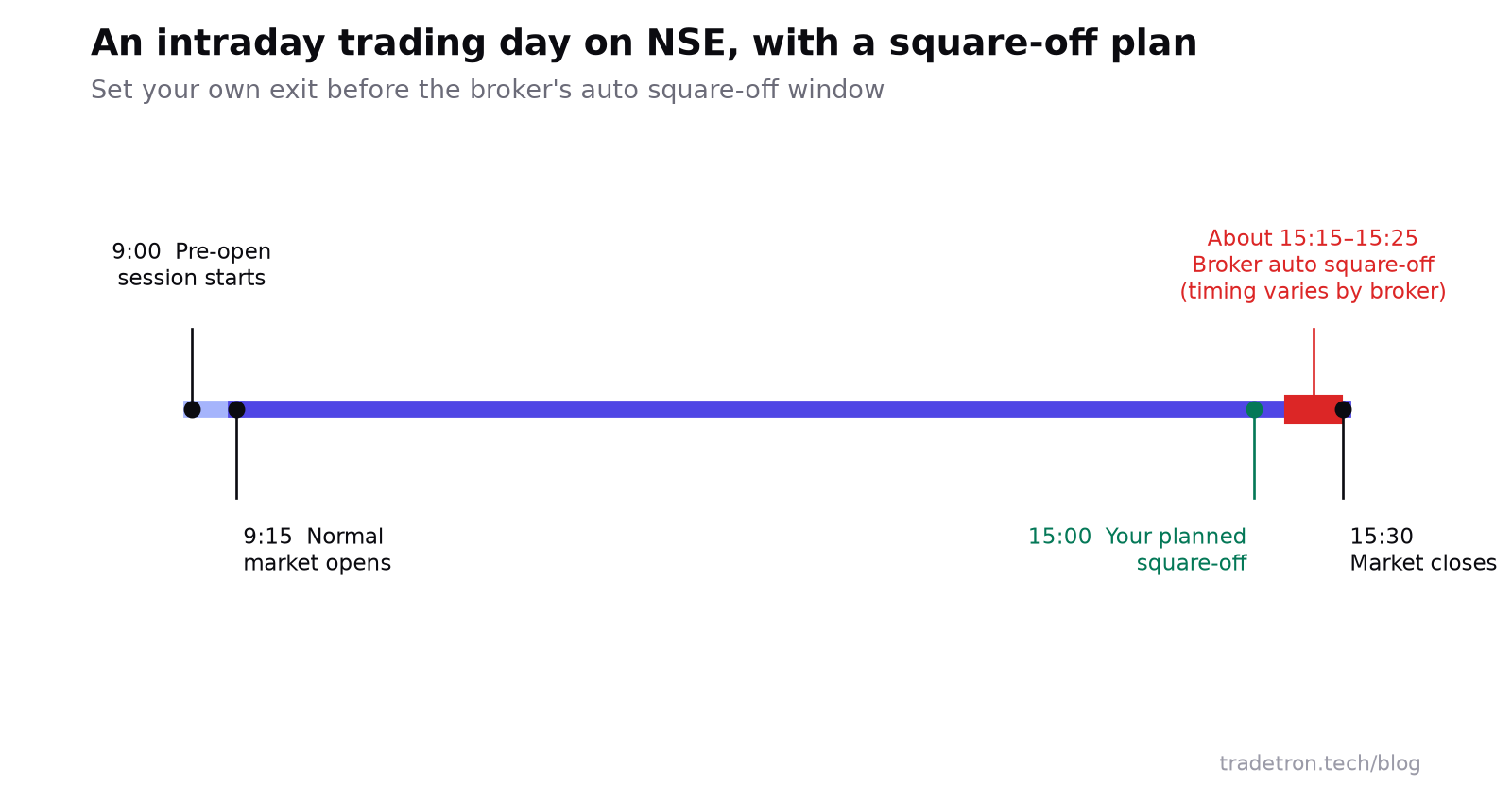 Plan your own square-off time before the broker's window
Benefits of SquareOff trading
- No overnight gap risk. Results, global markets and policy news after hours can open the price far from where you left it. Flat at the close means none of that touches you.
- Lower capital per trade. Intraday positions need less margin than overnight ones, because the risk is limited to one session.
- A clean slate every day. Each day's result is known by 3:30 pm. That makes it easy to measure a strategy and to stop when a daily loss limit is hit.
- Forced discipline. A fixed square-off time stops a losing intraday trade from turning into an unplanned "investment".
- Capital is free every evening for the next day's trades, or for other uses.
Risks and drawbacks
- Every idea must work today. Moves that need two or three days to play out are cut short.
- Costs add up. Trading every day means paying brokerage, STT and charges every day.
- Leverage magnifies losses. Lower intraday margin means a bigger position for the same capital.
- Late-day squeezes. Prices can move sharply near the close, and squaring off at market in that window can cost you.
- Most intraday traders lose. SEBI's 2023 study of the cash segment found around 7 in 10 individual intraday traders made a loss in FY23.
Square off in F&O: before expiry
Options and futures have their own square-off decision: close before expiry, or let them settle.
- Index options and futures (NIFTY, BANK NIFTY and others) are cash-settled at expiry.
- Stock futures and options are physically settled: an in-the-money stock option or a stock future held to expiry becomes a delivery of shares, which needs full funds or shares in your account.
That is why most traders square off stock F&O positions before expiry day. On NSE, expiries are now on Tuesday; for monthly contracts, the last Tuesday of the month.
How to build a square-off strategy
- Pick the instrument. A liquid stock, NIFTY futures, or a NIFTY option. Liquidity keeps your square-off fills close to the screen price.
- Define the entry window. For example, no entries before 9:30 (skip the noisy open) and none after 2:30 pm.
- Write the entry signal. An opening-range breakout, price above VWAP with an EMA crossover, or any rule you've tested.
- Set a stop loss and target on every position. Fixed points, a percentage, or a multiple of ATR.
- Set the time square-off. Close everything at, say, 3:10 pm, whatever the P&L.
- Add a daily loss limit. Square off everything and stop for the day if the strategy loses more than a set amount.
- Backtest, then run it in test mode before using real money.
This example shows structure, not a recommendation. Test it over several months of data, including quiet and volatile periods, before using it.
Automate the square-off on Tradetron
For more on exits and settings, read Advanced Settings explained, Repair Once and Repair Continuous and understanding slippage.
Frequently asked questions
What is square off in trading?
Square off means closing an open position with the opposite trade, selling what you bought or buying back what you sold, so your net position becomes zero and the profit or loss is booked.
What happens if I don't square off an intraday position?
Your broker closes it automatically near the end of the session at market price, usually with an extra charge per order. For an intraday short in the cash market, failing to square off can lead to an exchange auction and a penalty.
What time is auto square-off?
It depends on the broker and segment, typically between about 3:15 and 3:25 pm for equity intraday positions. Check your broker's published timings and set your own exit earlier.
Is square off the same as selling?
Only if you started by buying. If you started by short-selling or writing an option, you square off by buying back. Square off simply means taking the opposite of your open position.
Should I square off options before expiry?
Usually yes for stock options and futures, because they are physically settled and can turn into share delivery. Index options are cash-settled, but many traders still exit before expiry to avoid last-day volatility.
Can I automate square-off?
Yes. On Tradetron, a Universal Exit condition based on time, for example 3:10 pm, closes every position in the strategy automatically, alongside per-position stop losses and targets.