What Is a Basket Order? A Simple Guide for Investors
A basket order is a group of orders for several securities that you set up together and send in one go, instead of placing each buy or sell one by one. You might use one to buy ten stocks for a portfolio, to put on a multi-leg options position, or to rebalance holdings in a single action.
How a basket order works
You build a list: which securities, buy or sell, how many, and at what kind of price (market or limit). Your broker's platform saves this as a basket. When you click to execute, the platform sends every order in the list to the exchange, one after another, in a few seconds.
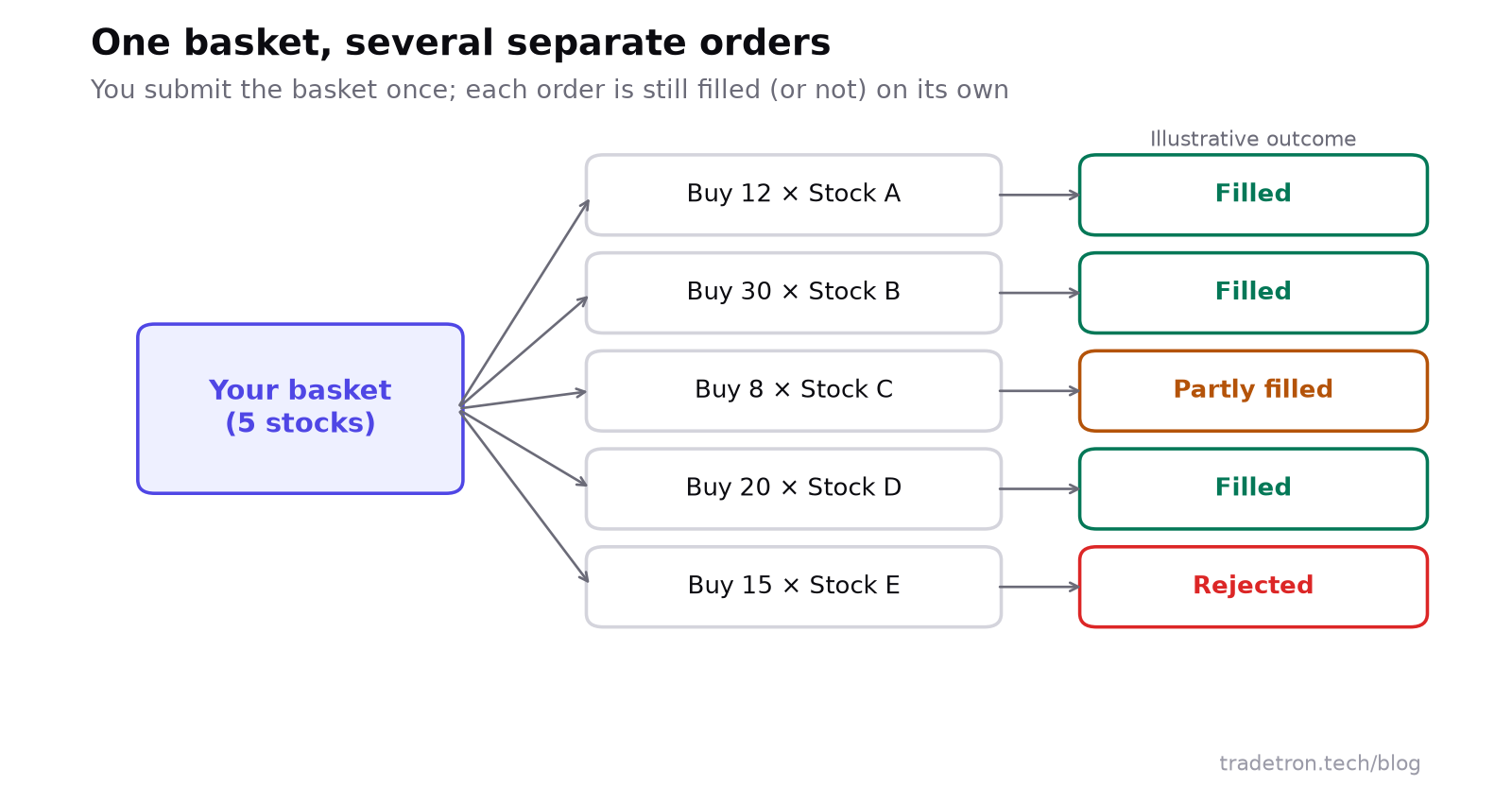 A basket is convenient, not all-or-nothing
That last point matters. The exchange sees separate orders, not one combined trade. If one stock hits its circuit limit or your funds run short halfway through, you can end up with part of the basket.
An example: a ₹1,00,000 equal-weight basket
Say you want to put ₹1,00,000 equally into five stocks, about ₹20,000 each. The prices below are made up for the example:
| Stock | Price (example) | Shares | Amount |
|---|---|---|---|
| Stock A | ₹1,650 | 12 | ₹19,800 |
| Stock B | ₹650 | 30 | ₹19,500 |
| Stock C | ₹2,400 | 8 | ₹19,200 |
| Stock D | ₹980 | 20 | ₹19,600 |
| Stock E | ₹1,300 | 15 | ₹19,500 |
| Total | ₹97,600 |
Shares come in whole numbers, so you rarely hit the exact weight; here ₹2,400 stays in cash. Placing five orders manually is fine. Placing 25, or redoing them every month to rebalance, is where a basket (or automation) earns its keep.
Types of basket orders
| Type | What's in the basket | Example |
|---|---|---|
| Index basket | The stocks of an index, roughly in their index weights | A home-made NIFTY 50 tracker |
| Sector basket | Stocks from one sector | Private banks, IT, pharma |
| Thematic basket | Stocks linked by an idea | Renewable energy, consumption, manufacturing |
| Options basket | Several option legs of one strategy | An iron condor or hedged strangle on NIFTY |
| Rebalancing basket | The buys and sells needed to restore target weights | Trim winners, top up laggards |
Benefits and drawbacks
Pros
- One submission instead of many: faster and fewer typing mistakes
- All trades go out at nearly the same time, so prices are close together
- Makes it practical to hold a diversified set of stocks
- Easy to reuse: save the basket and place it again
Cons
- Not all-or-nothing: partial fills and rejections can leave the basket incomplete
- Large baskets in thinly traded stocks can move prices against you
- Usually no saving on brokerage: each order is charged
- A basket is a one-time action; it doesn't monitor or rebalance itself
Basket orders vs single orders vs mutual funds and ETFs
| Single orders | Basket order | Mutual fund / ETF | |
|---|---|---|---|
| Effort for 10 stocks | 10 separate orders | One submission | One purchase |
| You choose the stocks | Yes | Yes | No, the fund does |
| You own the shares directly | Yes | Yes | No, you own units |
| Rebalancing | Manual | Manual (resubmit) | Done by the fund |
A basket sits between doing everything yourself and handing it to a fund: you keep full control of what you own, with less clicking.
How to place a basket order
- Decide the purpose. Index replication, a sector view, a theme, an options strategy, or a rebalance.
- Pick the securities. Check liquidity: thinly traded stocks are where baskets go wrong.
- Set quantities. Work out shares from your capital and target weights, as in the example above.
- Choose order types. Market orders fill quickly but at whatever price is available; limit orders control price but may not fill.
- Check margin and funds for the whole basket, not just the first few orders.
- Execute and check every order. Look for partial fills or rejections and deal with them straight away.
Monitoring and rebalancing
Once a basket is in place, the weights drift as prices move. If Stock A doubles, it's no longer 20% of the basket. Rebalancing means selling some of what grew and buying what lagged to get back to your targets, on a schedule (monthly, quarterly) or when a weight drifts past a limit.
Doing that by hand means rebuilding the basket each time. That's the job automation does well. Read more in winning basket trading strategies and systematic portfolio management.
Frequently asked questions
What is a basket order in the stock market?
It is a set of orders for several securities that you create together and submit in one action. Each order then goes to the exchange separately.
Are basket orders all-or-nothing?
No. Each order in the basket is processed on its own, so some can fill while others are rejected or only partly filled. Always check each order's status after placing a basket.
Do basket orders save brokerage?
Usually not. Most Indian brokers charge brokerage per executed order, so a basket of ten orders is charged like ten orders. The benefit is speed and convenience, not lower cost.
Can I use basket orders for options?
Yes. Baskets are a common way to put on multi-leg option positions such as spreads, straddles and iron condors. Place the bought legs before the sold legs to get any margin benefit for hedged positions.
Are basket orders good for beginners?
They can help a beginner build a diversified set of stocks without many separate orders. Start with liquid stocks and small amounts, and check every order after the basket is placed.
How do I rebalance a basket?
Compare each holding's current weight with its target, then sell what has grown above target and buy what has fallen below. Tools like Tradetron's Stockbag automate this with rules.