Margin Benefit: How a Hedge Cuts Option-Selling Margin
Margin benefit is the drop in margin your broker blocks when you add a hedge to a short option. Selling a naked put needs margin for a large, open-ended loss; buy a cheaper put further out on the same underlying and expiry, and the worst case is capped, so the exchange's margin system asks for far less. In one real example the margin roughly halved.
How margin benefit works
When you sell an option, the exchange's margin system (SPAN plus exposure margin) estimates how much you could lose in a bad move and blocks that much from your account. For a naked short put, that potential loss is large, because the underlying can fall a long way.
Buy a put at a lower strike, on the same underlying and expiry, and the picture changes. Below the hedge strike, every rupee you lose on the short put is made back by the long put. The position is now a bull put spread with a maximum loss you can calculate in advance, and the margin system recognises that.
- ₹88,177 margin to sell one lot of the put alone
- ₹44,547 margin with a further-out put bought as a hedge
- About 50% less margin for the same short option
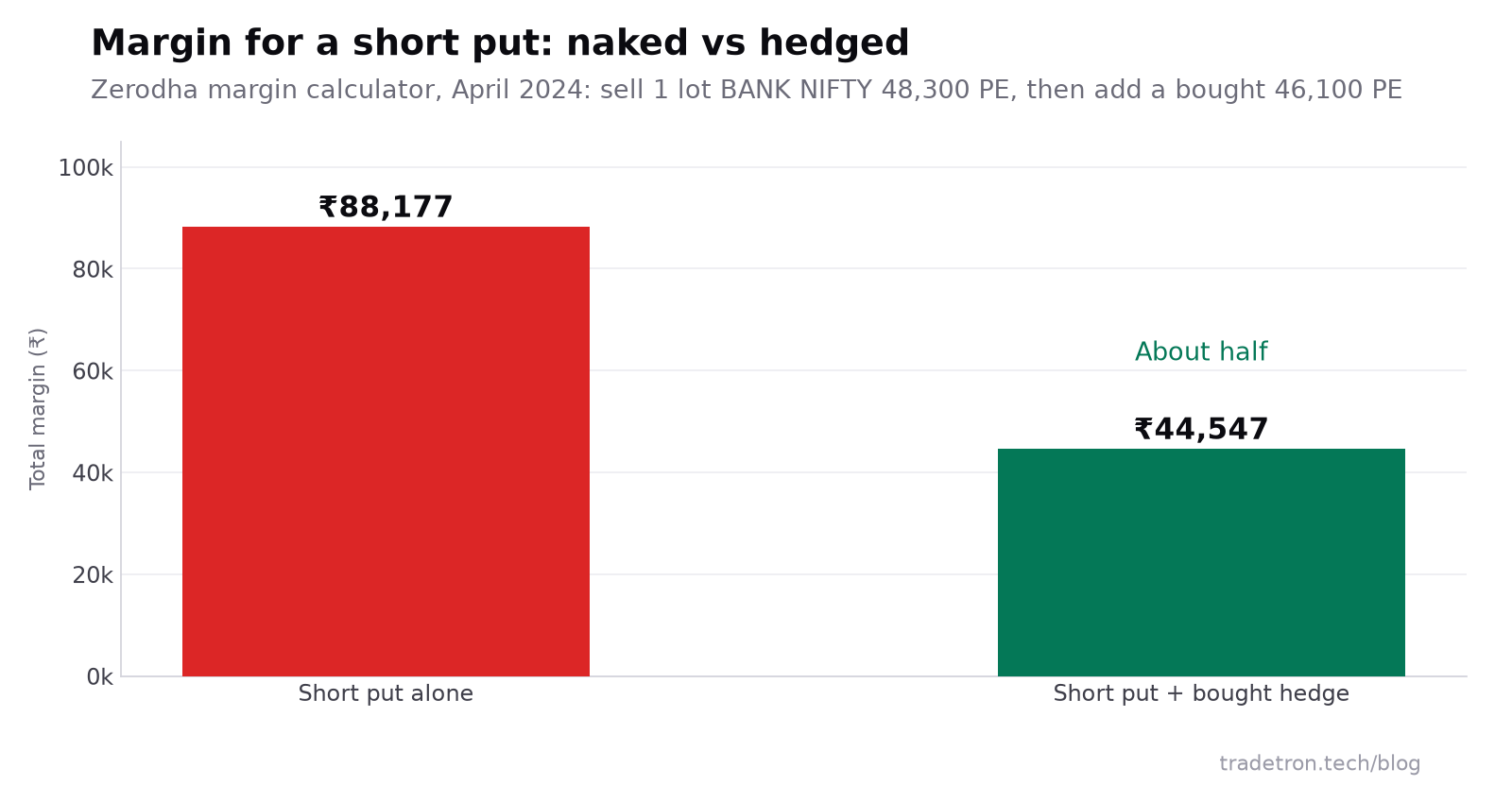 A real margin-calculator example from April 2024
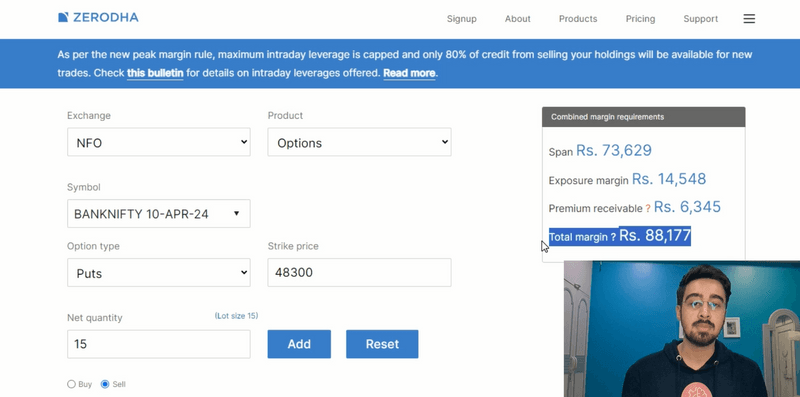 Short put alone
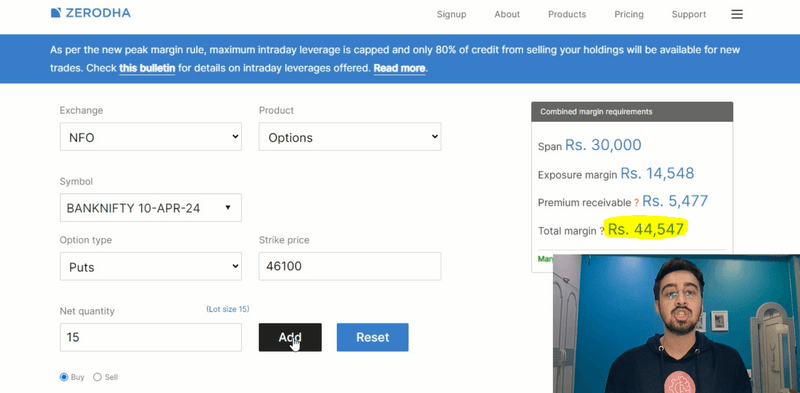 Short put plus a bought hedge
Choosing the hedge
The hedge in the example cost about ₹10 per unit: a far out-of-the-money option. How far out you buy is a trade-off:
| Hedge | Cost | Margin saved | Protection |
|---|---|---|---|
| Close to the short strike | Higher | Most | Strong: small maximum loss |
| Moderately far | Medium | Large | Moderate |
| Very far, very cheap | Lowest | Still meaningful | Weak: the loss can be large before the hedge helps |
A very cheap hedge mainly buys margin relief, while a closer hedge buys real protection. Know which one you are paying for.
Getting the order right
The benefit only applies while both legs are in place. If the short leg is open without the hedge, even for a few seconds, your broker may need the full naked margin. Two rules prevent that:
- On entry, buy the hedge first. Place the long option, then the short option. Check the order in which your strategy places its legs, and put the buy first.
- On exit, close the short first. Buy back the short option, then sell the hedge. Closing the hedge first leaves a naked short for a moment and can fail a margin check.
- Size to the hedged margin, with a buffer. Margin requirements rise when volatility jumps. Leave room so a spike doesn't trigger a shortfall.
Tradetron's "Exit Shorts first" setting
In a strategy's Advanced Settings, under Tranching, Exit Shorts first set to Yes makes the strategy square off sell positions before buy positions whenever it exits. That keeps the hedge in place until the short is closed.
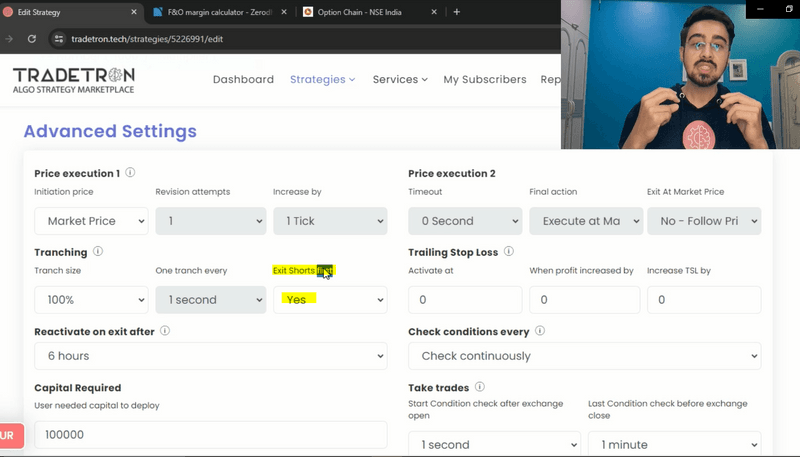 Advanced Settings: Exit Shorts first = Yes
Using margin benefit in a strategy
Margin benefit lets one capital base support a position that would otherwise need twice the money. Common uses:
- Iron condors and iron flies are hedged by design, so they need much less margin than a naked strangle or straddle.
- Intraday option-selling strategies like the Theta Gainers delta-neutral build can add a cheap hedge per side to bring the capital needed down.
- Diversifying across days and instruments: the freed margin can run a second, uncorrelated strategy instead of more lots of the same one.
Pros
- Much less capital blocked per short option
- The maximum loss is capped and known in advance
- Makes multi-leg strategies affordable on smaller accounts
- Exit Shorts first keeps the hedge in place during exits
Cons
- The hedge costs premium on every trade
- Very cheap hedges protect little in a normal move
- Temptation to over-size with the freed margin
- Leg order mistakes can trigger margin shortfalls
Further reading: what is hedging, the Nifty option hedging strategy, and Tradetron's Advanced Settings explained.
Frequently asked questions
What is margin benefit in options trading?
It is the reduction in required margin when a short option is paired with a bought option that limits its loss, for example a short put with a lower-strike long put on the same underlying and expiry. The exchange's margin system sees the capped risk and blocks less money.
How much margin does a hedge save?
It depends on the strikes, the underlying and current volatility. In one 2024 BANK NIFTY example, a hedge cut the margin for a short put by about half. Check your own trade in your broker's margin calculator.
Should I buy the hedge before selling the option?
Yes. If the short is placed first, your broker may need full naked margin until the hedge is bought, and the order can be rejected for insufficient funds. Buy first, then sell.
What does "Exit Shorts first" do on Tradetron?
It is an Advanced Settings option that makes the strategy close sell positions before buy positions when it exits, so a short option is never left open without its hedge.
Does a hedge make option selling safe?
It caps the loss but doesn't remove it. You can still lose up to the gap between the strikes minus the premium collected, and more lots mean a bigger total loss.