Understanding Slippage in Trading: A Complete Guide
Slippage is the difference between the price you expected to trade at and the price you actually got. If your strategy signals a buy at ₹120 and the order fills at ₹121.50, you have ₹1.50 of slippage per unit. It happens because prices move between the signal and the fill, and because the order book may not hold enough quantity at your price.

What is slippage in trading?
Every trade has two prices: the price your logic points to when the signal fires, and the price your broker confirms. The gap between them is slippage.
Slippage can also work in your favour (positive slippage), when the price moves your way before the fill. In practice, the costly kind is more common, because the moments you most need to trade, such as a stop being hit in a fast fall, are the moments when prices move fastest against you.
Why does slippage happen?
| Cause | What happens | Where it's worst |
|---|---|---|
| Volatility | Price moves between signal and fill | Market open, news, expiry-day afternoons |
| Thin liquidity | Not enough quantity at the best price, so the order fills at several worse prices | Far out-of-the-money options, small caps |
| Order size | A large order eats through several price levels | Multi-lot orders in thin strikes |
| Delay | Time between the condition being met, the order being sent and the exchange filling it | Strategies that check conditions once a minute |
| Order type | Market orders take any price; stop orders become market orders when triggered | Stops in fast markets |
Liquidity: the factor traders underestimate
A NIFTY future and a deep out-of-the-money NIFTY option can behave completely differently at the moment of execution. In a liquid contract, the bid-ask spread is tight and there is quantity at each price level, so a moderate order barely moves the price. In a thin one, the visible quantity may cover only part of your order, and the rest "walks" up the order book to get filled. That walk is slippage, no matter how good the strategy's logic is.
What slippage costs: the rupee view
A rupee or two per unit sounds harmless. Multiply it out:
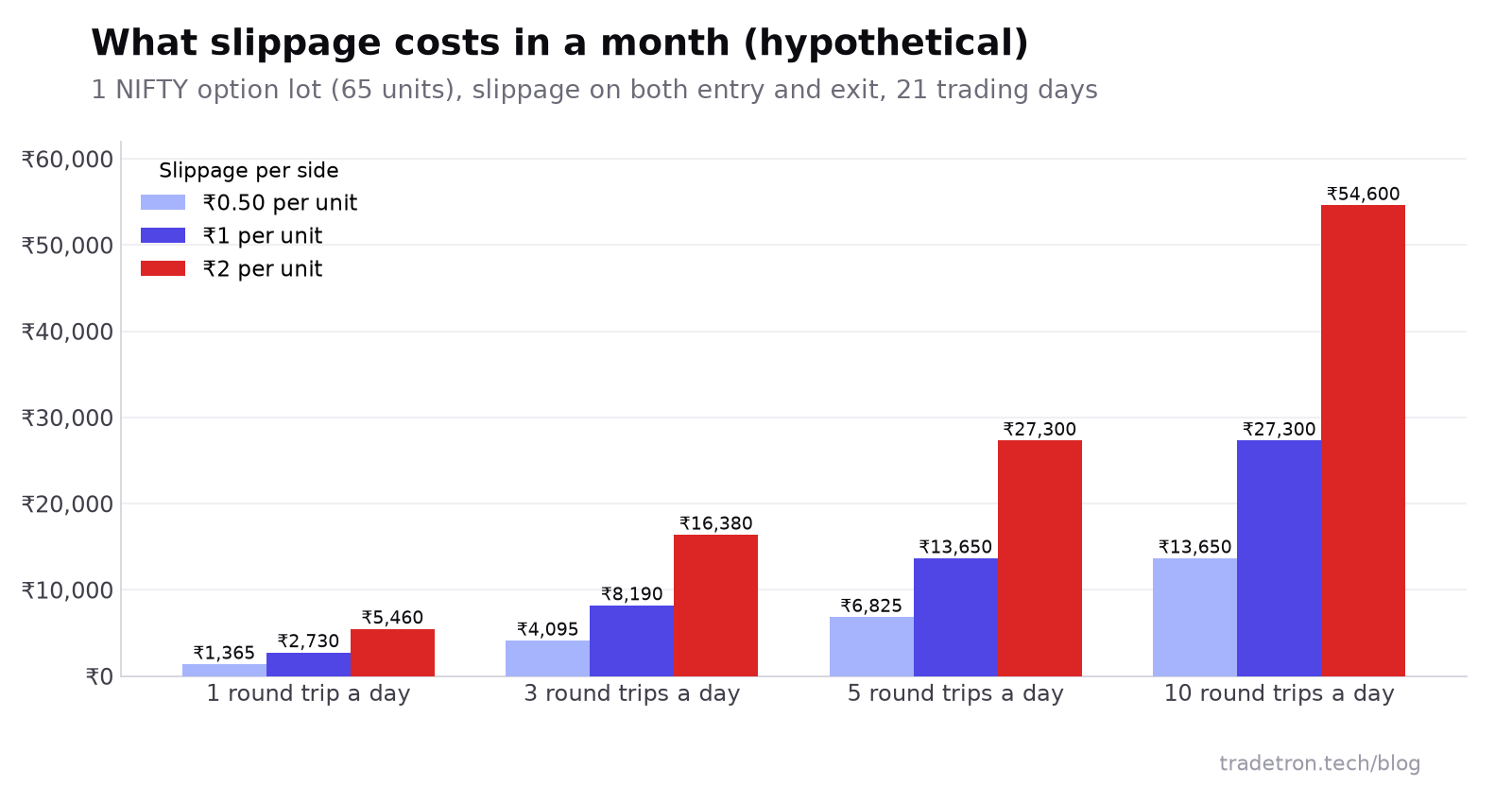 Slippage scales with how often you trade and how big your positions are
Order types and slippage
| Order type | How it behaves | Slippage risk | Fill certainty |
|---|---|---|---|
| Market | Fills immediately at the best available price | Highest; no price protection | Fills in almost all normal conditions |
| Limit | Fills only at your price or better | Capped | May not fill if the price runs away |
| Stop-loss market (SL-M) | Becomes a market order once the trigger is hit | Inherits market-order slippage, often at the worst moment | Fills once triggered |
| Stop-loss limit (SL) | Becomes a limit order once triggered | Capped | May not fill if price jumps past the limit |
No order type removes slippage. Each one moves the risk somewhere else: price risk, fill risk or timing risk. For an exit stop, a fill at a slightly worse price is usually better than no fill at all; for an entry, missing the trade is often the cheaper outcome.
Why backtests understate slippage
A backtest has no order book. On Tradetron, each simulated trade fills at the open or close price of the candle (your trade price setting). Real markets rarely offer that exact price, in your size, at that exact moment. Three effects follow:
- Perfect fills. Every order fills completely at the candle price.
- No delay. The time between "condition met" and "order filled" doesn't exist in the test.
- Coarse data. A strategy that checks conditions once a minute can't see what happened inside that minute, so stops can look cleaner in the test than they would be live.
That is why you should always read a backtest after costs. Tradetron's backtest report lets you apply brokerage and slippage in its cost section without re-running the test, so you can see whether the strategy still holds up at, say, ₹1 per unit per side. More on the backtest-to-live gap in nine reasons your backtest doesn't match live trading.
How to reduce slippage
- Trade liquid instruments and strikes. Near-the-money index options and index futures have the tightest spreads.
- Avoid the most volatile minutes if your strategy doesn't need them, such as the first few minutes after the open.
- Use limit pricing with revisions for entries, so you don't chase the price, with a fallback so the order isn't left unfilled forever.
- Split large orders into smaller pieces instead of sending one block.
- Size to the market. If your order is a large share of the quantity at the best price, reduce the size or pick a more liquid contract.
- Measure it. Compare your fill prices with the signal prices every month. If slippage grows, find out why before blaming the strategy.
Managing execution on Tradetron
Tradetron's Advanced Settings decide how a strategy's live orders are priced and what happens if they don't fill:
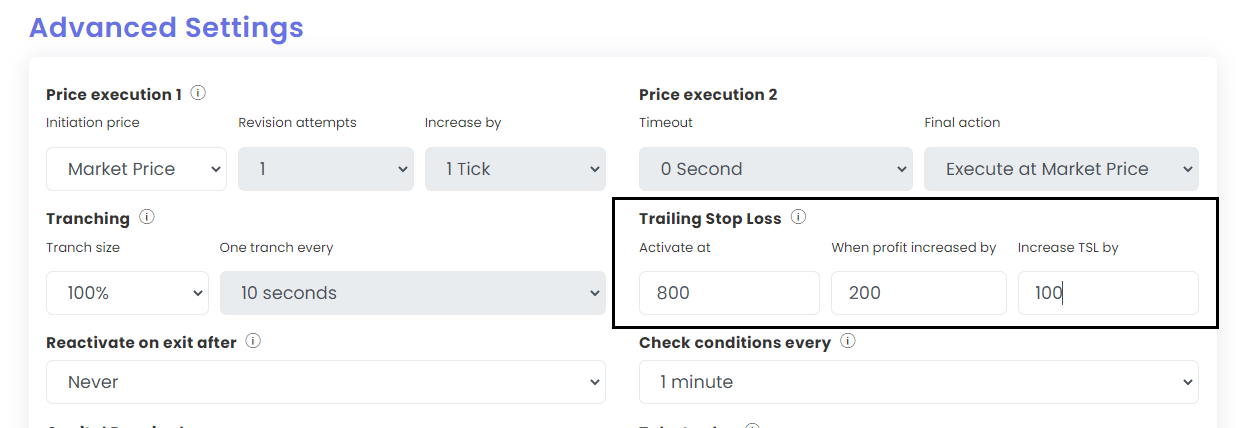 Price execution and tranching settings in Advanced Settings
- Price execution 1: the initiation price (for example best bid/ask, average of bid and ask, LTP or market price), the number of revision attempts, and how many ticks to increase by on each revision.
- Price execution 2: a timeout, and a final action if the order still hasn't filled, such as executing at market price.
- Tranching: splits an order into smaller pieces (a tranch size) sent at intervals, to reduce the impact of a large order.
These settings apply to live orders. Backtests fill at the candle's open or close price, which is why the report's cost section matters. The guide to Tradetron's advanced settings explains each option.
Frequently asked questions
What is slippage in trading?
Slippage is the difference between the price you expected when you placed or triggered an order and the price at which it actually filled. It is usually caused by price movement and limited quantity at the best price.
Is slippage always bad?
No. Positive slippage happens when the price moves in your favour before the fill. But costly slippage is more frequent, because orders are often triggered when prices are moving fast, such as when a stop loss is hit.
Do market orders or limit orders cause more slippage?
Market orders, because they take whatever price is available. Limit orders cap the price, but they may not fill if the market moves away.
How much slippage should I assume in a backtest?
It depends on the instrument, the size and how often you trade. A practical approach is to test a few levels (for example, ₹0.50, ₹1 and ₹2 per unit per side for index options) and check that the strategy still makes sense at the higher ones. Then compare with your actual fills once you trade live.
Can slippage be eliminated?
No. It can be reduced by trading liquid instruments, using limit pricing with revisions, splitting large orders and avoiding the most volatile minutes, but it is part of every live market.
Why is slippage higher on expiry day?
Option premiums can move very quickly near expiry, and some strikes become thin, so the price can change a lot between the signal and the fill. Wider spreads on cheap, far-away strikes add to it.