How to Backtest Your Trading Strategy Like a Pro with Tradetron

To backtest a trading strategy like a pro, treat it as an experiment: write the rules as a testable idea, run one baseline, change one thing at a time, stress the result with costs and different periods, check the chosen version on data you didn't tune it on, and confirm it in live conditions before using real money. On Tradetron every step works without code.

What professionals do differently
Amateurs ask "what settings made the most money?" Professionals ask "is there a real edge here, and how would I know if there isn't?" The difference shows up in the process:
| Amateur backtest | Professional backtest |
|---|---|
| Tries settings until the curve looks good | States the idea first, then tests it |
| Reads total profit | Reads drawdown, profit factor, trade count and monthly spread |
| Ignores costs | Finds the slippage level at which the edge disappears |
| Trusts the best result | Checks it on held-back data and nearby settings |
| Goes live at full size | Runs Live Offline, then starts small |
The example strategy
We'll walk through the workflow with a simple, common intraday options idea. The figures later in this post are hypothetical, to show the method.
Writing the hypothesis down matters. It tells you what to look for in the results (does the edge come from time decay on quiet days?) and what would disprove it (losses clustering on big-move days that the stop doesn't contain).
Step 1: Build the rules completely
On Tradetron's no-code builder, the example becomes:
- Entry condition: Time ≥ 09:20.
- Positions: sell NIFTY CE at ATM and sell NIFTY PE at ATM, weekly expiry, 1 lot each (65 units).
- SL trigger on each leg: the leg's LTP ≥ its entry price × 1.25, with the entry price taken from the Traded Instrument keyword.
- Exit condition: Time ≥ 15:15.
If a rule needs judgement ("exit if it looks weak"), it can't be tested. Make it a number or drop it. New to the builder? See building a strategy without coding and the keywords guide.
Step 2: Run a baseline backtest with the right settings
| Setting | For this strategy | Why |
|---|---|---|
| Date range | A few years | Includes calm and volatile markets |
| Candle frequency | 1 minute | Time-based entry and LTP-based stops |
| Trade price | Open | The trade acts on a signal that has just appeared |
| Type | Intraday | Everything closes the same day |
Save the report and note it as "baseline". Every later change is compared with this run. The backtesting guide explains each setting in detail.
 The Backtest page: every run with its grade, return, drawdown and Sharpe
Step 3: Read the baseline like a sceptic
Before changing anything, ask:
- How many trades? Enough to mean something across many months?
- Where is the maximum drawdown, and what happened on those days?
- Is profit spread across months, or did a few months make it all?
- What do the worst days look like? For a short straddle, the losses on big-move days decide everything.
- Does the result fit the hypothesis? If profit came from somewhere unexpected, find out why before trusting it.
How to evaluate a strategy's performance explains drawdown, profit factor and expectancy.
Step 4: Change one thing at a time, and log it
Now test variations: stop at 20%, 25% or 30%; entry at 9:20, 9:30 or 10:00. Change one variable per run and keep a log:
| Version | Change from baseline | Max drawdown | Profit factor | Notes |
|---|---|---|---|---|
| v1 | Baseline (25% SL, 9:20) | … | … | |
| v2 | SL 20% | … | … | More stop-outs? |
| v3 | SL 30% | … | … | Bigger losses on trend days? |
| v4 | Entry 9:30 | … | … |
Tradetron's sweep option runs several values of one number in the strategy in one go and shows them side by side, which makes this step much faster.
Step 5: Stress-test costs and slippage
A short straddle trades four times a day (two entries, two exits). Even small slippage adds up. Find the level of slippage at which the edge disappears:
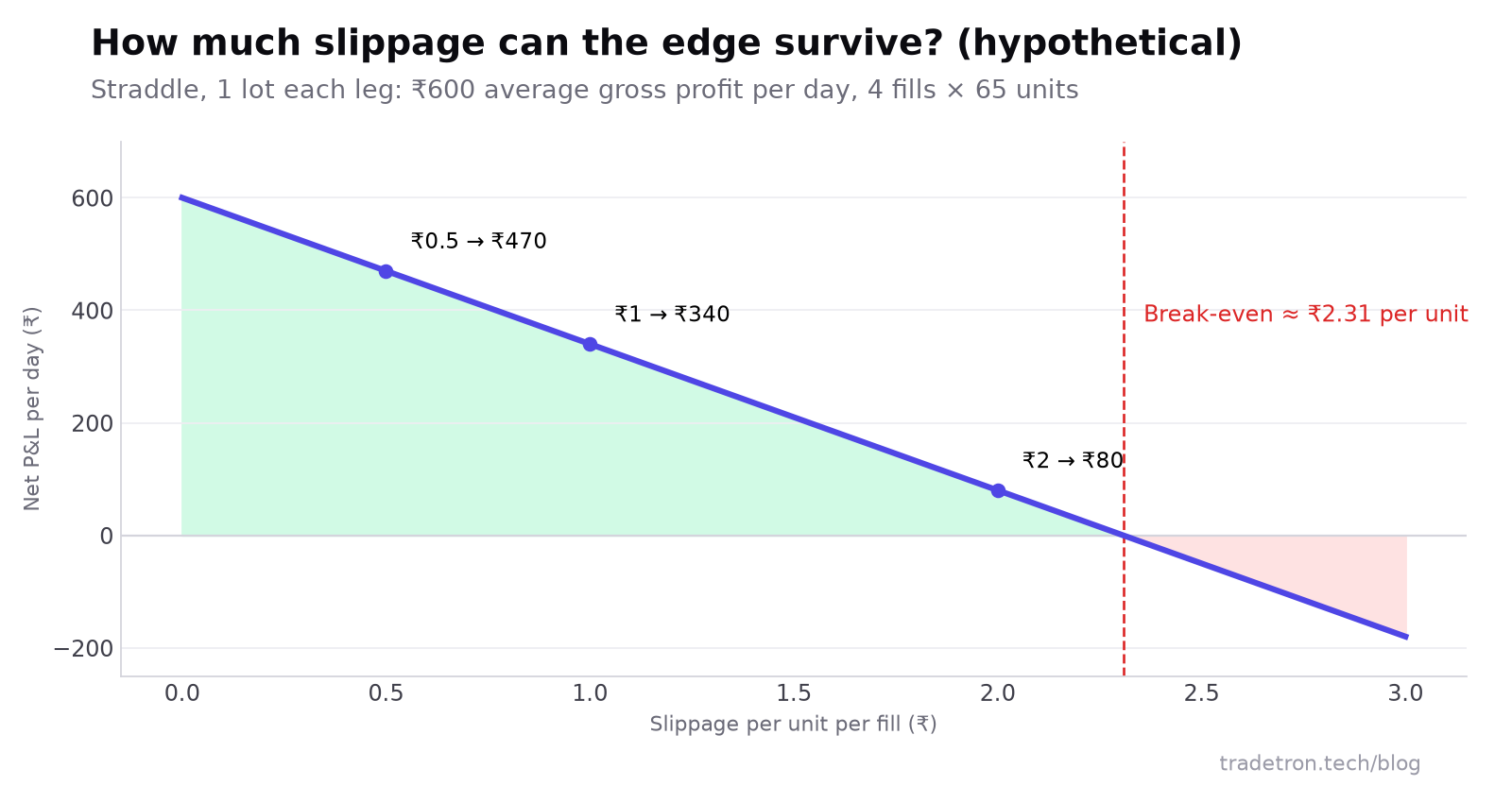 Hypothetical: the break-even slippage tells you how much margin for error the strategy has
Tradetron's backtest report has a cost section where you can apply brokerage and slippage without re-running the test. Try a few levels and see where the strategy stops making sense. More in understanding slippage.
Step 6: Check it on data it hasn't seen
Everything so far was tuned on the same data. A professional always keeps some back. With a sweep, Tradetron can hold back part of the period: versions are compared on the earlier part and the winner is checked on the later part. If the chosen version does far worse on the held-back data, it was fitted to noise.
Also look at each year on its own. A strategy that only worked in one year of the test probably has a narrower edge than the total suggests.
Step 7: Test forward, then go live small
- Deploy Live Offline. The strategy runs and records every trade, but nothing is sent to the exchange. Let it run for a few weeks.
- Compare with the backtest for the same days. Same entries? Similar exits? If not, find out why before going further.
- Go Live Auto at the smallest size on your broker, and compare fill prices with signal prices.
- Scale up gradually using the multiplier, only after live results look like the test.
Before you start, read the ten most common backtesting mistakes.
Frequently asked questions
What does backtesting mean in trading?
Backtesting means running a strategy's rules on historical market data to see how it would have performed: which trades it would have taken, its profit and loss, and its worst drawdown.
Can I backtest without coding?
Yes. On Tradetron you build a strategy from conditions and positions in a visual builder and run the backtest from the strategy page. No code is needed.
How do professionals avoid overfitting?
They state the idea before testing, limit the number of versions they try, change one thing at a time, prefer settings whose neighbours also work, and check the chosen version on data that wasn't used to choose it.
How long should I backtest a strategy for?
Long enough to include rising, falling and sideways markets, and to produce a meaningful number of trades. For an intraday strategy, a few years of data is a sensible target.
Is backtesting accurate?
It is a simulation. It uses historical prices but can't fully reproduce live fills, slippage or delays. That is why professionals apply realistic costs, check held-back data and test forward before going live.
Can I automate a strategy after backtesting it on Tradetron?
Yes. The same strategy you backtested can be deployed Live Offline and then Live Auto on your connected broker, without rebuilding it.