Is Trading Easy or Hard? The Truth Most Beginners Don't Hear
Trading is easy to start and hard to do well. Opening an account and placing an order takes minutes. Making money consistently is hard because you compete with professionals, pay costs on every trade, and have to follow your own rules while your money is moving. Most beginners lose, but the reasons are known, and most of them can be fixed.

Why trading looks easy
From the outside, trading sounds like four steps:
- Buy when the price is low.
- Sell when it is higher.
- Use a chart and a couple of indicators.
- Repeat.
And the tools have never been easier. A discount broker app, a free charting site and a YouTube playlist get you started on the same day. Brokerage on delivery trades is zero at many brokers, and a NIFTY option can be bought for a few thousand rupees.
That ease of entry is exactly the trap. Low friction to start does not mean low difficulty to win. Placing a trade is the easy 5%. Deciding which trade, how much, and when to get out, then doing it the same way a hundred times, is the other 95%.
What the numbers say about beginners
You don't have to take anyone's word on this. SEBI has studied retail trading results directly:
- 9 in 10 individual F&O traders made a net loss between FY22 and FY24 (SEBI study, Sep 2024)
- 7 in 10 individual intraday traders in the cash segment made a loss in FY23 (SEBI study, 2023)
These are not "bad traders" in a special category. They are mostly ordinary people who found trading easy to start. The useful question is not "is trading hard?" but "why do most people lose, and what do the few who don't do differently?"
Why trading is actually hard
1. You are trading against professionals
Every trade has someone on the other side. In Indian markets that is often a proprietary desk, an institution or an algorithm with better data, faster execution and strict risk limits. Your edge has to be real to survive that.
2. Costs are charged on every trade
Brokerage may be low, but STT, exchange charges, GST, stamp duty and slippage add up. A strategy that is slightly profitable before costs can be a losing one after them, especially if you trade often.
3. Small wins, big losses
Beginners tend to grab small profits quickly ("let me book it before it goes away") and hold losing trades hoping they come back. That flips the math against you. Look at how often you need to be right just to break even:
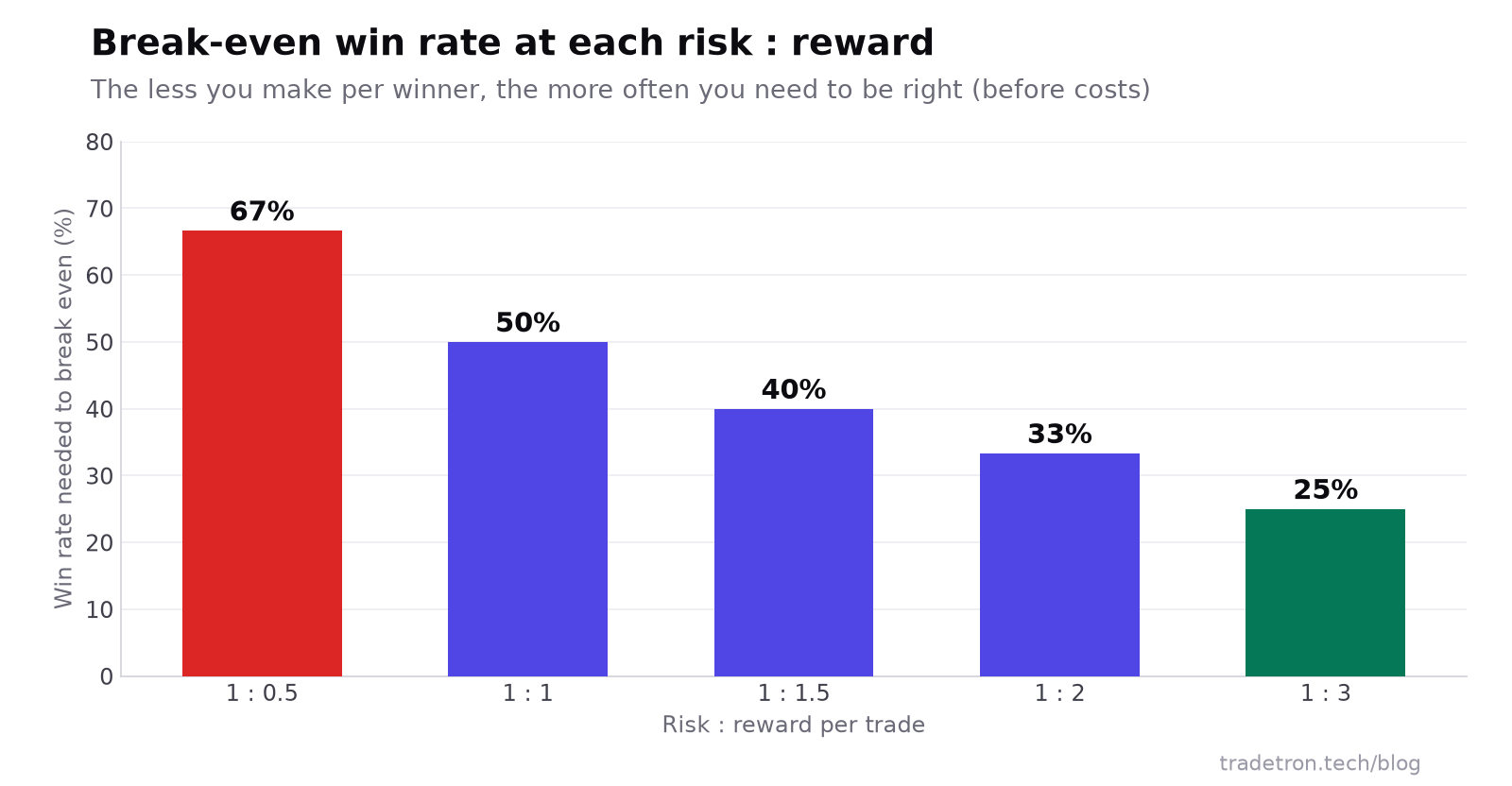 Break-even win rate = 1 ÷ (1 + reward/risk), before costs
4. Emotions show up when money is real
Fear makes you exit good trades early. Hope makes you hold bad ones. After a loss you want to "win it back" with a bigger trade. Results in a simulator or a notebook rarely survive the first real losing streak, because real money changes how you behave. For more on this, read the psychology of algorithmic trading.
5. No tested strategy, just tips
Trades based on a Telegram tip, a news headline or a "sure" setup are not a strategy. A strategy has written rules for entry, exit, position size and when not to trade, and has been tested on past data. Without that, you cannot tell bad luck from a bad idea.
6. Overtrading and noise
Prices move all day. If every move looks like an opportunity, you end up taking low-quality trades, paying more costs, and getting tired and careless by the afternoon.
Is trading hard for everyone?
Not equally. How hard it feels depends mostly on how you approach it:
| Approach | What it looks like | Typical experience |
|---|---|---|
| Tip-follower | Trades on news, tips, social media | Results depend on luck; no way to improve |
| Learning beginner | Studies charts, trades small | Makes mistakes, improves slowly if they keep a journal |
| Systematic trader | Written rules, fixed risk per trade | Results can be measured and the rules improved |
| Automated (algo) trader | Rules coded or built in a tool and run automatically | Emotions removed from execution; the rules still need to be good |
Trading also differs by style. Trading vs investing explains why investing for years is usually simpler than trading for days or minutes, and the types of trading guide compares intraday, swing and positional styles.
How to make trading easier (not easy)
- Pick one market and one instrument. For example NIFTY options, or a handful of large-cap stocks. Jumping between stocks, crypto and options splits your attention.
- Write one strategy down. Entry rule, exit rule, stop loss, position size, and the times you will not trade.
- Fix your risk per trade. Many traders cap it at 1–2% of capital. On ₹2,00,000, that is ₹2,000–₹4,000 at risk per trade.
- Test it on past data. A backtest shows how the rules behaved across good and bad periods, and how deep the losing streaks were.
- Run it in test mode before real money. Watch it work in live market conditions without real orders.
- Start small and keep a journal. Record why you took each trade and whether you followed the rules. Most lessons come from the trades where you broke them.
Where automation helps, and where it doesn't
Automation does not make a bad strategy good. What it does is remove the human weak points from following a strategy: hesitating on an entry, moving a stop loss, skipping a trade after two losses, or forgetting to exit before the close.
If you are just starting, the free learning path and the 7% rule on stop losses are good next reads.
Frequently asked questions
Is trading easy or hard for beginners?
It is easy to start and hard to do well. Opening an account and placing trades is simple, but making money consistently needs a tested strategy, strict risk control and the discipline to follow your rules when you are losing.
Why do most traders lose money?
The common reasons are trading without a tested strategy, risking too much per trade, cutting winners early while holding losers, overtrading, and underestimating costs. SEBI's studies found that most individual F&O and intraday traders lost money.
Is trading harder than investing?
Usually, yes. Trading needs frequent decisions, tight risk control and attention during market hours. Long-term investing in diversified funds or quality stocks needs fewer decisions and gives each idea more time to work.
How long does it take to learn trading?
There is no fixed timeline. Many traders spend a year or more learning, testing and trading small before they have rules they trust. Some never become consistently profitable, which is why starting small matters.
Can I start trading with little money?
Yes, but small capital does not mean small risk: options and leveraged products can lose money quickly. Learn with test or simulated trades first, then use an amount you can afford to lose while you learn.
Does algo trading make trading easier?
It makes following your rules easier, because the system executes them without hesitation. It does not make a weak strategy profitable. You still need to design, backtest and monitor the rules.