Position Sizing for F&O Traders: How Many Lots to Trade
Position sizing for F&O traders means choosing how many lots to trade from how much you are willing to lose if your stop is hit, not from how much margin you have. The formula is simple: lots = (capital × risk per trade) ÷ (stop distance × lot size), rounded down, and if the answer is zero, the trade is too big for your account at that stop.
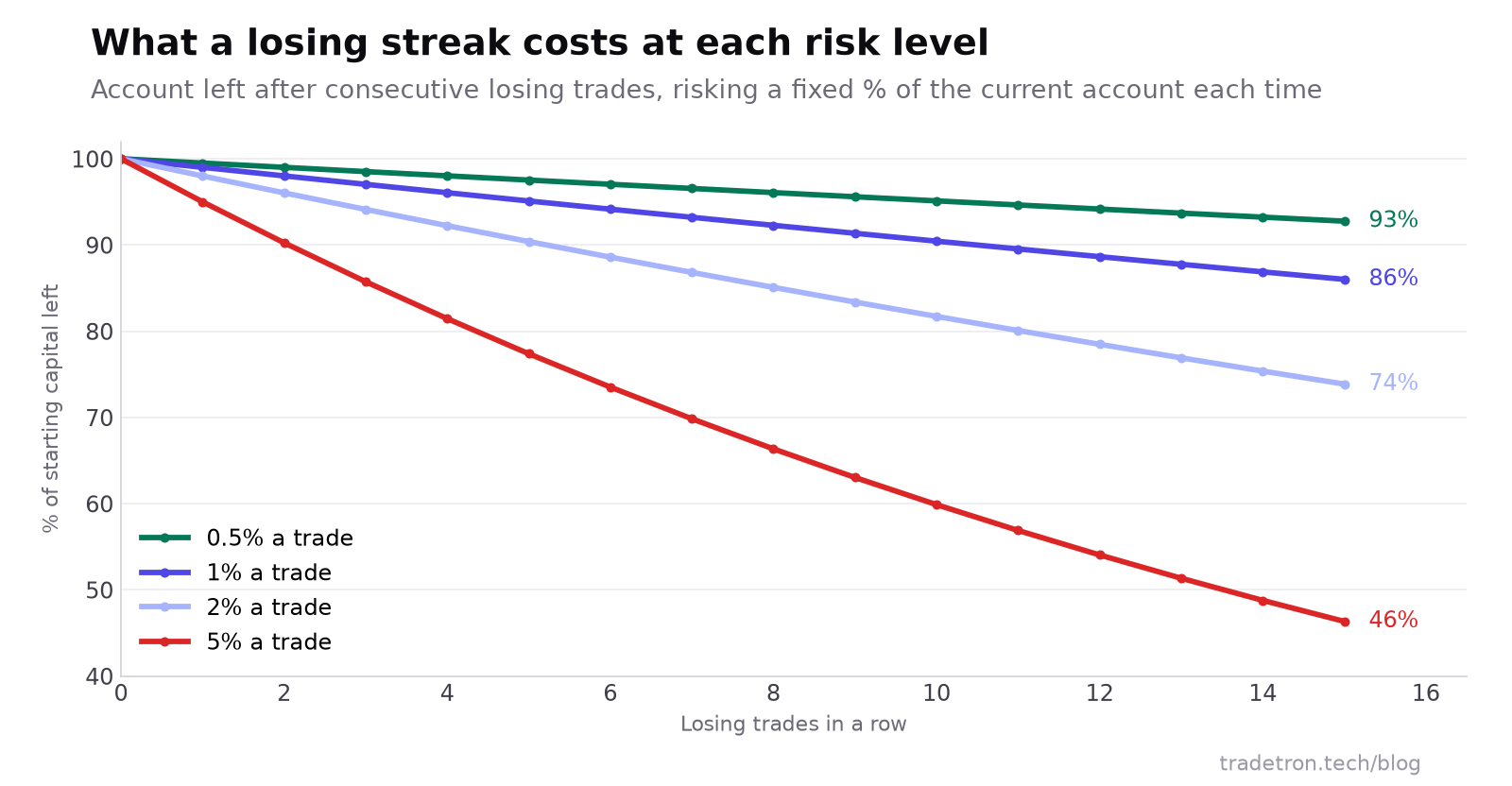 After 15 losses in a row: about 93% of the account is left at 0.5% a trade, 86% at 1%, 74% at 2% and 46% at 5%
Why position size matters more than the entry
Two traders can take the same NIFTY trade, with the same entry and the same stop, and end the year in very different places. The difference is how many lots each one traded. Entries decide whether a trade wins; position size decides how much a losing trade costs and how long you can keep going.
F&O makes this sharper. Futures and options are leveraged, so a small move in NIFTY is a large move in your account. And F&O comes in lots: one NIFTY lot is 65 units and one BANK NIFTY lot is 30, so you can't buy "a little less" of a contract.
Step 1: decide your risk per trade
Risk per trade is the most you are willing to lose on one trade if the stop is hit, written as a share of your trading capital. Many traders choose somewhere between 0.5% and 2%. There is no correct number, but the smaller it is, the longer a losing streak you can survive.
| Trading capital | 0.5% a trade | 1% a trade | 2% a trade |
|---|---|---|---|
| ₹2,00,000 | ₹1,000 | ₹2,000 | ₹4,000 |
| ₹5,00,000 | ₹2,500 | ₹5,000 | ₹10,000 |
| ₹10,00,000 | ₹5,000 | ₹10,000 | ₹20,000 |
Use the capital you have set aside for trading, not your total savings. And recalculate as the account changes: risking 1% of the current balance means trades get smaller during a drawdown, which slows the damage.
Step 2: find the rupee risk of one lot
The risk of one lot is the distance from your entry to your stop, in points, times the lot size. How you measure the distance depends on what you trade.
Futures. Stop distance × lot size. A NIFTY futures trade with a 60-point stop risks 60 × 65 = ₹3,900 per lot. A BANK NIFTY futures trade with a 150-point stop risks 150 × 30 = ₹4,500 per lot.
Option buying. The premium is the most you can lose. With no stop, the risk per lot is the whole premium × lot size. With a stop on the premium, it is the distance from your buy price to the stop. A NIFTY call bought at 120 with a stop at 80 risks 40 × 65 = ₹2,600 per lot; without the stop it risks 120 × 65 = ₹7,800.
Option selling. A short option has no natural limit, so the stop defines the risk. A NIFTY option sold at 100 with a stop at 150 risks 50 × 65 = ₹3,250 per lot, if the stop fills near its level. Gaps and fast markets can fill it much worse, which is why a hedged structure is easier to size: a spread's maximum loss is (strike width − net credit) × lot size, whatever the market does.
Step 3: divide, then round down
Always round down. Rounding up to "just one more lot" is how a 1% rule quietly becomes a 2% rule.
When the answer is zero, the honest choices are: use a tighter stop that still makes sense for the setup, trade a smaller instrument, use a hedged structure with a defined loss, or skip the trade. Widening your risk limit for this one trade is not on the list.
The free position size calculator does this arithmetic for futures and options; type in your lot size and it returns the lots and the rupee risk.
Margin is not risk
Your broker blocks margin to cover what the exchange requires for the position. That number answers "can I open this?", not "what can I lose?".
| Margin | Risk | |
|---|---|---|
| What it is | Money blocked to hold the position | Money lost if the stop is hit or the worst case happens |
| Who sets it | Exchange and broker rules | You, through your stop and size |
| What it tells you | Whether you can open the trade | Whether you should |
A hedged option position can need far less margin than a naked one and still carry a known, limited loss. A naked short option can fit comfortably inside your margin and still lose several times what you planned on a gap. Size by risk first, then check that the margin fits. If you size by "how many lots my margin allows", you are letting the exchange's rules choose your risk.
Our guide to how a hedge cuts option-selling margin explains the margin side in more detail.
Size for the losing streak, not the average trade
Every strategy has losing streaks, including good ones. The question is whether your account and your nerves survive the streak long enough for the strategy's edge, if it has one, to show.
| Losses in a row | Left at 0.5% a trade | Left at 1% a trade | Left at 2% a trade | Left at 5% a trade |
|---|---|---|---|---|
| 5 | 97.5% | 95.1% | 90.4% | 77.4% |
| 10 | 95.1% | 90.4% | 81.7% | 59.9% |
| 15 | 92.8% | 86.0% | 73.9% | 46.3% |
The recovery is harder than the fall. An account down 40% needs a 67% gain to get back to where it started; one down 10% needs 11%. Check what your own worst streak could do with the drawdown calculator, and read seven ways to reduce drawdown for the other controls.
Three more limits worth setting
Risk per trade is the first layer. Three more stop a bad day from becoming a bad month:
- A daily loss limit. Stop trading for the day once losses reach a set amount, for example three times your risk per trade. Bad days cluster; a limit stops one from snowballing.
- A cap on total open risk. If you run several strategies or positions at once, add up what each can lose at its stop. Five positions at 1% each is 5% at risk at the same moment, and correlated positions (several NIFTY option sellers, say) tend to lose together.
- A rule for changing size. Decide in advance when you increase or cut size, such as recalculating at the start of every month from the current balance. Changing size after a win or a loss, in the moment, is where most sizing discipline breaks.
Adjusting for volatility
A fixed stop in points means different things on a calm day and a wild one. Some traders set the stop from volatility instead, for example a multiple of ATR (average true range), and let the size follow: a wider stop on a volatile day means fewer lots, so the rupee risk stays the same.
The rule doesn't change: rupee risk per trade stays fixed, and the number of lots is what moves.
If you are comparing plans for running several strategies, the pricing page lists what each one includes. For the wider picture, read our guide to risk management in algo trading.
Trading in futures and options involves a substantial risk of loss. The capital, prices and lot counts in this article are arithmetic examples, not recommendations.
Frequently asked questions
What is position sizing in F&O trading?
It is deciding how many lots to trade so that, if your stop is hit, you lose no more than a fixed amount you chose in advance. The number of lots comes from your risk limit and your stop, not from your margin.
How do I calculate position size for futures?
Divide the rupee amount you are willing to lose by the risk of one lot, which is the stop distance in points times the lot size. For ₹5,000 of risk and a 60-point stop on NIFTY futures: 5,000 ÷ (60 × 65) = 1.28, so 1 lot.
How much should I risk per trade?
Many traders risk between 0.5% and 2% of their trading capital on one trade. Smaller is safer: at 1% a trade, ten losses in a row cost about 10% of the account; at 5% they cost about 40%.
How do I size an option selling position?
Set a stop on the premium and size from the distance between your sale price and the stop, times the lot size. Remember that a short option can gap past its stop, so a hedged structure such as a spread or an iron condor, with a known maximum loss, is easier to size safely.
Should I size my trades by margin?
No. Margin tells you whether you can open the position; it doesn't tell you what you can lose. Size by your risk per trade first, then check that the margin required fits in your account.
What if one lot is already more than my risk limit?
Then the trade doesn't fit your account at that stop. Use a tighter stop that still suits the setup, trade a smaller instrument, use a hedged structure with a defined loss, or skip the trade.