What Is Hedging? A Simple Explanation and How to Automate It
Hedging means taking a second position to reduce the risk of one you already hold. If you own NIFTY futures and buy a NIFTY put, the put gains if the market falls, cushioning the loss on the futures. A hedge works like insurance: you pay a cost, in premium or in reduced profit, to limit how much a bad move can hurt you.
What is hedging? The short answer
A hedge is a position whose job is to move the opposite way to something you already own, so that a bad outcome hurts less. Everyday versions:
- You own a car, so you buy insurance. You don't hope to crash; you limit the damage if you do.
- A business that earns in dollars and pays in rupees can lock in an exchange rate, so a sudden currency move doesn't wipe out its margin.
Why traders hedge
- To cap the worst case. A hedged position has a known maximum loss.
- To survive gaps. Overnight news or events can move the market before you can react. A hedge is already in place.
- To smooth results. Smaller swings in P&L make it easier to stick with a strategy.
- To use less margin. In F&O, hedged positions often need less margin than naked ones, because the exchange's risk calculation recognises the offset.
- To buy time. A hedge lets you decide calmly instead of reacting in a panic.
Three hedging examples for Indian traders
1. Protective put on a futures position
You buy one NIFTY futures lot (65 units) at 25,000. To protect it, you buy a 24,500 put for 120 points (hypothetical premium), costing 120 × 65 = ₹7,800.
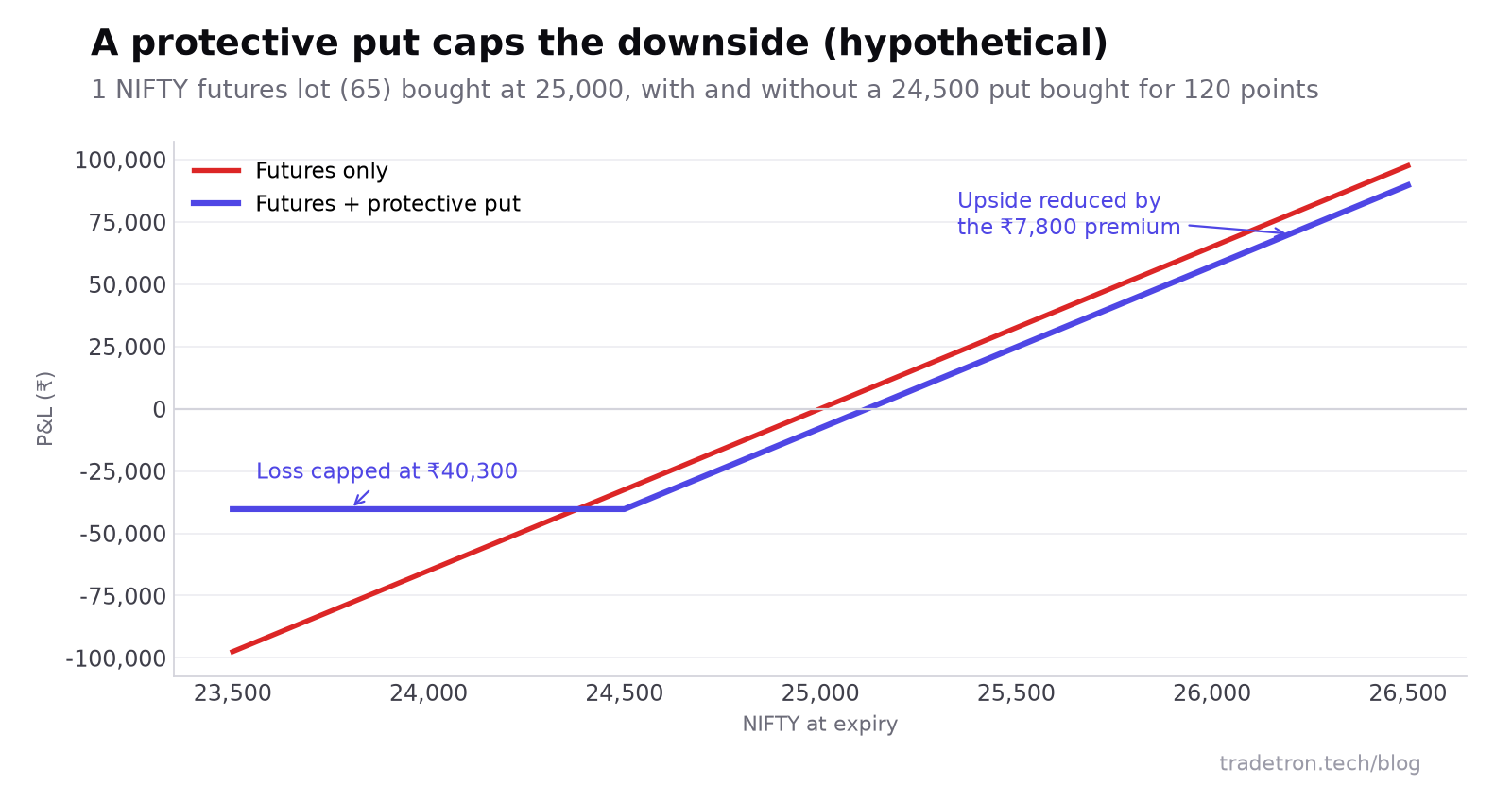 Hypothetical premium. The put caps the loss; its cost lowers the profit on every outcome
| NIFTY at expiry | Futures only | Futures + put |
|---|---|---|
| 26,000 | +₹65,000 | +₹57,200 |
| 25,000 | ₹0 | −₹7,800 |
| 24,500 | −₹32,500 | −₹40,300 |
| 23,500 | −₹97,500 | −₹40,300 |
The maximum loss with the put is (25,000 − 24,500 + 120) × 65 = ₹40,300, however far NIFTY falls. The cost is ₹7,800 off every outcome, and the position now needs NIFTY at 25,120 to break even.
2. Index hedge on a stock portfolio
You hold a stock portfolio and worry about a broad market fall, but don't want to sell your stocks. Selling NIFTY futures or buying NIFTY puts offsets part of a market-wide decline.
An index hedge only covers market risk. If one of your stocks falls on its own news while the index rises, the hedge won't help.
3. Wings on a short option position
Option sellers face the biggest open-ended risk. A short NIFTY straddle can lose without limit if the market gaps. Buying an out-of-the-money call and put turns it into an iron fly, with a fixed maximum loss. The premium you pay for the wings lowers the maximum profit; in exchange, one bad day can't do unlimited damage. The iron condor guide shows the same idea with wider strikes.
Common hedging instruments compared
| Hedge | Protects against | Cost | Watch out for |
|---|---|---|---|
| Buy put options | A fall in the underlying | The premium, paid upfront | Time decay; the put loses value daily if nothing happens |
| Sell index futures | A broad market fall | Gives up upside as well | Lot size makes small portfolios hard to hedge exactly |
| Option wings (iron fly, condor) | Big moves against short options | Lower net premium | Wings too far away protect little |
| Diversification | One stock or sector going wrong | Possibly lower returns from your best idea | Doesn't help in a market-wide crash |
The costs and limits of hedging
Pros
- Caps or reduces the worst-case loss
- Protects against gaps you can't react to
- Can lower the margin a position needs
- Makes drawdowns easier to sit through
Cons
- Always costs something: premium, or upside you give away
- Partial protection only, unless the hedge matches exactly
- Lot sizes make precise hedges hard on smaller accounts
- A badly sized hedge becomes a new bet
A hedge that "didn't pay off" in a calm month isn't a mistake, just as unused insurance isn't. The right question is whether it kept your risk inside a range you can live with.
From idea to rule: making hedging systematic
Most traders hedge inconsistently: sometimes, too late, at a random size. To hedge well, decide in advance:
- What risk you're hedging: a gap, a fall in the index, a big move against short options.
- Which instrument: puts, futures or wings.
- When the hedge goes on: always, at entry; or when a condition is met, such as NIFTY moving 1% from where you entered.
- How big it is: matched to the exposure, rounded to whole lots.
- When it comes off: when the main position closes, at a time, or when the risk has passed.
- How much you'll spend on hedging over a month, as a share of expected profit.
How to automate hedges on Tradetron
On Tradetron each of those decisions becomes part of the strategy:
- Permanent hedges: add the hedge legs to the same entry as the main position, for example buy the wings and sell the straddle together. Brokers often give a margin benefit when the hedge is in place first; see using margin benefit on Tradetron.
- Conditional hedges: use a Repair condition to add a hedge when something happens, such as the underlying moving a set distance from your entry, or the strategy's P&L falling past a level. Repair Once and Repair Continuous explains the difference.
- Exits: close everything together with a Universal Exit, so the hedge never stays on after the main position has gone (or the other way round).
- Test it: backtest the hedged and unhedged versions over the same period and compare drawdown and profit after costs.
For more ways to protect a strategy, see risk management in algo trading and the NIFTY option hedging strategy guide.
Frequently asked questions
What is hedging in simple words?
Hedging is taking an extra position that gains when your main position loses, so a bad move hurts less. It is like buying insurance: it costs something, and it limits the damage if things go wrong.
What is an example of hedging in the stock market?
Buying a NIFTY put option while holding NIFTY futures or a stock portfolio. If the market falls, the put gains value and offsets part of the loss.
Does hedging eliminate risk?
No. It reduces specific risks, usually at a cost, and can introduce new ones such as a hedge that's the wrong size or doesn't match the position. An index hedge, for example, doesn't protect against one stock falling on its own news.
Is hedging the same as diversification?
They're related but different. Diversification spreads money across positions that don't move together. Hedging adds a position designed to move against a specific risk you hold.
Does hedging reduce margin in F&O?
Often, yes. Hedged option positions such as spreads, iron condors or iron flies usually need less margin than the same short options without protection, because the maximum loss is limited. Check with your broker for the exact figure.
Can I automate hedging?
Yes. On Tradetron you can put hedge legs in the same entry as the main position, add hedges conditionally with Repair conditions, and close everything together with a Universal Exit, all without code.