How to Create an Algo Trading Platform: Build It or White Label It
To create an algo trading platform, you need six parts working together: a strategy builder, a backtesting engine, live market data, an order manager connected to brokers, risk controls, and a user layer with billing and admin. You can build them yourself, which takes a large team and a long time, or launch a white label platform under your own brand.
What is an algo trading platform?
An algo trading platform is software that lets users write trading rules, test them on historical data and run them automatically in the live market. Instead of a trader watching a chart and placing orders, the platform checks the conditions on every price update and sends the order when they are met.
A good platform does three jobs: it makes strategies easy to build, honest to test, and safe to run.
How the pieces fit together
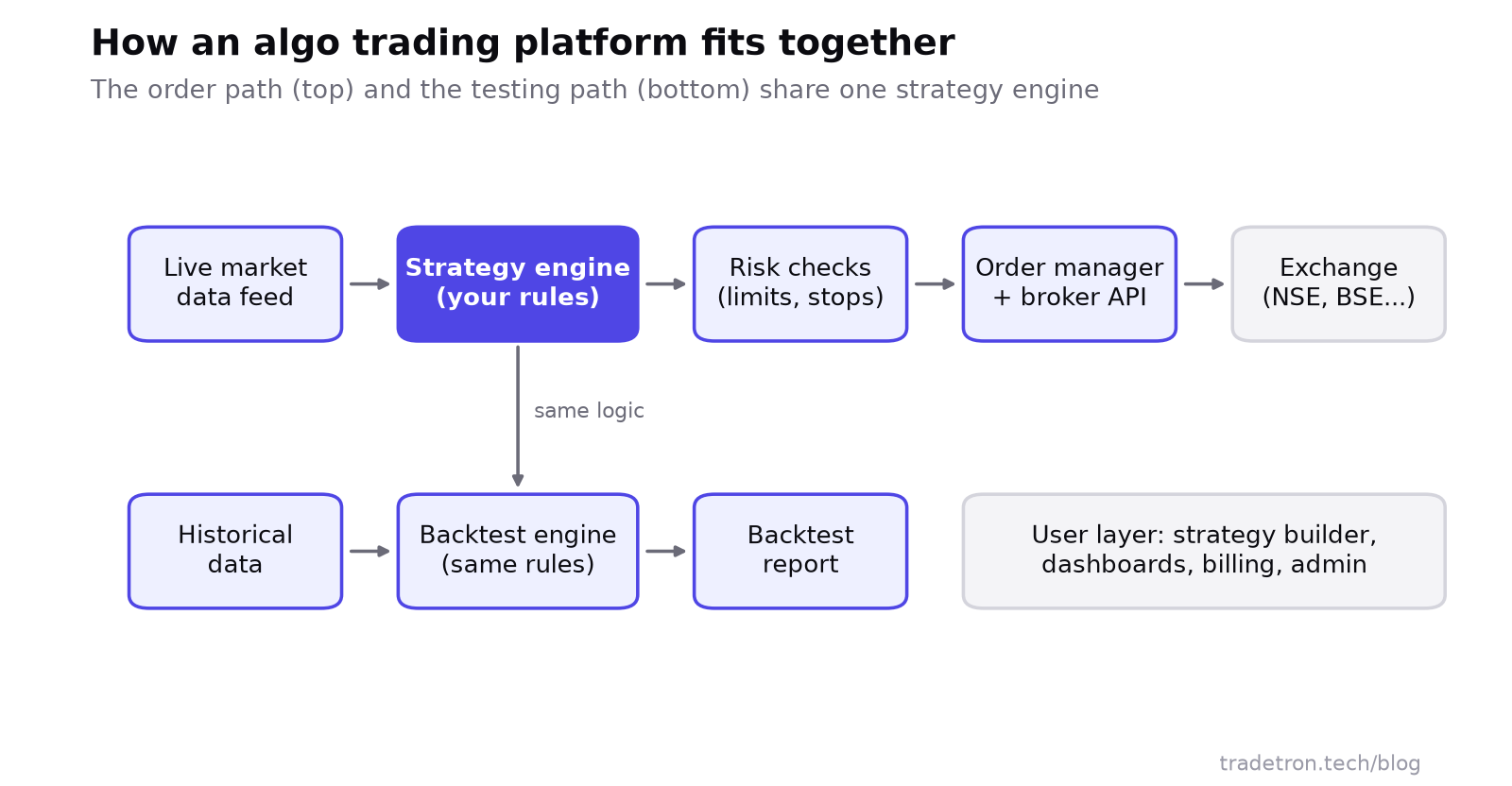 The order path and the testing path share one strategy engine
The key components
1. Strategy builder
Where users define rules: entry conditions, exits, stop-losses, position size. A no-code builder with dropdowns and keywords opens the platform to traders who don't program; a code option serves those who do.
2. Backtesting engine
Runs a strategy on historical data and reports what would have happened: trades, profit and loss, drawdown. It must use the same rule logic as the live engine. If the two differ, users trust results that live trading never repeats.
3. Market data
Live prices for running strategies and clean historical data for backtests. Data errors are strategy errors: a bad tick can trigger a real order.
4. Order management and broker connections
Turns a strategy signal into an order at the user's broker, tracks fills, handles rejections and partial fills, and keeps positions in sync. Each broker's API is different, and every one of them changes over time.
5. Risk controls
Limits that sit between the strategy and the order: maximum quantity, maximum loss per day, stop-losses that always fire, and a way to stop everything at once.
6. User layer
Dashboards, reports, notifications, subscription plans, payments and an admin panel. This is what your clients actually see.
7. Security and compliance
Encryption, secure storage of broker credentials, audit logs, and the controls needed under SEBI's rules for retail algo trading.
Build in-house or white label?
| Build in-house | White label | |
|---|---|---|
| Time to launch | Many months, often more than a year | Weeks |
| Team | Developers, DevOps, QA, security, data | Product owner, sales, support |
| Broker integrations | You build and maintain each one | Provided |
| Backtesting and data | You source data and build the engine | Provided |
| Control | Complete | Within the provider's features |
| Ongoing cost | Salaries and infrastructure, forever | Platform fees |
Build if technology is your core business, you need something no provider offers, and you can fund a team for years.
White label if your strength is clients, research or distribution, and you want to offer algo trading under your own brand without becoming a software company.
Why offer trading under your own brand
- Loyalty. Clients who use your platform every day see your name, not a third party's.
- A new revenue line. Strategies, subscriptions and services on top of your existing business.
- Control of the experience. You choose which strategies, markets and plans clients see.
- Differentiation. In a market where brokerage is a race to zero, a branded algo platform gives clients a reason to stay.
What makes a good online trading platform
Whether you build or buy, clients judge the platform on the same things:
| What keeps clients | What drives them away |
|---|---|
| Easy enough for a beginner to build a first strategy | Feature overload that confuses new users |
| Backtests that match live behaviour | Backtests that look better than live results |
| Stops and limits that always fire | Downtime during market hours |
| Fast, responsive support on market days | Hidden costs and unclear plans |
The most damaging item in the right-hand column is the second: a platform whose backtests flatter strategies loses clients' trust the first month they trade live.
Steps to launch an algo platform
- Define who it's for. Retail traders, your existing broking clients, or strategy creators? Which markets?
- Choose build or white label. Use the table above, and be honest about your team and budget.
- Set up brokers and data. Make sure your clients' brokers are supported.
- Design plans and pricing. Decide what is free, what is paid and how you'll collect payments.
- Load strategies. Build, backtest and test the strategies you'll offer before any client sees them.
- Pilot in a test mode. Run with a small group and simulated execution first.
- Launch, support and iterate. Watch support tickets and usage closely in the first months.
More for platform owners: white label trading platforms for sub-brokers, offering basket trading on your own algo platform and offering quantitative trading on a white label platform.
Frequently asked questions
What is an algo trading platform?
It is software that lets users write trading rules, test them on historical data and run them automatically, sending orders to a broker when the rules' conditions are met.
How do I start building an algo platform?
Start by defining your users and markets, then decide whether to build or white label. If you build, the core parts are a strategy builder, a backtest engine, market data, broker integrations, risk controls and a user layer. If you white label, focus on branding, pricing, strategies and support.
Why is backtesting essential in an algo platform?
It shows how a strategy's rules would have behaved on past data before real money is at risk. It is only useful if the backtest engine runs exactly the same logic as live trading.
What is white label stock trading?
It is offering trading or algo trading to clients under your own brand, using a platform built and run by a technology provider. Clients see your name; the provider runs the technology.
Can I offer automated strategies to my clients on a white label platform?
Yes. On Tradetron's white label, you can build and backtest strategies and make them available to your clients, who run them through their own connected brokers. Check the SEBI rules that apply to offering algos to retail clients first.
What security does an algo platform need?
Encrypted connections, secure storage of broker credentials, two-factor login, audit logs of every order, and regular security reviews. Clients' money stays with their broker, so protecting the broker connection is the priority.