SEBI Algo Trading Rules in India: What Retail Traders Must Know
SEBI's algo trading rules let retail traders in India automate their trading through their broker's API, with conditions. Every algo order is tagged with an exchange-issued identifier, brokers are responsible for every algo they allow, algo providers must be empanelled with the exchanges, and algos that place orders above the exchange's speed threshold must be registered.
Why SEBI wrote new rules for algo trading
Algo trading in India started with institutions: SEBI allowed direct market access in 2008, and automated strategies followed. Retail traders arrived much later, mostly through broker APIs and third-party platforms. Before 2025, that retail side had gaps:
- Platforms could sell strategies to the public with no regulator knowing who built them.
- Orders from an algorithm looked the same at the exchange as orders typed by hand.
- Open APIs could be used by anyone holding a login, which made misuse hard to trace.
- If an algorithm misbehaved, it was not always clear who was responsible.
The 2025 framework closes those gaps without banning retail automation. It is about traceability and accountability, not about who is allowed to automate.
The main rules, one by one
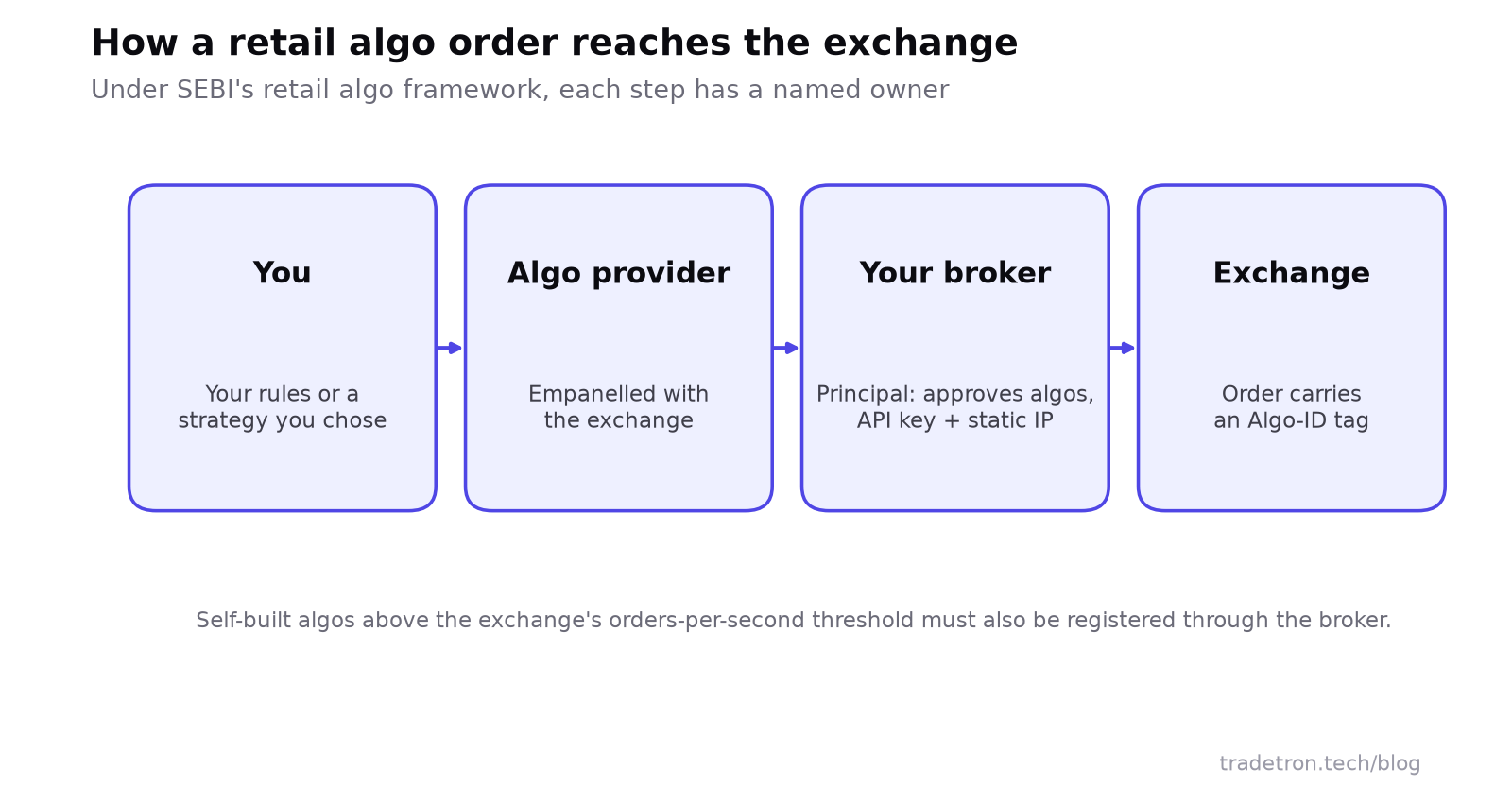 Each step in the chain has an owner under SEBI's framework
1. Retail algo trading through APIs is formally allowed
Retail traders can automate through their broker's API. What changed is how that access works: no more open APIs. Access goes through a key issued for you, used from a static IP address that your broker has whitelisted, with login controls such as two-factor authentication.
2. Brokers are responsible for every algo
The broker is the "principal". It must get exchange approval for the algos it offers, monitor what runs through its systems, and handle complaints about algo trading from its clients. If a provider's algo misbehaves, the broker is accountable to the exchange and SEBI.
3. Algo providers must be empanelled with the exchanges
Third-party algo providers act as the broker's "agents" and must be empanelled with the exchange before brokers can work with them. Empanelment is with NSE or BSE, not a SEBI licence for the software.
4. Every algo order carries an Algo-ID
Each algorithm gets a unique identifier from the exchange, and every order it sends carries that tag. If a strategy floods the market or behaves strangely, the exchange can see exactly which algo, broker and client it came from, and can stop it.
5. Self-built algos: register only above the speed threshold
If you write your own algo, you don't need to register it as long as it stays below the order-per-second threshold set by the exchange (NSE set it at 10 orders per second). Your orders are still tagged. Above the threshold, the algo must be registered with the exchange through your broker. SEBI also limited self-built algos to your own account and your immediate family's.
6. White box vs black box
| White box | Black box | |
|---|---|---|
| What you see | The full logic: entry, exit, stops | Only the results; the logic is hidden |
| Who can offer it | An empanelled algo provider | Only a SEBI-registered Research Analyst |
| Extra duty | Logic must be disclosed and reproducible | A research report for each algo, and fresh registration if the logic changes |
A no-code builder where you write and see every rule yourself is the white-box case.
What the rules mean for you
If you trade with your own rules
Nothing changes in how you build a strategy. Connect your broker through the platform's official integration, make sure your static IP is set up the way your broker requires, and keep your order rate well below the threshold. Almost every rule-based retail strategy (option selling, breakouts, moving-average systems) places a handful of orders a minute, not ten a second.
If you subscribe to someone else's strategy
Check who stands behind it. Ask whether the provider is empanelled with the exchange, and if the logic is hidden, for their SEBI Research Analyst registration number. A seller who can't answer either question is a red flag under the current rules.
If you are a broker or sub-broker
You now carry responsibility for every algo on your platform: approvals, monitoring, grievances and the provider's due diligence. Many brokers meet this by partnering with an empanelled platform rather than building their own.
When the rules took effect
SEBI issued the circular on 4 February 2025 and set an initial start date of 1 August 2025. The start was then pushed back and phased in through late 2025 and early 2026, with brokers registering their algo products and running mock sessions with the exchanges. The framework applies in full from 1 April 2026. For the phase-by-phase timeline and what the Algo-ID means for your orders, read SEBI's Algo-ID mandate is now live.
Did the rules make algo trading harder?
For most retail traders, no. The day-to-day work (writing rules, testing, deploying) is the same. What changed is behind the scenes: tagged orders, whitelisted access, named responsibility. The rules mostly hurt sellers of unaccountable "black box" strategies, which is what they were meant to do.
They also don't change the economics. Regulation makes the market safer to automate in; it doesn't make a strategy profitable. We cover that question honestly in is algo trading profitable in India?
For the wider legal picture, read is algo trading legal in India?
Frequently asked questions
What are SEBI's algo trading rules for retail traders?
Retail traders can automate through their broker's API. Every algo order carries an exchange-issued Algo-ID, access is through a client-specific key from a whitelisted static IP, brokers are responsible for the algos they allow, and algo providers must be empanelled with the exchange.
Do retail traders need to register their algos?
Not if they built the algo themselves and it stays below the exchange's orders-per-second threshold (10 per second on NSE). Above that threshold, the algo must be registered with the exchange through the broker.
Can I sell my algo trading strategy to others?
Only through the regulated route: as or through an exchange-empanelled algo provider working with a broker. If you want to keep the logic hidden (a black box), you also need SEBI Research Analyst registration.
What is the difference between white-box and black-box algos?
A white-box algo discloses its full logic to the user. A black-box algo hides it. Under SEBI's framework, black-box algos can only be offered by SEBI-registered Research Analysts, who must keep a research report for each one.
Do I need a static IP for algo trading?
API-based algo access now has to come from a static IP whitelisted by your broker. How this works depends on your broker and platform, so check your broker's setup instructions.
When did SEBI's algo trading rules come into force?
SEBI issued the circular on 4 February 2025. After a phased roll-out through late 2025 and early 2026, the framework applies in full from 1 April 2026.
Is algo trading still legal in India?
Yes. The framework adds tagging and accountability; it does not ban retail algo trading.