How to Scale a Trading Business Without Losing Control of It
To scale a trading business without losing control of it, grow your process before your capital: standardise risk rules across every strategy, add a portfolio-level loss limit, monitor everything in one place, automate the repetitive execution work, and validate each new strategy before it joins the live book. Scaling means running more strategies and markets without a matching rise in manual effort or uncontrolled risk.
None of this promises profit. Scaling increases both opportunity and exposure, and automation reduces manual error without removing market risk.
What does it mean to scale a trading business?
Scaling a trading business means increasing the number of strategies, markets or capital you actively trade without a proportional increase in manual effort or uncontrolled risk.
Compare two traders:
| Trader A: "bigger" | Trader B: "scaled" | |
|---|---|---|
| Approach | Doubles capital in one strategy | Runs five strategies across setups and timeframes |
| Risk | All in one idea | Spread across several, with shared limits |
| If the strategy has a bad month | The whole business has a bad month | One part of the book has a bad month |
| Workflow | Same as before, higher stakes | Repeatable, monitored, reviewed |
Trader A has grown exposure. Trader B has grown an operation.
Why manual trading hits a ceiling
Manual trading works at small scale because one person can hold the whole picture in their head. As you add strategies, that breaks:
- Attention doesn't scale linearly. Two strategies are more than twice the work, because you also track how they interact: overlapping margin, correlated risk, conflicting signals.
- Execution slips under load. The same trader who runs one setup precisely makes more entry and exit errors juggling several in a fast session.
- Discipline gets harder. Staying calm across five open positions in a drawdown is harder than across one.
- Reviews get skipped. The post-trade review is usually the first thing dropped, and it's the habit that prevents repeated mistakes.
Hitting this ceiling, not running out of ideas, is usually the real trigger to change how you trade.
The real challenges of scaling
- Diversification without sprawl. More strategies should reduce concentration, not create a list nobody reviews.
- Consistent risk rules. A stop-loss on one strategy is easy. A drawdown limit across ten independently designed strategies is not.
- More brokers, instruments and rules. Adding index options to equities means new margin rules, expiries and order types.
- Market-structure changes. Exchanges revise contracts. NIFTY's lot size is now 65 and BANK NIFTY's 30, NSE's weekly NIFTY expiry is on Tuesday, and BANK NIFTY has monthly expiries only. Each change has to be checked across every strategy that touches those contracts. See what to check after the lot-size change.
- Data without decisions. More strategies mean more P&L lines, logs and alerts. They help only if there's a routine that turns them into decisions.
Managing multiple strategies without multiplying your workload
- Centralise monitoring. One place to see every strategy's status, exposure and recent results.
- Standardise before you diversify. Use common conventions for stop-losses, position sizing and exits, even when strategies differ.
- Separate research from operations. Building and refining is research. Running live is operations. Constantly tweaking live strategies is a common source of inconsistent results.
- Review at the portfolio level. A strategy can look fine alone and still be a problem if it loses on the same days as three others.
Risk management: the part most traders scale too slowly
Risk rules have to grow with your strategy count, not after it.
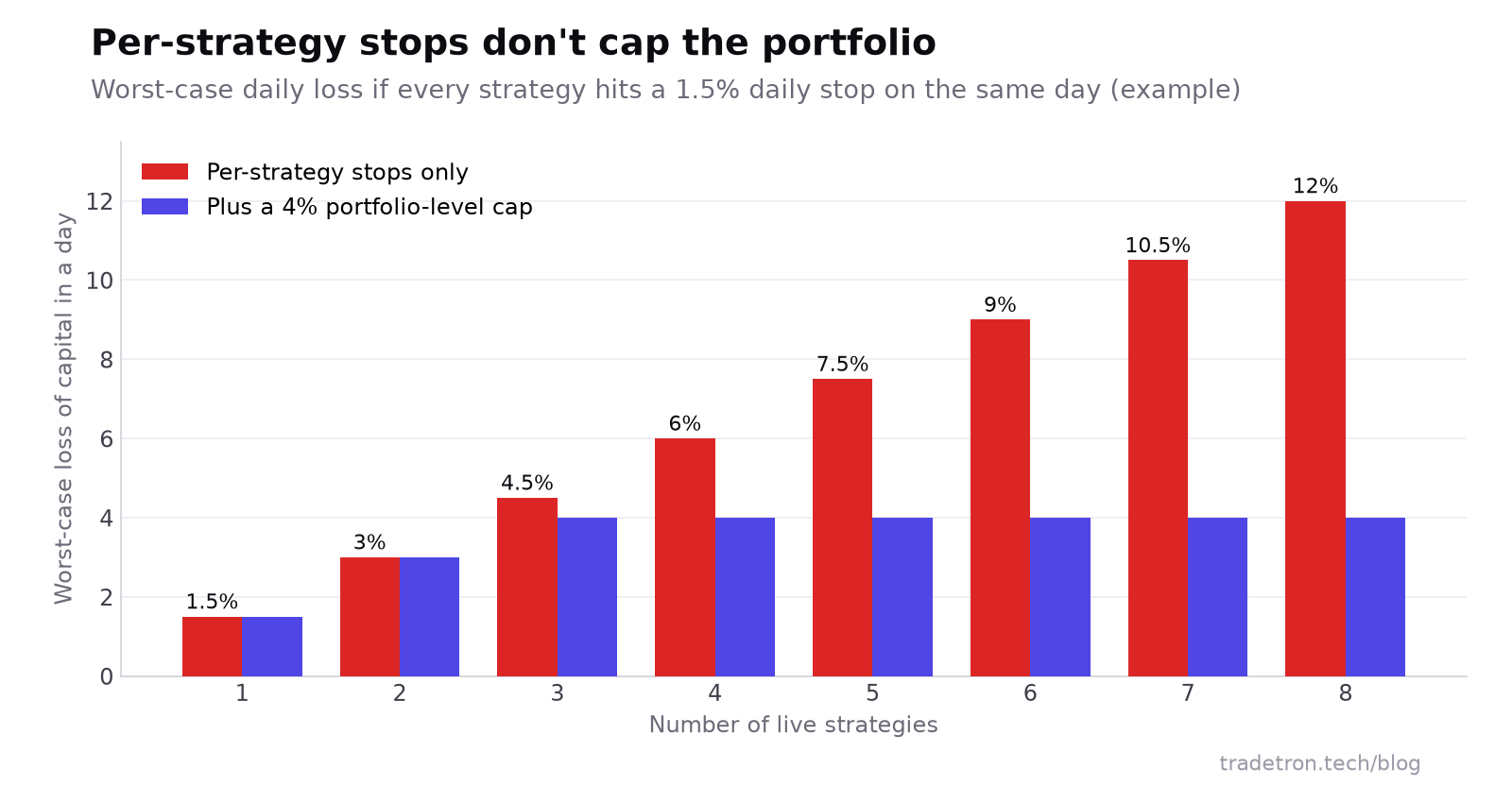 If each strategy can lose 1.5% of total capital in a day, the worst case grows with every strategy you add, unless there is a portfolio-level cap (example)
- Portfolio-level loss limits, not just per-trade stops, so several strategies losing on the same day can't exceed a set maximum.
- Correlation awareness. Strategies that look unrelated can move together in a volatility spike. Check how they behaved on the market's worst days.
- Capital allocation discipline. Decide each strategy's allocation in advance; don't let it drift towards whatever did well last month.
- Kill-switch logic. A predefined point at which a strategy stops automatically, rather than relying on someone noticing.
For context on why this matters: SEBI's study of FY25 found that about 91% of individual F&O traders made a net loss. Scaling activity without scaling risk discipline doesn't avoid that outcome; it can reach it faster, across more positions at once. For techniques, see reducing drawdown: seven risk-management techniques.
Technology: what changes as you scale
- Broker coverage. Running strategies across markets needs infrastructure that can connect to more than one broker without re-entering trades by hand.
- Backtesting before capital. Every new strategy gets tested on historical data first. Scaling never means skipping validation.
- A test run alongside the live book. Before a strategy joins the portfolio, run it on live prices without real orders and check it behaves as expected.
- Alerts. You need to be told what needs attention, not check everything yourself.
- No-code building. If you're scaling strategy count rather than complexity, building without custom development for each one cuts the time from idea to test.
When should you automate part of your trading?
When manual execution has become the actual constraint, and not before. Signals:
- You miss entries or exits because you can't watch several setups at once.
- You have a validated strategy, and the barrier to running it is execution capacity, not conviction.
- Risk rules are applied inconsistently because there's too much to track.
- You want to test a new strategy without disrupting your existing routine.
Common mistakes when scaling
Do
- Add strategies only as fast as you can monitor them
- Validate every new strategy on its own
- Size each strategy by its own risk profile
- Review automated strategies on a schedule
- Prove the process before adding capital
Don't
- Skip testing because the existing book is doing well
- Copy position sizes across dissimilar strategies
- Ignore correlation until a shared drawdown exposes it
- Treat automation as "set and forget"
- Scale capital on an unproven workflow
A practical framework for scaling
- Audit your current operation. List every strategy, its risk parameters and the manual effort it takes.
- Standardise risk rules before adding strategies: stop-loss logic, sizing and portfolio-level limits.
- Validate every new strategy independently: backtest, then a test run on live prices.
- Centralise monitoring, with alerts for what needs attention.
- Automate the repetitive execution layer, not the judgment layer.
- Review the portfolio on a fixed schedule for correlation, drawdown concentration and allocation drift.
- Scale capital last, once the process has proven it can handle the added complexity.
Frequently asked questions
What does it mean to scale a trading business?
It means increasing the strategies, markets or capital you trade without a proportional rise in manual effort or uncontrolled risk. It's a shift from managing individual trades to managing a coordinated operation.
Can trading strategies be automated?
Yes. Rule-based strategies with clear entry, exit and risk conditions can be automated on platforms that support building, backtesting and live execution. Automation executes the strategy consistently; it doesn't create an edge.
Is algorithmic trading scalable for retail traders?
It can be, within the limits of the trader's broker, capital and risk framework. No-code platforms lower the technical barrier, but scalability still depends on sound risk management and realistic sizing.
How can automation help manage multiple strategies?
It removes the manual execution and monitoring load of running several strategies and applies rules consistently. It still needs central oversight, because strategies can behave unexpectedly when markets change.
What are the risks of scaling a trading operation?
Correlated losses across strategies that looked independent, inconsistent risk rules, technical or execution failures, and increasing capital before the process is proven.
Can automated trading eliminate manual intervention completely?
No. Automation handles routine execution, but strategies still need periodic human review, risk oversight and adjustment as markets change.
This article is for education only and is not investment advice. Algorithmic and options trading involve substantial risk, including loss of capital.