Best Paper Trading Platform in India: How to Choose One

The best paper trading platform in India is the one that tests your trades the way they will really run: live NSE and BSE prices, F&O contracts with current lot sizes, realistic fills and costs, a record of every trade, and a clean switch to real orders. On Tradetron, that test mode is called Live Offline: the strategy runs and records every trade, but nothing is sent to the exchange.

What is paper trading?
Paper trading is practice trading with simulated money on real market prices. You pick instruments, place buy and sell orders, set stops and targets, and track profit and loss exactly as you would with real capital. The only difference is that no order reaches the exchange and no money changes hands.
The name comes from the days when traders wrote their trades down on paper to see how they would have done. Today it is also called virtual trading, simulated trading or demo trading. On Tradetron the mode is called Live Offline.
It sits between two other ways of checking a trading idea:
| Backtesting | Paper trading (Live Offline) | Live trading | |
|---|---|---|---|
| Prices used | Historical data | Today's live prices | Today's live prices |
| Money at risk | None | None | Real capital |
| Speed | Years of data in minutes | Real time, one day at a time | Real time |
| What it answers | Would these rules have worked before? | Do the rules behave as intended right now? | Does it work with real fills, costs and nerves? |
| Biggest blind spot | Hindsight and overfitting | Real fills, costs, emotions | None: every mistake costs money |
A sensible path uses all three in order: backtest the idea on years of data, run it Live Offline for a few weeks, then trade it live at the smallest size.
Why paper trade before risking real money?
Most beginners don't lose money because they never read about markets. They lose it on mistakes that only show up in practice: an order for the wrong strike, a stop that was never placed, a position sized ten times too big. Paper trading lets you make those mistakes when they are free.
Pros
- No capital at risk while you learn how orders, lots, margins and expiries work
- Tests a strategy on live prices, which a backtest can't do
- Shows how often the rules trigger, at what times, and how they act on news days
- Builds the habit of following a plan and keeping a record of every trade
- Lets experienced traders try a new market or a new strategy without disrupting the one they already run
Cons
- No real fills, so slippage on fast or illiquid contracts is hidden
- Many simulators ignore brokerage, taxes and exchange charges
- No real fear or greed, so you may take risks you would never take with your own money
- A good simulated month can create false confidence
The last point is the one to watch. When the money isn't real, it is easy to double a losing position to "win it back" or ignore a stop because nothing hurts. If you wouldn't do it with real money, don't do it in simulation either: the habit is what you are actually practising.
What to look for in a paper trading platform in India
Simulators vary a lot. Some are little more than a game; others run your exact strategy on live data. Use this checklist when you compare them:
| What to check | Why it matters | Question to ask |
|---|---|---|
| Live data | Delayed quotes give you fills that were never possible | Are prices real time for every instrument I trade? |
| F&O coverage | Most Indian traders test options and futures, not just shares | Can I trade NIFTY, BANK NIFTY and stock options with current lot sizes and expiries? |
| Realistic fills | Filling at the last traded price flatters every trade | How does it decide the fill price for market and limit orders? |
| Costs | Brokerage, STT, exchange fees and GST can turn a small edge into a loss | Can I see or add charges to the simulated P&L? |
| Trade records | You learn from the log, not from the final P&L | Does it keep a time-stamped record of every entry, exit and reason? |
| Rules and automation | Testing a strategy means the same rules run every time | Can it run my entry, exit and stop rules on its own? |
| Path to live | Rebuilding a strategy for live trading invites new errors | Can the same setup place real orders through my broker? |
Two details catch many Indian traders out. First, lot sizes change: NIFTY is now 65 and BANK NIFTY is 30, so a simulator still using old lot sizes misstates your risk on every trade. Second, expiries changed: NIFTY 50 has a weekly expiry on Tuesday, while BANK NIFTY, FINNIFTY and MIDCPNIFTY now have monthly expiries only. A platform should reflect both.
Types of paper trading platforms in India, compared
There is no single best platform for everyone. The right choice depends on whether you trade by hand or by rules. Here is how the main types compare:
| Platform type | Best for | How trades are placed | Watch out for |
|---|---|---|---|
| Broker demo or virtual mode | Learning the order screen of the broker you will use | You click buy and sell yourself | Check whether data is live, which segments are covered, and whether charges are counted |
| Simulator apps and trading contests | Beginners learning basics, or practising for fun | You click buy and sell yourself | Leaderboards reward big risks; fills and costs are often simplified |
| Charting platforms with a simulated account | Discretionary traders who place trades from charts | You click on the chart, or set alerts | Depends on the data feed you have; usually not linked to an Indian broker's order flow |
| Algo platforms with a test execution mode, such as Tradetron | Anyone testing rule-based strategies | The strategy places simulated orders by its own rules | You need to write your rules clearly, which is also the point |
If you trade by hand and want to learn your broker's app, its own demo mode is the natural start. If you want to test a strategy, meaning a fixed set of rules, you need a platform that runs those rules for you. Testing a strategy by clicking manually is mostly a test of your concentration.
The limits of paper trading: why live results come in lower
A simulated profit is the best case, not the forecast. Three things almost always take a bite out of it in live trading:
- Charges. Brokerage, STT, exchange transaction charges, SEBI fees, stamp duty and GST apply to every real trade.
- Slippage. A real market order fills at whatever price is available, not at the last traded price. On fast moves or far out-of-the-money options, the gap can be large. See slippage in trading for how it happens.
- You. Real money makes people skip valid signals after a loss and size up after a win.
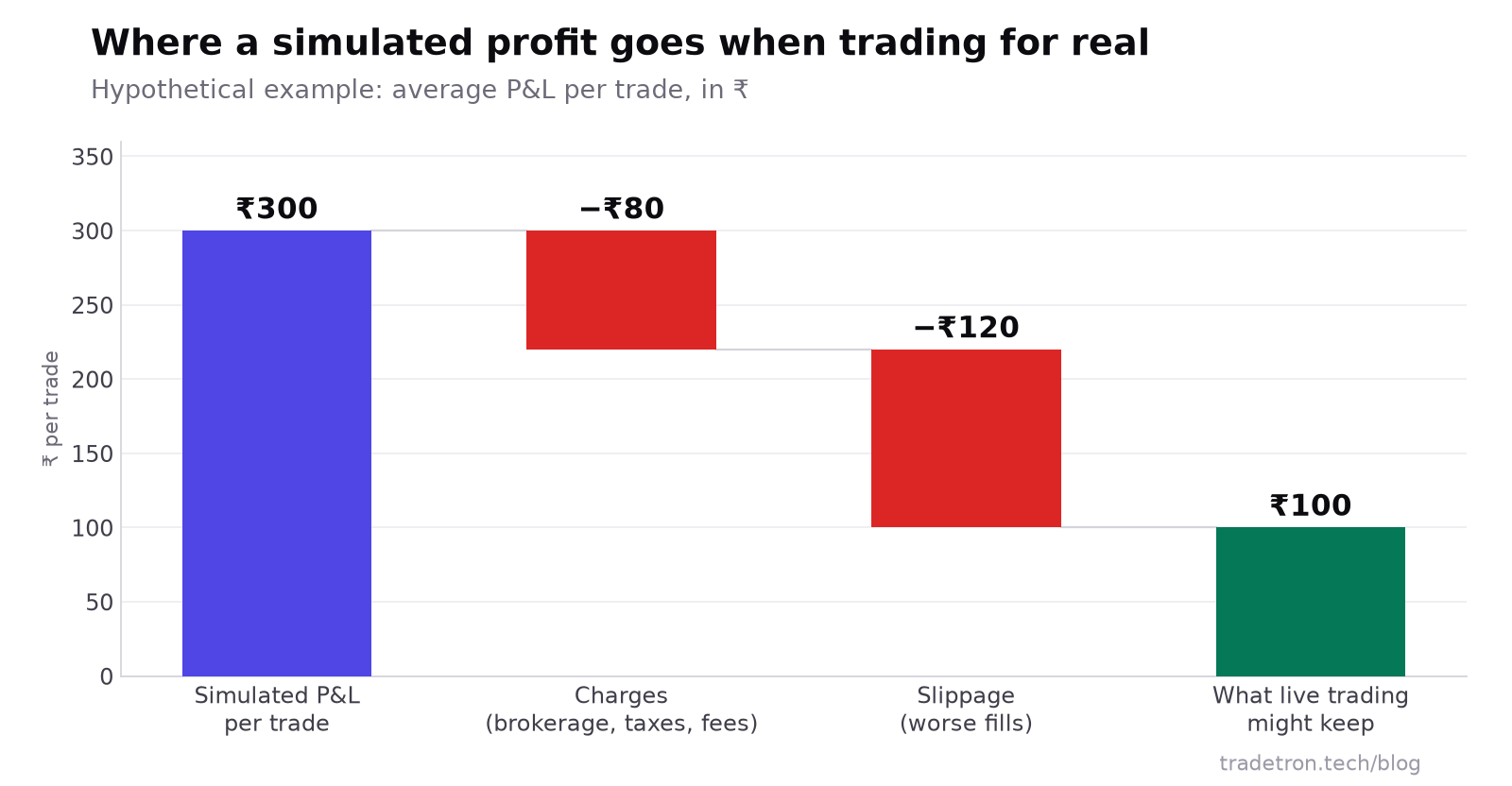 Hypothetical example: charges and slippage can take most of a small simulated edge
The numbers above are an example, not a measurement. The lesson is real: a strategy that makes only a little per trade in simulation can lose money live. The smaller the average profit per trade, the more charges and slippage matter. For the full list of gaps, read nine reasons your backtest doesn't match live trading.
How to paper trade on Tradetron with Live Offline
Tradetron is a no-code platform for building, testing and running rule-based strategies. You don't place simulated trades by hand. You write the rules once, and the platform runs them on live prices.
- Build or pick a strategy. Create one in the strategy builder (entry and exit conditions, positions, stop loss and target per leg) or choose one from the Marketplace.
- Backtest it. Run your own strategy on historical data and read the report: drawdown, number of trades and how results are spread, not just the total.
- Deploy it in Live Offline. When you deploy, choose the Live Offline execution type. The strategy runs on live prices and records every trade, but nothing is sent to the exchange.
- Watch the log, not just the P&L. Check that each entry and exit happened at the time and price your rules intended. Double entries, missed exits or stops that never armed are logic bugs, and Live Offline is where you want to find them.
- Compare with the backtest. Over the same days, are trade counts and behaviour similar? If not, find out why before going further.
Because the rules run automatically, you can test several strategies side by side, including ones that trade while you are at work.
How to move from paper trading to live trading
There is no fixed number of weeks. Move when the evidence is good enough, then start small.
- Collect enough trades. A handful of trades proves very little. An intraday strategy produces a useful sample faster than a weekly one; read why a test run can save your algo strategy for how many trades you need.
- Check that live behaviour matches the backtest. Similar trade counts, similar timing, similar size of wins and losses.
- Subtract realistic costs. Take your simulated P&L, remove charges and an allowance for slippage. If little is left, the strategy isn't ready.
- Go live at the smallest size. One lot, or the smallest quantity your rules allow. Change only the execution type, not the rules.
- Set a stop-trading rule. Decide in advance the loss at which you will pause the strategy and review it. Write it down.
- Scale up slowly. Increase size only after live results look like the test results over a meaningful number of trades.
Common paper trading mistakes
- Using unrealistic capital. Trading a simulated ₹1 crore when you will trade ₹2 lakh teaches the wrong position sizes.
- Ignoring costs. Always look at P&L after charges, especially for strategies that trade often.
- Taking risks you would never take live. Averaging down without limit or skipping stops builds habits you will carry over.
- Tweaking after every trade. Changing rules daily to make the simulated P&L look good is overfitting in slow motion.
- Staying in simulation forever. At some point the only remaining test is a small live one. Paper trading prepares you for it; it doesn't replace it.
For more on protecting capital once you are live, read seven ways to reduce drawdown.
Frequently asked questions
Which is the best paper trading platform in India?
It depends on how you trade. To learn a broker's order screen, use that broker's demo mode. To test rule-based strategies on live prices, use a platform that runs your rules automatically, such as Tradetron's Live Offline mode, which records every trade without sending anything to the exchange.
What is paper trading in the stock market?
It is practice trading on live market prices with simulated money. You place orders, set stops and track P&L as usual, but no order reaches the exchange and no real money is used.
Is paper trading legal in India?
Yes. Paper trading is a simulation: no order is placed on the exchange and no money changes hands, so it is simply practice on market data.
Can I paper trade options and futures in India?
Yes, on platforms that cover F&O. Check that the simulator uses current lot sizes (NIFTY 65, BANK NIFTY 30) and current expiries. Our guide to paper trading options covers what to test.
How long should I paper trade before going live?
Until you have enough trades to judge the strategy and its live behaviour matches your backtest. For an intraday strategy that may be a few weeks; for a slow positional one it can take months. Then go live at the smallest size.
What is Live Offline on Tradetron?
Live Offline is Tradetron's test execution mode. The strategy runs on live market prices and records every trade, but nothing is sent to the exchange. When you are ready, you deploy the same strategy in Live Auto, which places real orders through your broker.
Does paper trading profit mean I will make money live?
No. Paper trading leaves out slippage, real charges and the pressure of real money, so live results are usually lower. Treat a simulated profit as the best case and test small before scaling up.