How to Add a Trailing Stop Loss to a Short Strangle Automatically
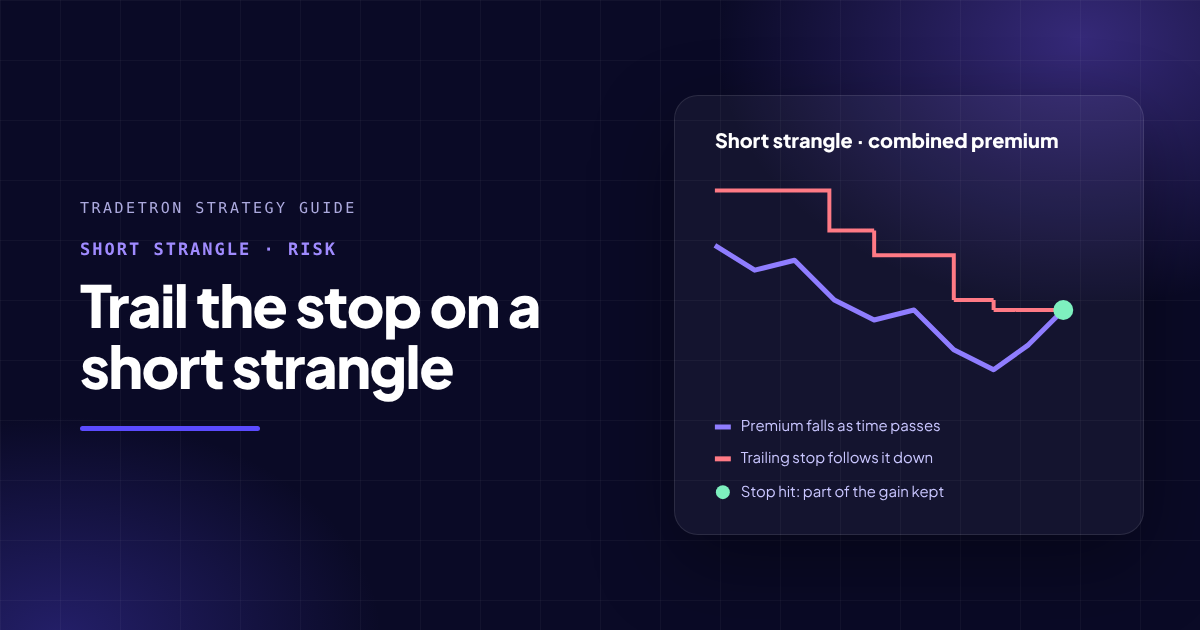
A short strangle sells an out-of-the-money call and put. As time passes and the premium falls, a fixed stop loss stays where it was, so a late reversal can take back most of the day's gain. A trailing stop moves with the trade and locks part of that gain in.
Here are three common ways to trail a strangle, and how to set them up so they run by themselves.
Way 1: Trail each leg
Each leg has its own stop that moves down as that leg's premium falls.
Example: you sell a call at ₹100 with a stop at ₹130. For every ₹10 the premium falls, the stop moves down ₹10. If the call drops to ₹60, the stop is now at ₹90.
Good for: reacting quickly when one side is tested.
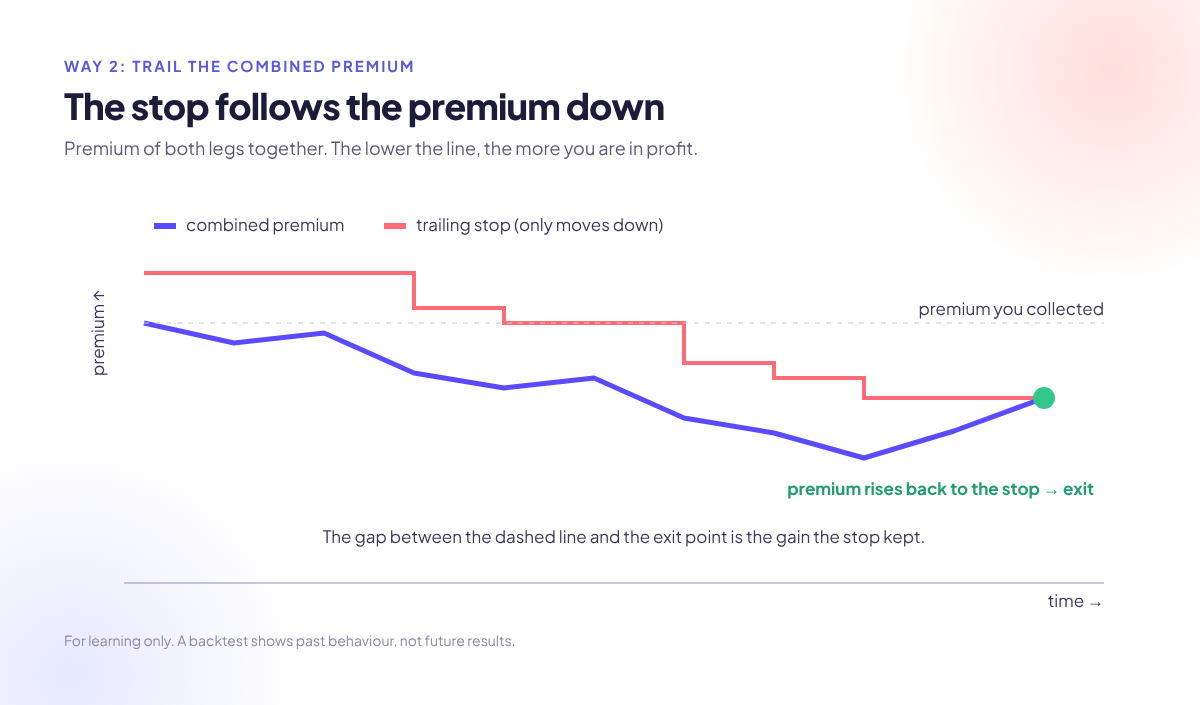
Way 2: Trail the combined premium
The stop watches the total premium of both legs together.
Example: you collect ₹200 in total with a stop at ₹260. As the total falls, the stop follows it down by the same amount.
Good for: avoiding being stopped out of one leg just before the market turns back.
Way 3: Lock in profit after a level
Nothing moves until the position reaches a set profit. After that, the stop is placed to protect part of it, then trails.
Example: once the profit reaches ₹3,000, set the stop to keep at least ₹1,500, then trail by ₹500 steps.
Good for: letting the trade breathe early and protecting gains later in the day.
How to set it up without code
- On Tradetron, build the strangle in the Option Wizard: sell 1 OTM call and 1 OTM put on Nifty, choosing strikes by distance or premium.
- Set the entry and exit times.
- In the exit settings, add the stop loss, then turn on the trailing stop and choose how far and in what steps it moves. Pick per leg or combined.
- For lock-in-profit rules, add the profit level and the amount to protect.
- Backtest on 1-minute data and compare all three ways over the same period.
What to look for in the backtest
- Worst days, not the total. Trailing stops change how bad the bad days are.
- How often you are stopped out early. A tight trail can turn many winning days into small ones.
- Gap openings. A stop cannot protect you from a price that jumps past it.
A backtest shows how rules behaved on past data. It is not a forecast.
Frequently asked questions
Can I add a trailing stop to a short strangle automatically?
Yes. On Tradetron you set the trailing stop in the strategy's exit settings, per leg or on the combined premium, and it moves on its own while the strategy runs.
Is it better to trail per leg or on the combined premium?
It depends on the market. Per-leg trailing reacts faster; combined trailing gets stopped out less often. Backtest both on the same period and compare the worst days.
Does a trailing stop mean I always exit in profit?
No. It can still be hit at a loss, and a sudden gap can fill beyond the stop price.
Can I test trailing stops without placing real orders?
Yes. Run the strategy in Live Offline. It follows live prices and records each trade and stop without sending orders to your broker.