Theta Gainers Delta Neutral Intraday Algo Strategy: Full Build

The Theta Gainers delta-neutral intraday strategy sells an out-of-the-money call and put every day at 9:22, then keeps the position balanced through the day: whenever one leg's premium rises 30%, it closes the other leg and re-sells it at a strike priced like the rising one. There is no fixed target or stop on the legs; the adjustments and a universal exit do the risk work.

The idea behind the strategy
The Theta Gainers YouTube channel demonstrated this as an intraday option-selling strategy. Selling a call and a put collects premium that decays through the day. The danger is a one-way move: one leg's premium balloons while the other shrinks, and the position stops being neutral.
Instead of a fixed stop loss, the strategy rebalances. It takes profit on the leg that is working and re-sells it closer to the market, so both legs carry similar premiums again. Similar premiums usually mean similar deltas of opposite sign, which is what "delta neutral" means here: the position is roughly insensitive to small moves in either direction.
The rules
One adjustment, step by step
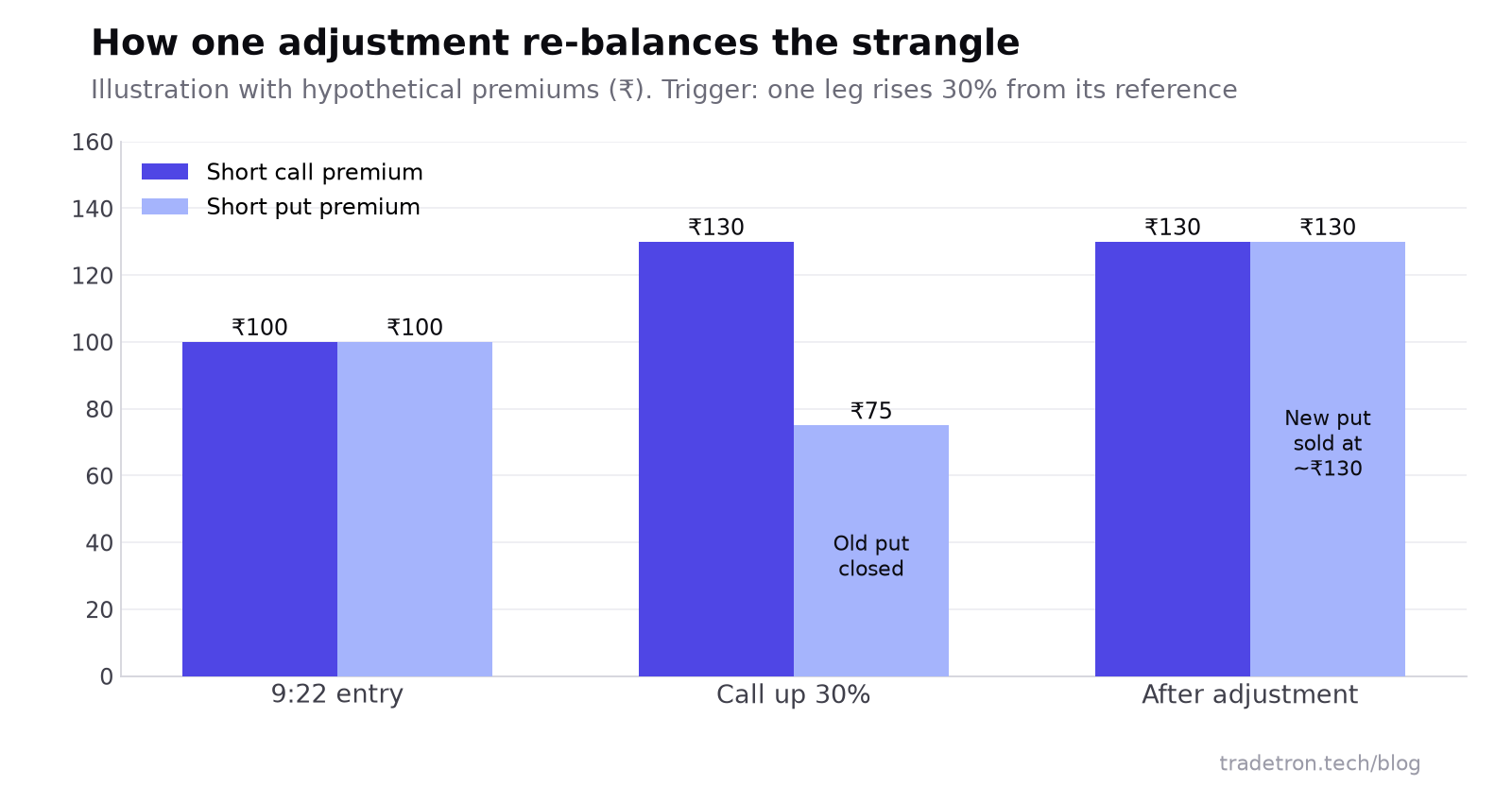 One adjustment cycle with hypothetical premiums
If the rally continues, the same thing happens again, each time banking the profitable side and moving it closer. If the market reverses, the new put becomes the rising leg and the call is the one that gets rolled.
How the build works on Tradetron
The strategy is a good example of three Tradetron building blocks working together.
1. A clean entry
The entry condition is two checks joined with AND: Time ≥ 922, and Positions Detail showing zero open quantity, so the strategy can't enter twice.
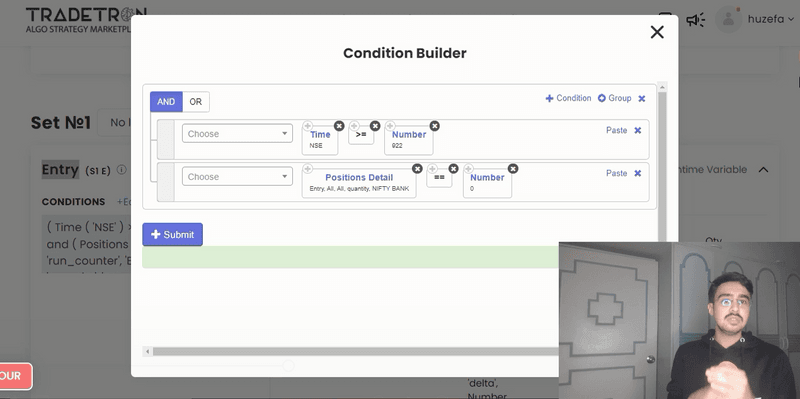 Entry condition: time is 9:22 or later and there is no open position
2. Runtime variables as memory
An adjustment rule like "the call is up 30%" needs to know the call's reference price, and after the first roll, which instrument is now the call. Runtime variables store this:
| Variable | Holds | Filled from |
|---|---|---|
| ce_ins / pe_ins | The call's / put's instrument name | Traded Instrument Name |
| ce_strike / pe_strike | Their strikes | Traded Instrument (Field: strike) |
| ce_price / pe_price | Their reference prices | Traded Instrument (Field: price) |
Every time a leg is replaced, the variables are updated, so the next 30% check measures from the new leg's price.
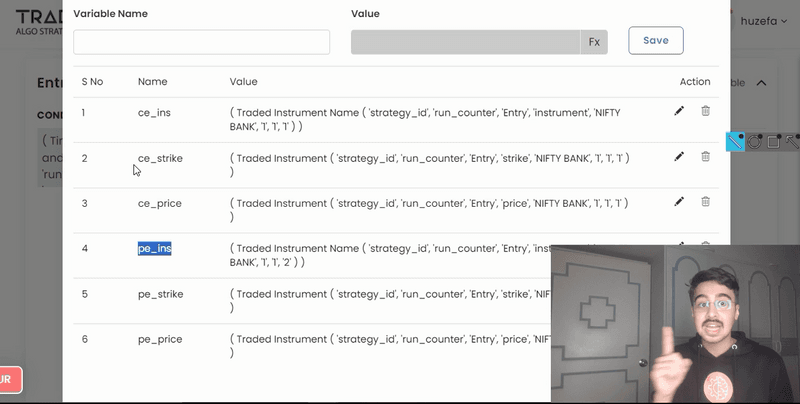 Runtime variables that track each leg
3. Repairs that roll the legs
The adjustments are Repair conditions: "LTP of ce_ins ≥ ce_price × 1.3" fires the put-side roll, and the mirror condition fires the call-side roll. The repair's positions square off the profitable leg and open a new one at a strike chosen by premium, close to the rising leg's current price. Because the condition can fire again and again through the day, it is a Repair Continuous, not a Repair Once. See Repair Once and Repair Continuous for the difference.
4. Universal exit and advanced settings
A Universal Exit closes everything at a set time before the market closes, or earlier if the strategy's total P&L crosses your loss or profit limit. In Advanced Settings you can set limit orders, and break large orders into smaller ones if the quantity exceeds what your broker or the exchange accepts in one order.
Which index to run it on today
Since November 2024, each exchange has only one weekly index expiry: NIFTY 50 on NSE and SENSEX on BSE. BANK NIFTY, FINNIFTY and MIDCPNIFTY options are monthly only. NSE weekly expiries fall on Tuesday and BSE's on Thursday.
| Index | Expiry available | Fit for this intraday strategy |
|---|---|---|
| NIFTY 50 | Weekly (Tuesday) and monthly | The closest match to the original build |
| SENSEX | Weekly (Thursday) and monthly | Works the same way on BSE |
| BANK NIFTY | Monthly only | Possible, but far from expiry the premiums decay more slowly intraday |
When you switch index, re-check lot sizes (NIFTY is now 65 per lot) and whether the 20-delta and 30% numbers still suit that index's typical daily move.
Pros
- No fixed stop loss that gets hit by a single spike
- Takes profit on the working leg as the market moves
- Keeps the position close to neutral through the day
- Fully mechanical, so it can run without watching the screen
Cons
- Strong trend days can force repeated adjustments
- Each roll moves short options closer to the market
- Many legs mean higher brokerage, taxes and slippage
- Depends heavily on the strategy-level loss limit
The same channel's longer-dated approach is in the Theta Gainers monthly options strategy. For the basics of the two-leg sell, read short strangle vs short straddle.
Frequently asked questions
What is a delta-neutral strategy?
A delta-neutral position is built so that small moves in the underlying barely change its value: the positive and negative deltas of its legs roughly cancel out. Option sellers use it to earn from time decay without betting on direction.
How does the 30% adjustment work?
When either short option's premium rises 30% above its reference price, the strategy closes the other, profitable leg and sells a new option on that side with a premium close to the rising leg's. Both legs then carry similar premiums, and the new prices become the next reference.
Why enter at 9:22 instead of 9:15?
The first few minutes after the open carry the overnight gap and wide spreads. Waiting a few minutes lets option prices settle, so the 20-delta strikes and their premiums reflect the market rather than the opening rush.
Can I still run this on BANK NIFTY?
BANK NIFTY now has only monthly expiries. You can run the logic on the monthly contract, but intraday decay is slower far from expiry. To keep the original weekly character, run it on NIFTY (NSE, Tuesday expiry) or SENSEX (BSE, Thursday expiry).
Does this strategy use a stop loss?
Not on individual legs. Risk is controlled by the adjustments and by a universal exit that closes the whole strategy at a set time or when total P&L crosses a loss limit you choose.