Theta Gainers Monthly Options Strategy: Build and Optimise It

The Theta Gainers monthly options strategy is a NIFTY iron condor: sell a call and a put at about 25 delta in the monthly expiry, buy hedges 500 points further out, and convert to an iron fly if NIFTY breaks out of the range you sold. Below are the full rules, how to backtest them, and the optimisations that were tested.

The strategy in one picture
Theta Gainers presented this strategy in a masterclass lesson. It is a premium-selling setup: you collect option premium up front and keep it if NIFTY stays in a range until expiry. The hedges cap how much you can lose if it doesn't.
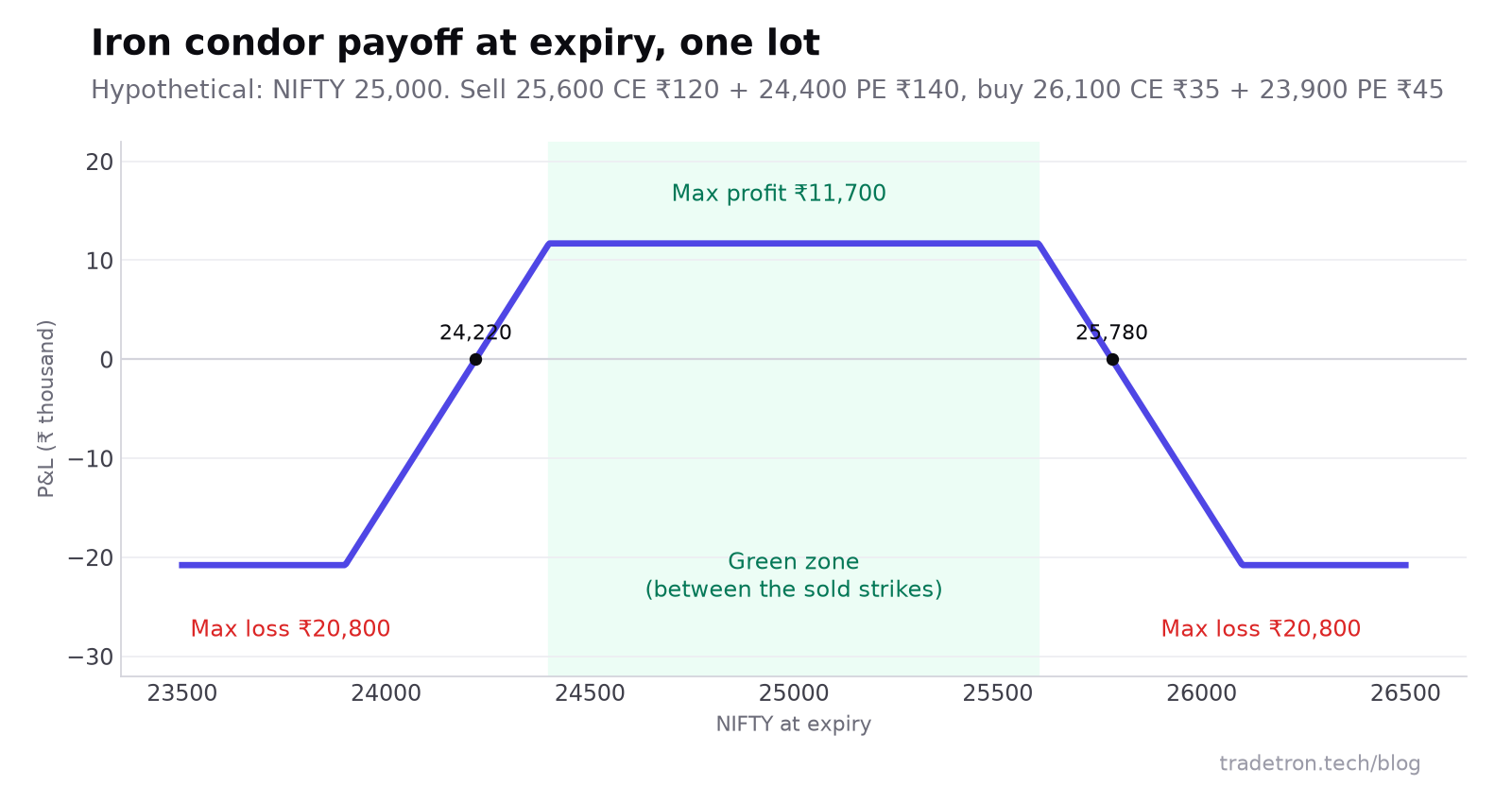 Hypothetical iron condor, one lot of 65. The shaded band is the green zone.
The numbers show the trade-off of every iron condor: the most you can make is smaller than the most you can lose, so you are relying on the range holding more often than not. That is why the adjustment and exit rules matter as much as the entry.
The rules
Why 25 delta?
Delta roughly tells you how likely an option is to finish in the money. A 25-delta short call has, very roughly, a one-in-four chance of ending in the money. Selling at ±25 delta places both short strikes far enough away to give NIFTY room to move, while still collecting meaningful premium. Delta-based strikes also adjust to volatility on their own: when markets are jumpy, the 25-delta strikes sit further out.
Why hedge 500 points away?
A monthly position is held overnight and through weekends, so it is exposed to gaps you can't react to. The long options 500 points beyond each short strike turn an open-ended loss into a capped one. They also reduce the margin the position needs, because the broker sees a defined-risk spread instead of naked short options. See how hedged positions get a margin benefit.
The adjustment: iron condor to iron fly
The key risk-management idea is to keep the probability of profit and the risk-to-reward in your favour as the market moves. When NIFTY breaks out of the green zone, one side of the condor is now under pressure and the other side has mostly decayed.
- Spot the breach. NIFTY trades beyond one of the strikes you sold at entry.
- Close the untested side. Exit the short option and its hedge on the side the market moved away from. Most of their premium is already earned.
- Re-sell at the new centre. Sell an option at the strike the market has moved to, with a fresh hedge 500 points beyond it.
- Result: a short call and short put at roughly the same strike, each hedged. That is an iron fly, centred on where NIFTY is now.
An iron fly collects more premium than the condor it replaces, which helps offset the loss on the tested side, but its profit zone is narrower. It only makes sense if NIFTY settles near the new centre.
Exits
- Profit booking near expiry. As expiry approaches, the strategy takes profit once a set target is reached instead of holding for the last few rupees of premium, when the risk of a late move is highest relative to what is left to earn.
- Universal exit. A strategy-level stop loss and a trailing stop loss close every leg together if the whole position's P&L crosses a limit. The exact values are in the duplicated strategy.
Backtesting and optimising
The first version was built exactly as described and backtested on historical data. The backtest showed where it struggled, and three changes were tested:
| Change tested | What it does | What to look for |
|---|---|---|
| Strategy-level trailing stop | Locks in part of the open profit as it grows | Smaller give-backs; a smoother P&L curve |
| Entries only on certain weekdays | Avoids entering on days that tested poorly | Is the difference large and stable, or just noise? |
| Weekly and intraday versions | Same logic on shorter holding periods | Less overnight risk, but more trades and costs |
The headline change was the trailing stop, added to reduce the choppiness in the P&L curve by closing positions that had given back too much of their gains. The weekday filter is the change to be most sceptical of. A rule like "only enter on Wednesdays" can look good in a backtest purely by chance, so check it across different years before you trust it.
Pros
- Defined risk on both sides thanks to the hedges
- Delta-based strikes adapt to volatility automatically
- A clear, mechanical adjustment instead of discretionary panic
- Hedges reduce the margin needed
Cons
- The maximum loss is larger than the maximum profit
- Sharp trending months can force adjustment after adjustment
- Overnight and weekend gaps can jump past the adjustment point
- Many legs mean more costs and more slippage
How to run it on Tradetron
For the intraday sibling of this strategy, read the Theta Gainers delta-neutral intraday build. For the basics of this structure, see our iron condor guide.
Frequently asked questions
What is the Theta Gainers monthly strategy?
It is a NIFTY monthly iron condor: sell a call and a put at about 25 delta, buy hedges 500 points further out, and convert to an iron fly if NIFTY moves outside the sold strikes. It earns from time decay while NIFTY stays in a range.
Why use monthly options instead of weekly?
Monthly options carry more premium and decay more slowly, so the position has more room for the market to move before adjustments are needed. The trade-off is that you hold through more overnight and weekend gaps. The strategy was also tested on weekly and intraday versions.
When should I adjust an iron condor?
This strategy adjusts when NIFTY trades beyond either of the strikes you sold. At that point, it closes the untested side and re-centres the position as an iron fly. Other traders adjust earlier, for example when a short option's delta doubles.
What is the difference between an iron condor and an iron fly?
Both sell a call and a put and buy hedges further out. An iron condor sells the call and put at different strikes, giving a wider profit zone and less premium. An iron fly sells both at the same strike, collecting more premium with a narrower profit zone.
Can I backtest the Theta Gainers strategy?
Yes. Duplicate either version on Tradetron, change the settings you want to test, and run a backtest on historical data. Then run it Live Offline before trading with real money.