Position Trading: Strategies, Tips and Tools

Position trading is a style where you hold a trade for weeks to months to ride a major trend, ignoring day-to-day noise. Position traders usually enter on a trend or breakout signal from daily or weekly charts, often filtered by basic fundamentals, and exit when the trend breaks. It needs little screen time, but wide stops, careful sizing and patience.

What is position trading?
A position trader asks one question: what is the main trend, and how do I stay in it for as long as it lasts? Instead of trading every swing, they accept pullbacks of 5–15% as normal and only exit when the trend itself is over.
| Swing trading | Position trading | Investing | |
|---|---|---|---|
| Holding period | Days to a few weeks | Weeks to months | Years |
| Charts | Daily, hourly | Daily, weekly | Mostly fundamentals |
| Exit trigger | Target or short-term signal | Trend break or trailing stop | Change in the business or goals |
| Screen time | Daily check | Weekly check | Occasional review |
| Main risk | Gaps, noise | Long drawdowns, event risk | Long bear markets |
In Indian markets, position traders mostly trade stocks and ETFs on delivery, and sometimes index or stock futures. The positional trading strategy guide covers instrument choice, futures rollovers and costs in India in detail.
Five position trading strategies
1. Trend following with moving averages
The simplest version: be long while price is above a long moving average and out (or short) when it falls below.
- Entry: daily close above the 200-day moving average, or the 50-day crossing above the 200-day (the "golden cross").
- Exit: close below the 50-day or 200-day average, or the 50-day crossing below the 200-day (the "death cross").
- Trade-off: you catch most of a long trend, but give back a chunk at the end and take several small losses in sideways years.
2. Breakouts from long bases
Stocks often spend months in a range before a big move. A breakout trader waits for the price to close above that range.
- Entry: weekly or daily close above a multi-month high, ideally on higher volume.
- Stop: below the top of the old range or the last swing low.
- Trade-off: many breakouts fail and fall back into the range, so losses must be cut quickly.
3. Buying pullbacks in an established trend
Instead of buying the breakout, you wait for the trend to pause.
- Entry: in a stock above a rising 50-day average, buy when it pulls back to that average and turns up.
- Stop: below the pullback low.
- Trade-off: better entry prices, but in strong trends the pullback may never come.
4. Relative strength
Rank a universe of stocks (say, the NIFTY 100) by their return over the last 6 or 12 months, and hold the strongest few. Rebalance monthly or quarterly, replacing stocks that drop out of the top group.
- Why it's used: stocks that have outperformed have tended to keep doing so for a while. This is the idea behind momentum investing.
- Trade-off: sharp reversals hurt, and rebalancing creates taxable gains and costs.
5. Fundamentals plus a technical trigger
Shortlist companies on fundamentals (earnings growth, debt, return on equity), then use a technical signal for timing. The fundamentals decide what to hold; the chart decides when.
The parts of a complete position trading plan
A position trade lasts long enough for you to talk yourself out of it many times. Write these down before you enter:
- Universe: which stocks, ETFs or futures you trade, with a minimum liquidity.
- Trend filter: the condition that must be true for any trade (e.g. NIFTY above its 200-day average).
- Entry rule: the exact signal and the candle it's based on (daily or weekly close).
- Initial stop: a level that proves the idea wrong: below the breakout, the swing low, or 2–3 × ATR.
- Position size: from your risk per trade and the stop distance (see below).
- Exit rule: a trailing stop or a trend-break signal, not a feeling.
- Portfolio limits: maximum number of positions, maximum per sector, maximum total risk.
- Review: a monthly check of whether you followed the rules.
Risk management: wider stops, smaller positions
Position trades need room. A 3% stop that works for a swing trade would be hit by normal noise in a trend that lasts months. Stops of 8–20% are common, which means positions must be smaller for the same rupee risk:
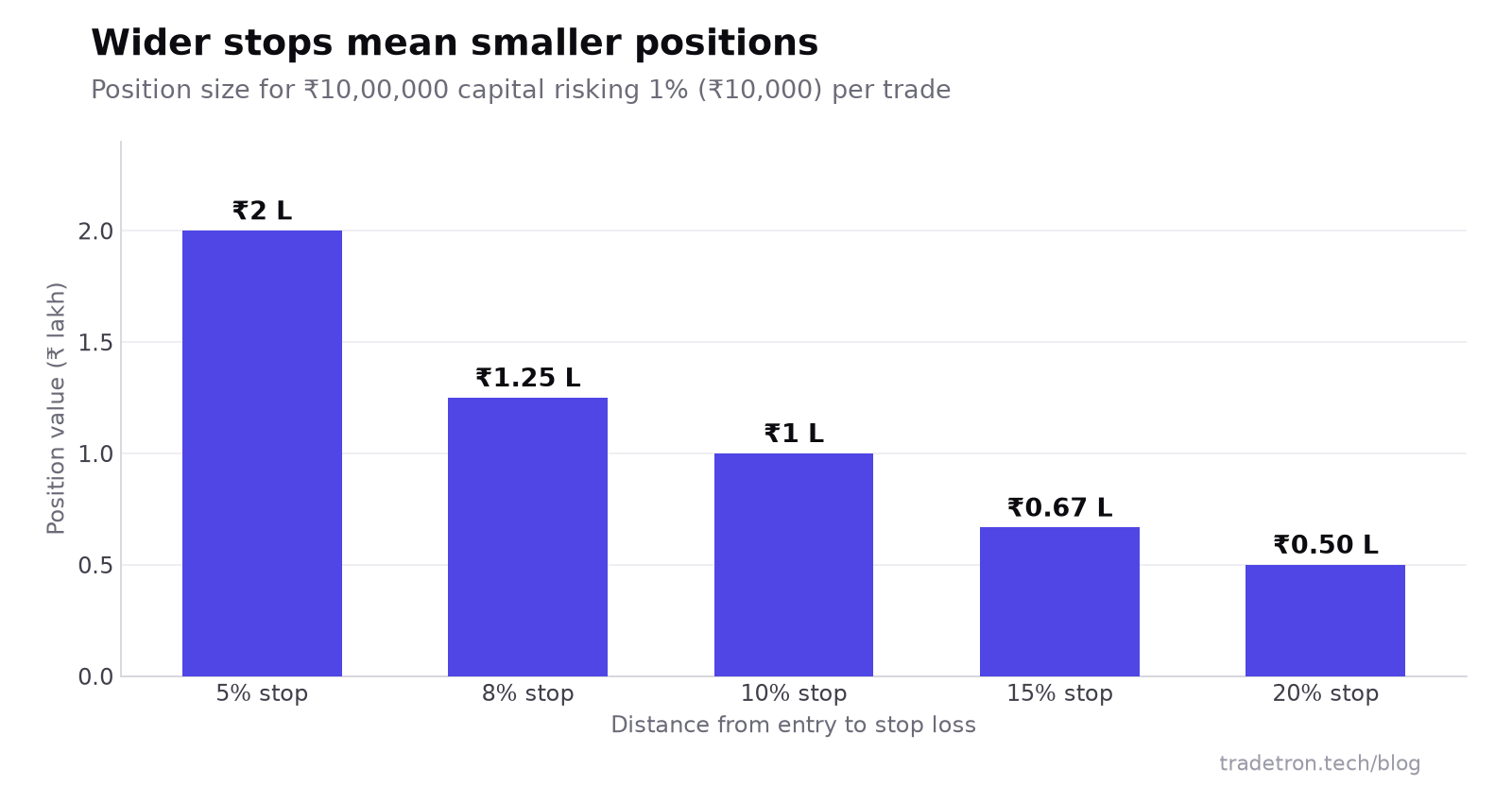 Position value = rupee risk ÷ stop distance
Other risks that matter more when you hold for months:
- Gaps: results, policy announcements and global news can open the stock well past your stop. Smaller positions are the only real protection.
- Correlation: five bank stocks are close to one trade. Cap exposure per sector.
- Leverage: futures held for months magnify every pullback. If you use them, size by the full contract value, not the margin.
Position trading tips
- Trade with the index trend. Most stocks follow the market. A simple filter such as "NIFTY above its 200-day average" keeps you out of many losing trades.
- Let winners run, cut losers fast. Position trading results usually come from a few big winners. Cutting them early with a tight target defeats the purpose.
- Use a trailing stop. Move the stop up as the trend continues, for example to the 50-day average or 3 × ATR below the highest close. Never move it down.
- Check weekly, not hourly. Daily price checks make you react to noise.
- Know the event calendar. Results dates and big policy events are when gaps happen.
- Keep a journal. Months-long trades are easy to misremember. Write down why you entered and what would make you exit.
Pros
- Low screen time; suits people with a full-time job
- Few trades, so costs are a small share of returns
- Can capture large trends
- Decisions are made calmly, after market hours
Cons
- Long stretches of sitting through 10–15% pullbacks
- Wide stops mean smaller positions
- Capital stays tied up for months
- Overnight and event gaps can jump past stops
Mistakes position traders make
- Turning a trade into an "investment" after it falls below the stop.
- Taking profits too early on the first 10% gain, then watching the trend run without you.
- Averaging down on a position that has broken its trend.
- Over-diversifying into 30 positions, too many to track and too small to matter.
- Changing the rules mid-trade because of a news headline.
Tools for position trading
| Tool | What it does for a position trader |
|---|---|
| Daily and weekly charts | Trend, bases, breakouts |
| Moving averages (50, 200), ATR | Trend filter, stops, trailing stops |
| Stock screener | Finds breakouts and relative-strength leaders |
| Backtesting software | Shows how the rules behaved over many years |
| Automation platform | Watches every position and exits by rule, even when you're busy |
Automate position trading on Tradetron
Related reading: the 7% rule for stop losses, trailing stop loss on Tradetron and types of trading in the Indian stock market.
Frequently asked questions
What is position trading?
Position trading is holding a trade for weeks to months to profit from a major price trend. Position traders use daily or weekly charts, often with a fundamental filter, and exit when the trend breaks rather than on short-term moves.
What is the difference between position trading and swing trading?
Swing traders hold for days to a few weeks to catch one move; position traders hold for weeks to months to ride the whole trend. Position trades use wider stops, fewer trades and less frequent monitoring.
Is position trading good for beginners?
It is one of the easier styles to start with because decisions are slower and made after market hours. Beginners still need written rules, a stop loss on every trade and position sizes small enough to sit through normal pullbacks.
Which indicators do position traders use?
The 50-day and 200-day moving averages for trend, ATR for stops and sizing, relative strength for picking stocks, and volume to confirm breakouts. RSI and MACD on weekly charts help judge momentum.
How much capital do I need for position trading?
There is no minimum for stocks on delivery. What matters is that each position is sized so a stop-out costs about 1–2% of your capital, which with wide stops means smaller positions than you might expect.
Can position trading be automated?
Yes. On Tradetron you can set entries from daily indicators, a stop loss and trailing stop on each position, backtest the rules and run them Live Offline before connecting a broker.