Algo Trading Myths, Tested Against How Tradetron Actually Works
The biggest algo trading myths are that automation guarantees profits, removes risk, needs coding skills, or can run unattended. None holds up. Algo trading guarantees that your rules are followed exactly, not that the rules make money. Below, eight common myths are checked against how a real no-code platform, Tradetron, actually behaves.
The eight myths at a glance
| Myth | Reality |
|---|---|
| 1. Algo trading guarantees profits | It guarantees consistent execution of your logic, good or bad |
| 2. You need to code | No-code builders cover most retail strategies |
| 3. It's only for institutions | Cloud platforms and broker APIs opened it to retail traders |
| 4. Automation eliminates risk | It changes which risks you manage |
| 5. A good backtest means good live results | Slippage, costs and regime change open a gap |
| 6. Set it and forget it | Strategies need regular review |
| 7. More complex is better | Complexity raises the odds of curve-fitting |
| 8. It's only for scalping | Positional, income and event strategies automate just as well |
Myth 1: Algo trading guarantees profits
Automation removes emotion, so surely it removes losses too? It doesn't. A bot follows your logic precisely, and if the logic is weak it will lose money precisely, repeatedly, and faster than a manual trader could.
SEBI's study of individual F&O traders for FY25 found that about 91% of them lost money. That study doesn't separate algo traders from manual ones, but it's a reality check: automation is not an exemption from the market.
On Tradetron: every strategy can be run Live Offline before any money is involved: the strategy runs and records every trade, but nothing is sent to the exchange. You find out whether the logic holds up before the market tests it for you.
Myth 2: You need to know how to code
No-code strategy builders replaced that requirement for most retail use cases. In Tradetron's builder, conditions are assembled from a library of keywords: price data, indicators like RSI and MACD, option Greeks like Delta and Theta, and time triggers, combined into Entry, Repair and Exit rules. For options traders, the Option Wizard starts from ready-made templates.
There's a grain of truth: highly bespoke logic, such as custom statistical models, can still benefit from code. That's a minority case, not the default. If you'd rather describe a strategy in plain English, an AI connector can build it on Tradetron for you.
Myth 3: Algo trading is only for professionals and institutions
Cloud infrastructure and broker APIs now do what institutions once paid to build in-house. A retail trader with a broker account and a browser can build, test and deploy a strategy. What separates outcomes today isn't account size or technology; it's strategy quality and risk discipline.
Myth 4: Automation eliminates risk
Automation removes the risk of human hesitation. It doesn't remove:
- Market risk. Prices can gap through your stop.
- Slippage. A stop still has to be filled, and in a fast market the fill can differ from the trigger price.
- Technology risk. Internet outages, broker API downtime and exchange latency still exist.
Automation removes
- Hesitation and second-guessing
- Missed entries while you're away from the screen
- Inconsistent position sizing
- Moving the stop "just this once"
Automation doesn't remove
- Market moves and gaps
- Slippage between trigger and fill
- Broker or connectivity outages
- A strategy that simply doesn't work
On Tradetron: risk controls sit in the strategy itself: stop losses and targets on each leg, a strategy-level trailing stop in Advanced Settings, and Overnight Protection, which buys a hedge before the close to protect short option positions overnight and exits that hedge the next trading day. It hedges; it doesn't close the strategy. Each of these reduces a specific failure mode. None removes risk.
Myth 5: A good backtest guarantees live performance
Live results usually differ from the backtest, and slippage is a big reason. A backtest fills at historical candle prices; a live order meets a real order book, a spread and timing. On a strategy with a thin edge per trade, small slippage changes everything:
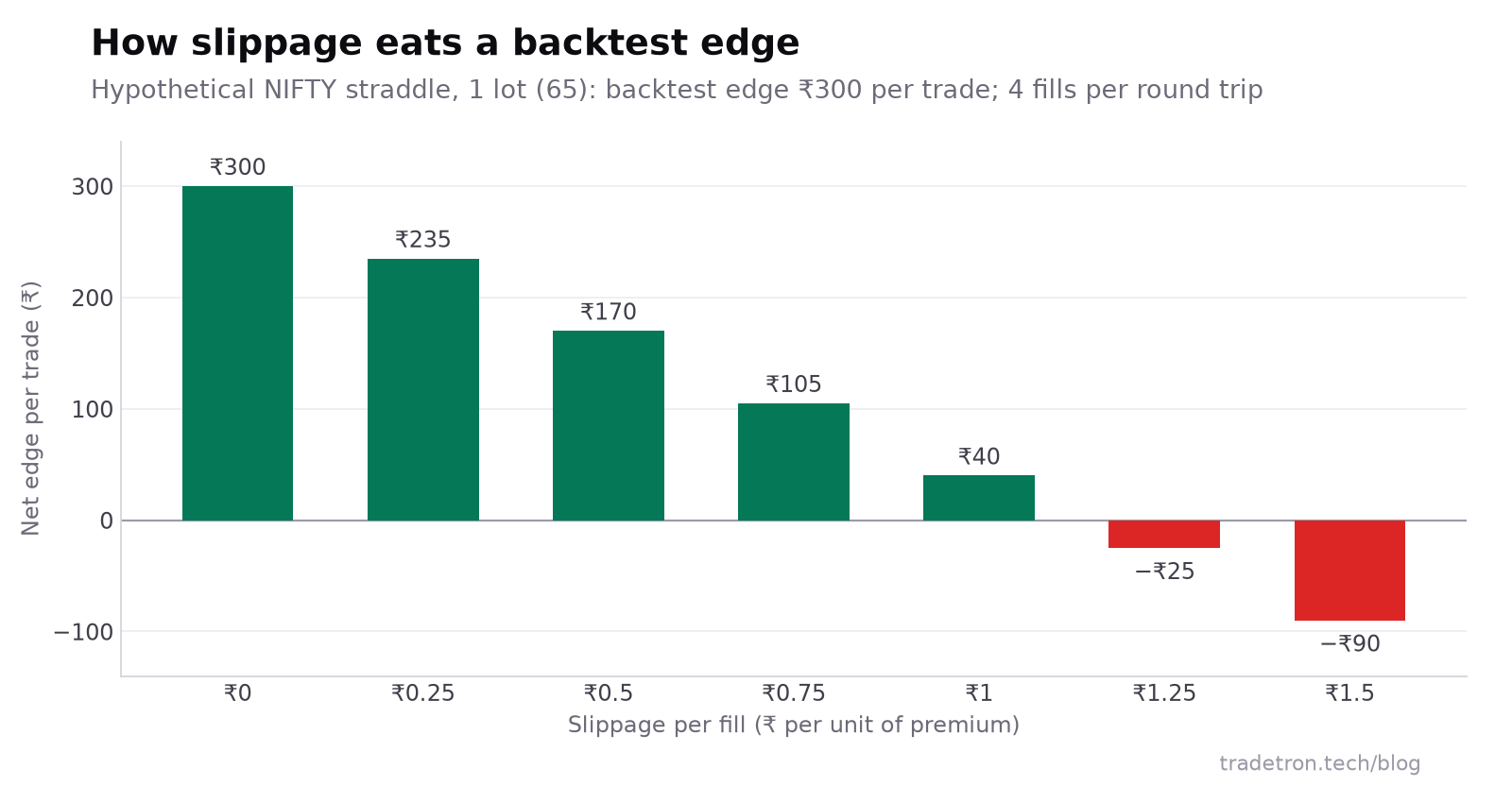 Hypothetical example: 4 fills × 65 units × slippage per fill comes off every trade
Live execution settings, such as order price (market, best price, average of bid/ask) and revisions, are set in Advanced Settings and apply to deployed strategies. Treat the backtest as a check on logic, then measure execution separately in Live Offline. Nine reasons a backtest doesn't match live trading covers the rest of the gap.
Myth 6: Automated strategies don't need monitoring
Markets change regimes. A mean-reversion strategy tuned for calm markets can bleed steadily once volatility expands, and nothing in the code knows that. Expiry changes, lot size revisions (NIFTY is now 65, BANK NIFTY 30) and news events can all invalidate a strategy's assumptions.
On Tradetron: the Deployed tab tracks positions and P&L live, the Notification Log records every entry, exit and error, and alerts can reach you on channels such as WhatsApp, SMS or email.
Myth 7: More complex strategies always perform better
Stacking conditions, legs and indicators often does the opposite. Each extra parameter makes it easier to fit the strategy to past noise rather than a real pattern (curve-fitting), and each extra leg is another chance of a partial fill or timing mismatch.
Tradetron lets one strategy hold several independent sets with Repair and Universal Exit conditions, so sophisticated logic is possible. That's a tool, not a target. Add complexity only after a simpler version has proven itself.
Myth 8: Algo trading is only useful for scalping
Scalping is one use among many. Rules can automate trend-following and mean reversion, event-driven trades, pairs trading, option-income strategies, and portfolios rebalanced on a schedule, across equities, indices, futures, options, currencies and commodities. Most of these don't need sub-second speed at all. Match the strategy to your time horizon and risk tolerance; automation supports patient approaches as well as fast ones. See positional trading for a slower example.
For the mistakes that follow these myths into live trading, read why algo strategies fail.
Frequently asked questions
Does algo trading reduce risk compared to manual trading?
It reduces some risks, such as emotional decisions, missed entries and slow execution. It doesn't reduce market risk. A strategy with weak logic or no stop loss loses money automatically, and faster.
Can a complete beginner start algo trading without a technical background?
Yes, on a no-code platform. Visual strategy builders and template tools like Tradetron's Option Wizard are built for traders who don't code. Start in Live Offline mode while you learn.
Why does a backtested strategy perform differently live?
Backtests fill at historical candle prices, while live orders meet real spreads, slippage and timing. Look-ahead bias in the test design and changing market conditions add to the gap.
Is algo trading legal in India?
Yes, through SEBI's framework, where API orders go through your broker. Read SEBI's algo-ID rules for retail traders for what applies now.
How much capital do I need to start algo trading?
There's no minimum tied to automation itself. It depends on what you trade: one lot of NIFTY options (65 units) needs very different capital from a stock portfolio. You can test logic in Live Offline mode before committing any capital.
Do I need to monitor an automated strategy every day?
Not every minute, but regularly. Check the logs for errors daily and review performance against the rules weekly or monthly, because markets change and the strategy won't notice on its own.