

Repair Once runs its action one time per entry cycle. It is not a continuous monitor. Using it wrongly is a common reason strategies behave unexpectedly.
The lifecycle
- Entry is taken. The set meets its entry conditions.
- Repair Once fires. Its condition becomes true and the action runs once.
- The set exits through its exit conditions (stop-loss, target, time, and so on).
- The cycle resets. Repair Once can fire again only in the next entry cycle.
Several Repair Once conditions in one set
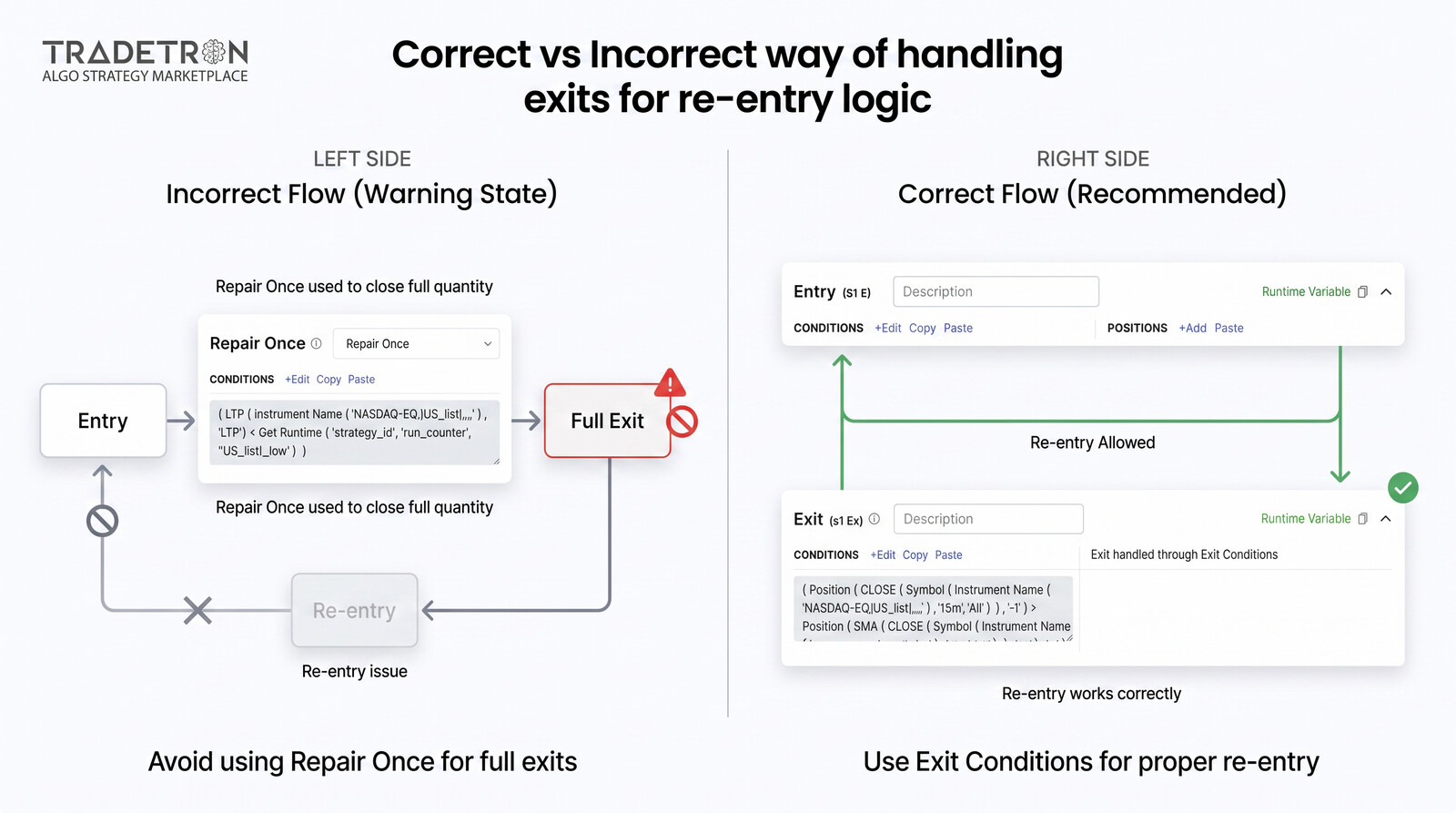
- Each one fires once per entry cycle, independently.
- If any of them brings the set’s active quantity to zero, the engine stops checking all remaining repair and exit conditions and goes back to checking entry conditions only.
- So the other Repair Once conditions never get a chance to run in that cycle.
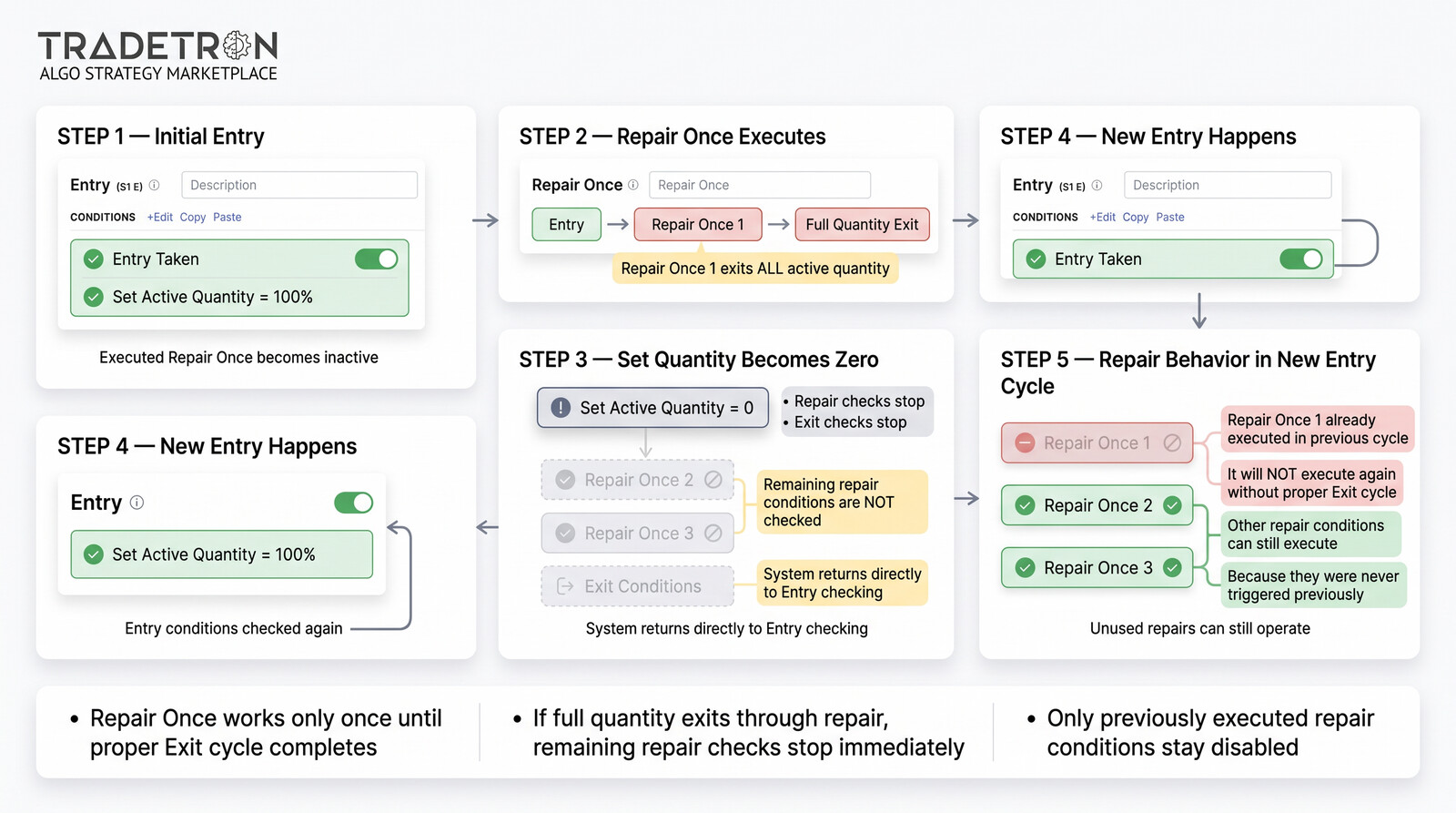
The mistake to avoid: exiting the full quantity with Repair Once
If Repair Once exits the whole position:
- Active quantity becomes zero and the engine looks for the next entry.
- No proper exit happened, so the Repair Once counter does not reset.
- On the next entry, the Repair Once condition will not fire again.
The strategy works on the first trade and breaks on every re-entry.
Good uses for Repair Once
- Adjusting position size after a threshold is crossed.
- Adding a hedge leg once.
- A per-leg stop-loss or Leg TSL (one Repair Once block per leg).
Handle the full exit with exit conditions, especially in strategies that re-enter. If you need an action to fire every time its condition is true, use Repair Continuous and make sure the condition resets after each fire.
Quick reference
| Question | Answer |
|---|---|
| How many times does it fire? | Once per entry cycle |
| When does it reset? | After a proper exit through exit conditions |
| What if a repair brings quantity to zero? | Only entry conditions are checked; Repair Once does not reset |
| Several Repair Once conditions? | Each fires once, but all stop if quantity hits zero |
| Safe as a full exit? | No, especially with re-entry |
 Edited with AI from the original Tradetron article, checked against current docs (Oct 2026). Spot something wrong? Tell us in the Community.