Dharmik's Intraday Strategy: Short Strangle on Synthetic Futures

Dharmik's intraday strategy sells the first out-of-the-money call and the first out-of-the-money put each day, with a 50% target and a 40% stop loss on each leg. Its twist is how it finds "out of the money": strikes are measured from the synthetic futures price (strike + call premium − put premium) rather than from the spot index.
The rules
Dharmik presented this at a trading event as a simple intraday option-selling setup:
Each leg is managed on its own. On a trending day, one leg typically hits its stop while the other moves toward its target, and the net result depends on how far the trend runs. On a quiet day, both legs can reach their targets.
- 50% target: the premium halves
- 40% stop loss: the premium rises by 40%
- 1st OTM strikes, measured from synthetic futures
What are synthetic futures?
A call and a put at the same strike and expiry together behave like a futures contract: buying the call and selling the put gains and loses point for point with the index. So their prices imply a futures price:
Synthetic futures = strike + call premium − put premium
For weekly options there is no weekly futures contract, so this is the cleanest way to see the price the options themselves are based on. It usually sits a little above spot, reflecting the cost of carry until expiry, and it can drift further when markets are moving fast.
Same market, same moment, a different pair of strikes. The synthetic-based strikes are the ones that are genuinely just out of the money relative to how the options are priced, which keeps the call and put premiums closer to each other.
Why the strike reference matters
| Reference | What it reflects | Effect on a short strangle |
|---|---|---|
| Spot | The cash index right now | Can be off by a strike when options price in a premium or discount |
| Monthly futures | Price for the monthly expiry | Includes carry to a different date than the weekly options |
| Synthetic futures | Price implied by the options you are trading | Strikes centred on the options' own pricing |
If the strikes are centred on the wrong level, one leg is effectively closer to the money than the other. The 40% stop on that leg is then more likely to be hit first, and the strategy carries a directional tilt you didn't intend.
Building it on Tradetron
- Set up the strategy with your capital, an intraday type and the entry time.
- Add two sell positions, a call and a put on the nearest weekly expiry, 1 lot each.
- Set target and stop on each position as a percentage of entry price: TGT 50, SL 40.
- Point the strikes at synthetic futures. Use the Synthetic Futures keyword in the strike selection so "1st OTM" is counted from the synthetic price instead of spot.
- Backtest it, then run it Live Offline before trading live.
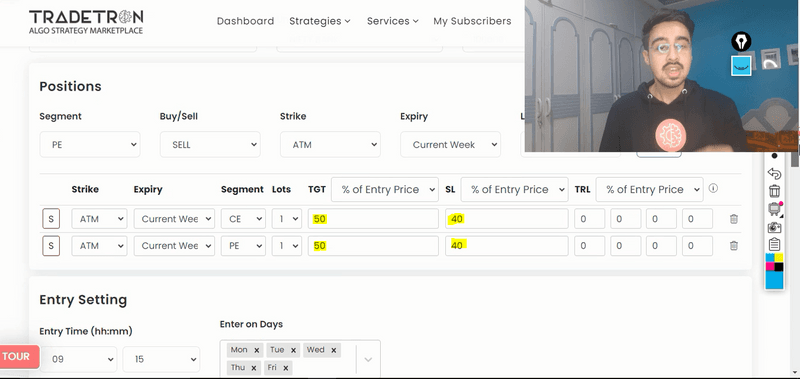 Both legs with a 50% target and 40% stop loss on entry price
Pros
- Very simple rules that are easy to automate
- Strikes centred on the options' own pricing
- Per-leg targets and stops keep each loss defined in percentage terms
- Intraday, so no overnight gap risk
Cons
- Trending days often stop out one leg while the other earns less
- Percentage stops on cheap options are only a few points wide
- Naked short options can gap past their stops
- Depends on liquid weekly options, now only NIFTY and SENSEX
Related: the strangle option strategy guide, straddle vs strangle and keywords in Tradetron.
Frequently asked questions
What is Dharmik's intraday strategy?
It sells the first out-of-the-money call and put every day, with a 50% target and a 40% stop loss on each leg. The strikes are chosen relative to the synthetic futures price rather than the spot index.
How do you calculate synthetic futures?
Take one strike, usually the ATM, and add the call premium and subtract the put premium: strike + CE − PE. For example, 22,000 + 166 − 110 = 22,056.
Why use synthetic futures instead of spot?
Synthetic futures reflect the price the options are actually trading around, including carry to expiry. Choosing strikes from it keeps the call and put more evenly out of the money than choosing from spot.
Which index can I use this strategy on?
Any index with liquid weekly options. Today that means NIFTY (NSE, Tuesday expiry) or SENSEX (BSE, Thursday expiry). BANK NIFTY, FINNIFTY and MIDCPNIFTY now have monthly expiries only.
Does Tradetron support synthetic futures?
Yes. The Synthetic Futures keyword returns the synthetic futures price for an underlying, and you can use it in conditions and strike selection.