Timing the Trade: Why Entry and Exit Rules Matter in Crypto

Entry and exit rules matter in crypto because the market trades 24 hours a day and moves fast, so decisions made in the moment are usually late or emotional. An entry rule says exactly when you buy; an exit rule says exactly when you sell, in profit or at a loss. Written in advance, they turn timing from a guess into a plan.

What are entry and exit rules?
An entry rule decides when you open a trade. An exit rule decides when you close it, either to take profit or to limit a loss. Both should be specific enough that two people reading them would make the same trade.
They are usually built from four kinds of inputs:
- Indicators: RSI, moving averages, MACD, Bollinger Bands, ATR.
- Price action: breakouts above a recent high, pullbacks to an average, candle closes.
- Volatility: how far the coin typically moves, used to size stops and filter quiet markets.
- Time: trading only in certain hours, or closing a trade after a set time.
"Buy when it looks strong" is not a rule. "Buy when the 15-minute candle closes above the highest high of the last 20 candles and RSI(14) is above 55" is.
Why timing matters more in crypto
- 24 × 7 the market never closes, so there is no natural point to stop and think
- 168 hours a week your open trade can move
- 1 missing exit rule can undo many small winning trades
- Volatility is high. Crypto can move several percent in hours. Entering a little early or a little late changes where your stop sits and how much you risk.
- The market runs while you sleep. Without rules, an open trade is unmanaged for a third of every day.
- Fast markets trigger emotional decisions. Fear makes you sell a dip that recovers; greed makes you hold a winner until it turns into a loser.
- A bad exit erases a good entry. You can buy at a near-perfect price and still lose if you have no plan for getting out.
How to write an entry rule
A complete entry rule has three parts.
- Trigger: the event that says "now". For example, price closes above the previous day's high.
- Filter: a condition that has to be true for the trigger to count. For example, RSI(14) above 55, or the price above its 50-period EMA, so you only take breakouts in an uptrend.
- Size: how much you buy, worked out from where your stop is (see below).
The five exits every crypto trade needs
Most traders spend their time on entries. Most results are decided by exits. Plan all five before you enter:
| Exit type | What it does | Example rule |
|---|---|---|
| Stop-loss | Caps the loss if you're wrong | Exit if price falls 4% below entry, or 2 × ATR below entry |
| Profit target | Banks a planned gain | Exit at 8% above entry |
| Trailing stop | Lets a winner run while protecting gains | Once 5% up, exit if price falls 3% from its highest point since entry |
| Signal exit | Exits when the reason for the trade is gone | Exit if RSI(14) falls below 40 |
| Time exit | Stops a trade that goes nowhere | Exit after 48 hours if neither stop nor target is hit |
How your stop and target set the win rate you need
The distance to your stop and the distance to your target decide how often you have to be right. If you risk 1 to make 2, one winner pays for two losers:
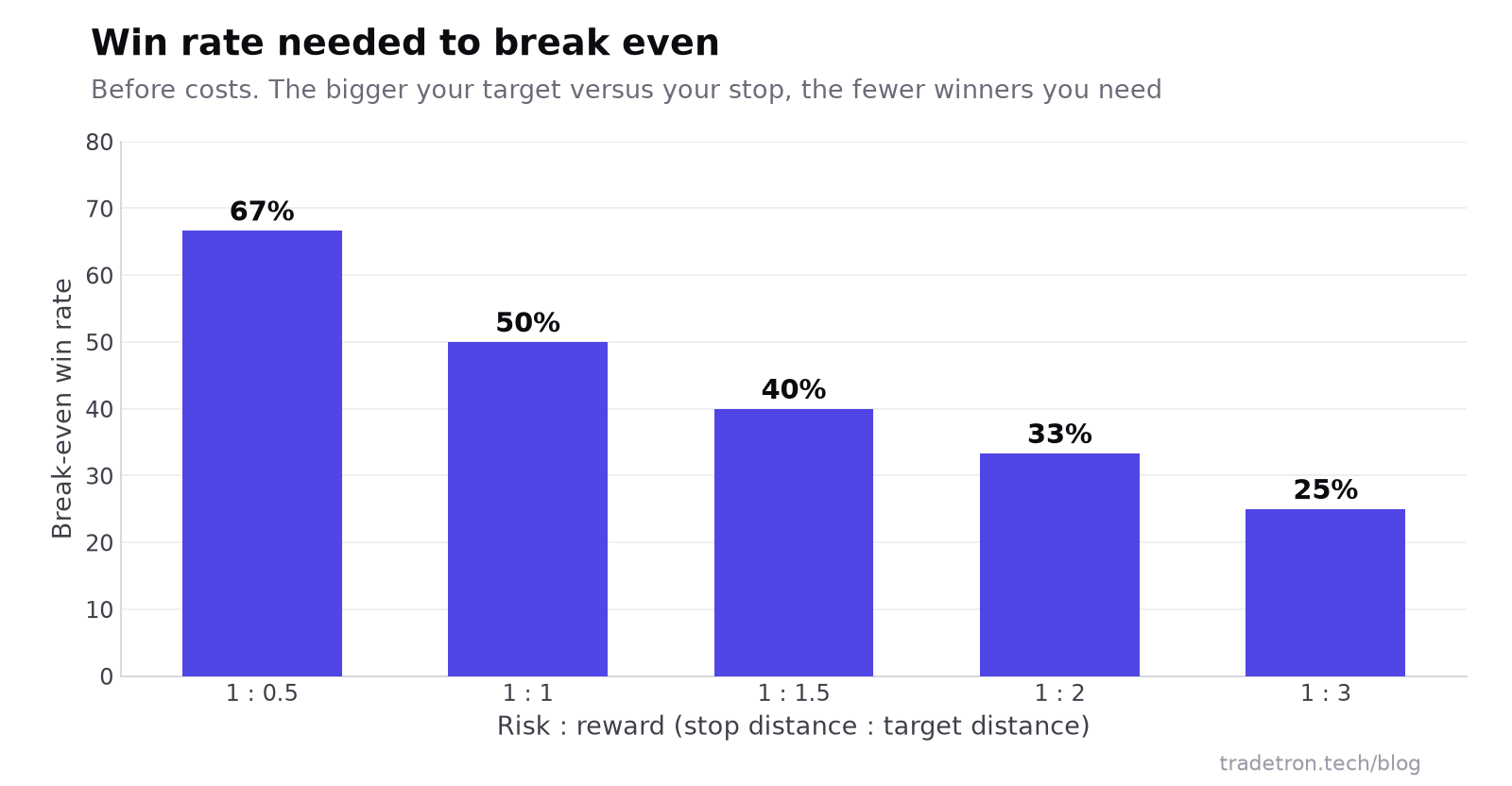 Break-even win rate for each risk-to-reward ratio, before costs
This is arithmetic, not a prediction. A strategy with a 1:3 ratio needs fewer winners, but a far-away target is also hit less often. Only testing tells you which balance your rules actually achieve.
Size the position from the stop
Your stop tells you how much to buy. Decide the most you will lose on one trade, then divide by the stop distance.
A wider stop means a smaller position. That is how a volatile coin and a calm coin can carry the same rupee risk.
What goes wrong without clear rules
- Entering too early. You buy a breakout before the candle closes, and price falls back into the range.
- Exiting too late. You wait for "a little more", the market reverses, and a profit becomes a loss.
- Panic exits. A normal dip scares you out, and price recovers without you.
- No stop-loss. One bad trade wipes out the gains from the last five.
- Moving the stop. You lower the stop "just this once" and turn a small planned loss into a large unplanned one.
Each of these is a decision made in the moment. Rules written in advance remove the moment.
Test your rules before you trust them
Before any real money, check how the rules would have behaved on past data:
- Did the entry catch real moves, or mostly noise?
- How often was the stop hit, and how big was the worst run of losses?
- Did exits protect profits, or cut winners too early?
- Do the results hold across different periods, or only one?
Then run the rules on live prices without real money for a while. A backtest shows how the rules behaved in the past; a live test shows how they behave now, with real prices and timing.
To choose the strategy these rules belong to, read what is the best trading strategy for crypto.
Frequently asked questions
Can beginners create entry and exit rules without coding?
Yes. No-code platforms like Tradetron let you build rules from dropdowns and keywords, such as "RSI(14) above 55" or "price 4% below entry". The harder part is making the rules complete: every trade needs a stop-loss, a profit plan and a fallback exit.
What is more important, entry or exit?
Exits usually matter more. A good entry with no exit plan can still turn into a large loss, while an average entry with a firm stop and a sensible target keeps losses small. Plan both before the trade.
How do I know if my entry rule is strong?
Backtest it on historical data and look at more than total profit: the number of trades, how often the stop was hit, the largest losing streak, and whether results hold across different periods. A rule that works in only one period is probably fitted to it.
Should I use the same exit for every crypto trade?
Use the same exit logic, not the same fixed number. A stop based on ATR adapts to each coin's volatility, so a calm coin and a volatile coin get stops of different widths but the same rupee risk.
What is a good stop-loss for crypto?
There is no single right number. Many traders use a multiple of ATR, such as 2 × ATR below entry, because a fixed percentage that suits one coin is either too tight or too loose for another. Size the position so that hitting the stop costs a set share of your capital, such as 1%.
Can I automate both entry and exit on Tradetron?
Yes. You can build the entry, exit, stop-loss, target and re-entry rules as one strategy, backtest it, run it Live Offline, and then deploy it on a connected crypto exchange.