Lists in Tradetron: Run One Strategy on Many Instruments
A List in Tradetron is a saved group of instruments, such as ten NIFTY stocks, that you attach to a set instead of a single instrument. The set's conditions are then checked for every instrument in the list, and each one that passes gets its own position and its own exit. You build the rule once and run it everywhere.

When to use a List
Lists are for strategies where the same rule applies to many instruments:
- A mean-reversion or breakout rule run on a basket of large caps.
- A monthly systematic buy of a fixed group of stocks.
- A scan-and-trade setup where any stock meeting your condition gets traded.
If your rule is specific to one instrument (a NIFTY options strategy, for example), you don't need a list.
How a list-based set works
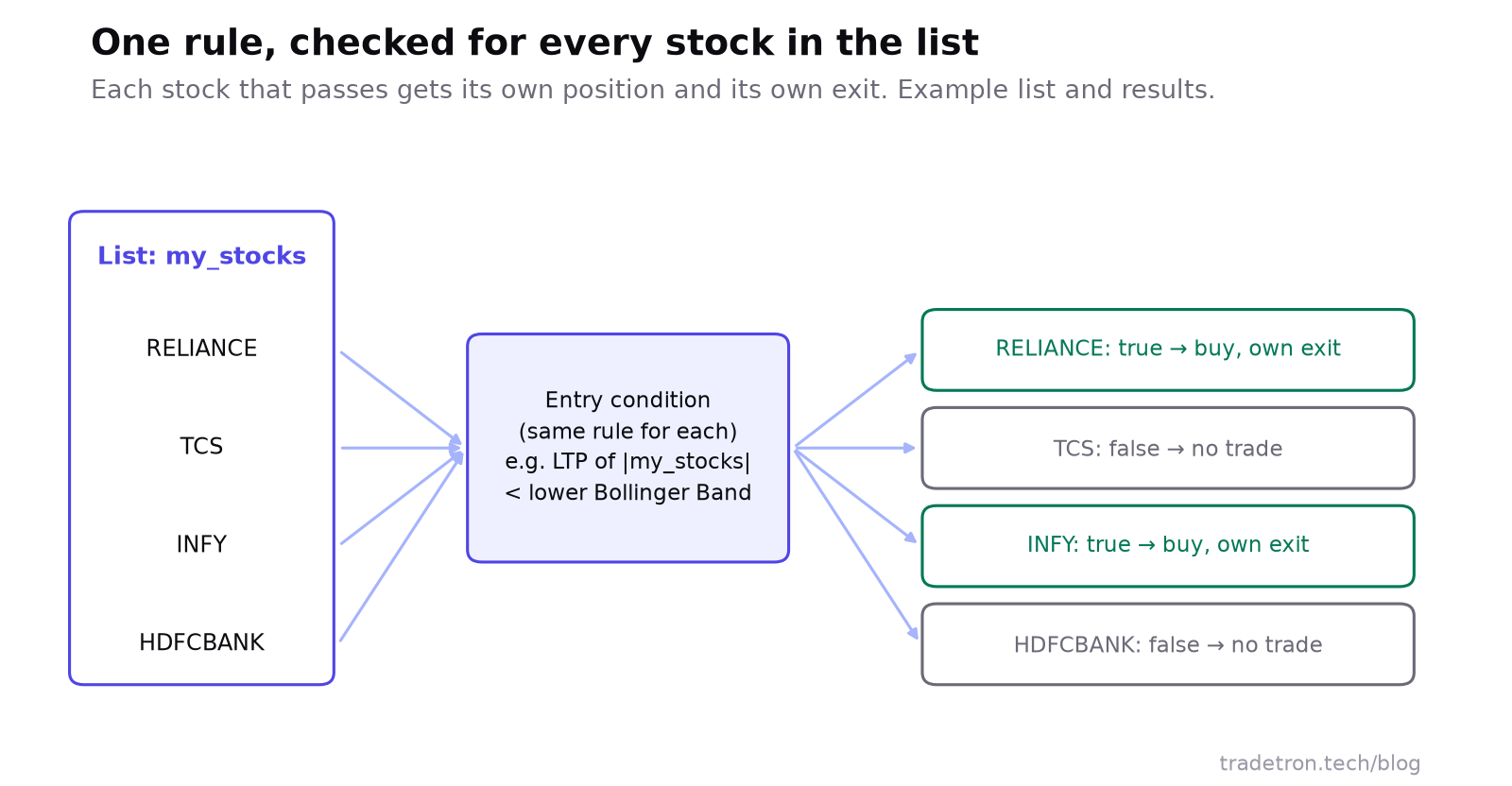 The same rule runs separately for each instrument in the list
When a set uses a list, Tradetron takes each instrument in the list, checks the set's entry condition for that instrument, and takes the position if it is true. Each instrument that enters becomes its own instance, with its own entry price and its own exit. If RELIANCE hits its exit, INFY's position is not touched.
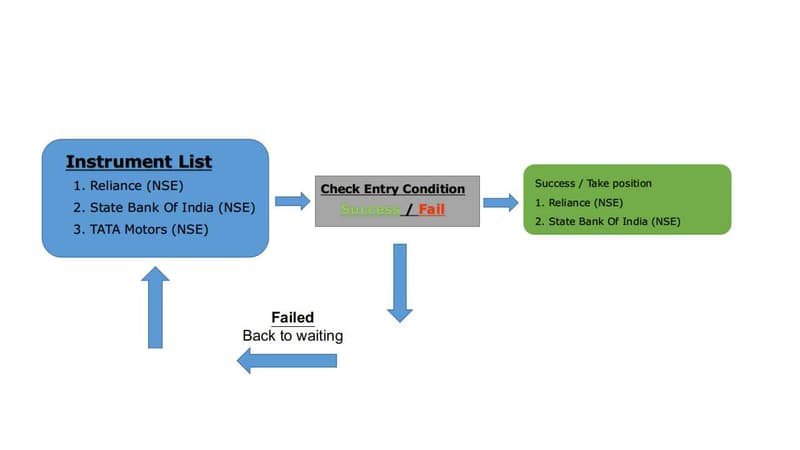 Each instrument in the list is checked in turn
How to create a List
- Open your strategy in the builder. Next to the set number, click the three dots.
- Click + ADD to create a new list. The list builder opens.
- Name the list. Use something you'll recognise in conditions, such as
nifty_banks. - Choose the exchange. Once chosen, it can't be changed for this list.
- Pick an instrument in Underlying and click Add. Repeat for each instrument.
- Click Save.
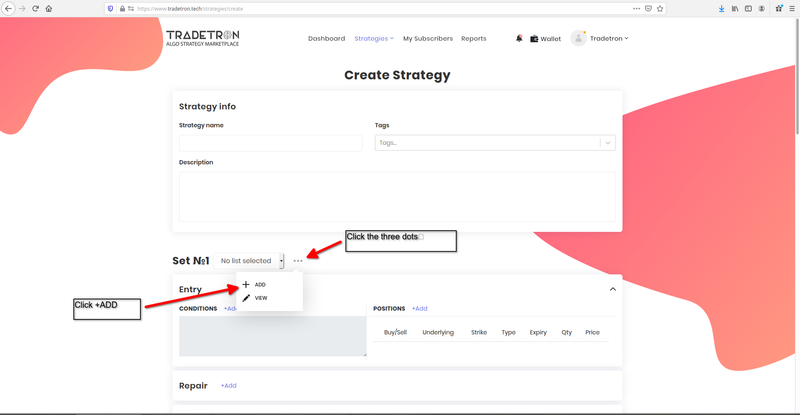 Create a list from the set's three-dot menu
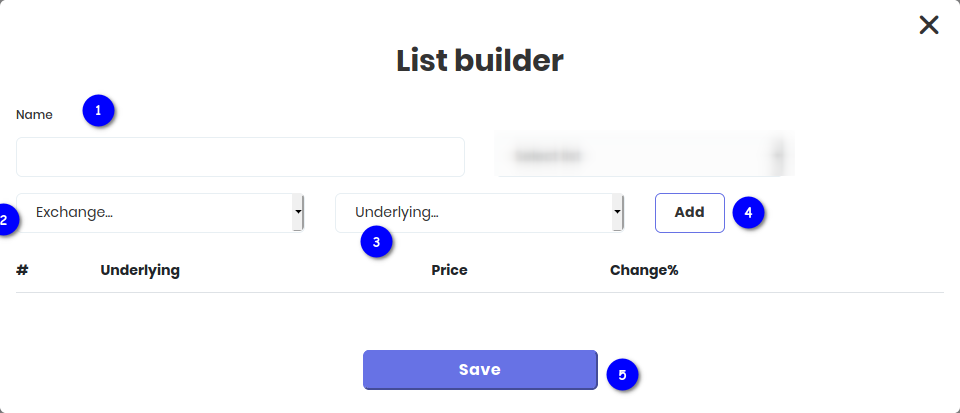 The list builder
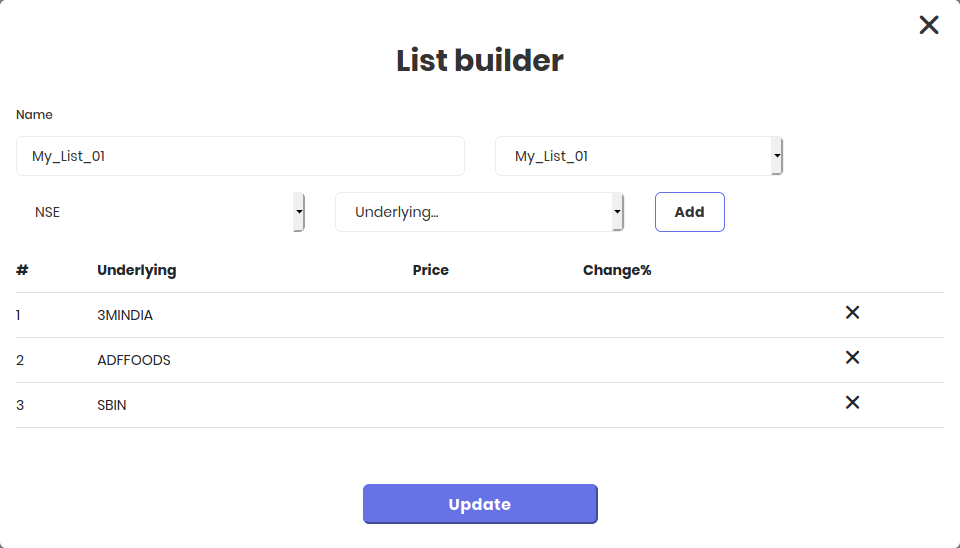 A saved list
Lists belong to your account. Other users can't see them, and you can reuse one list across several of your strategies.
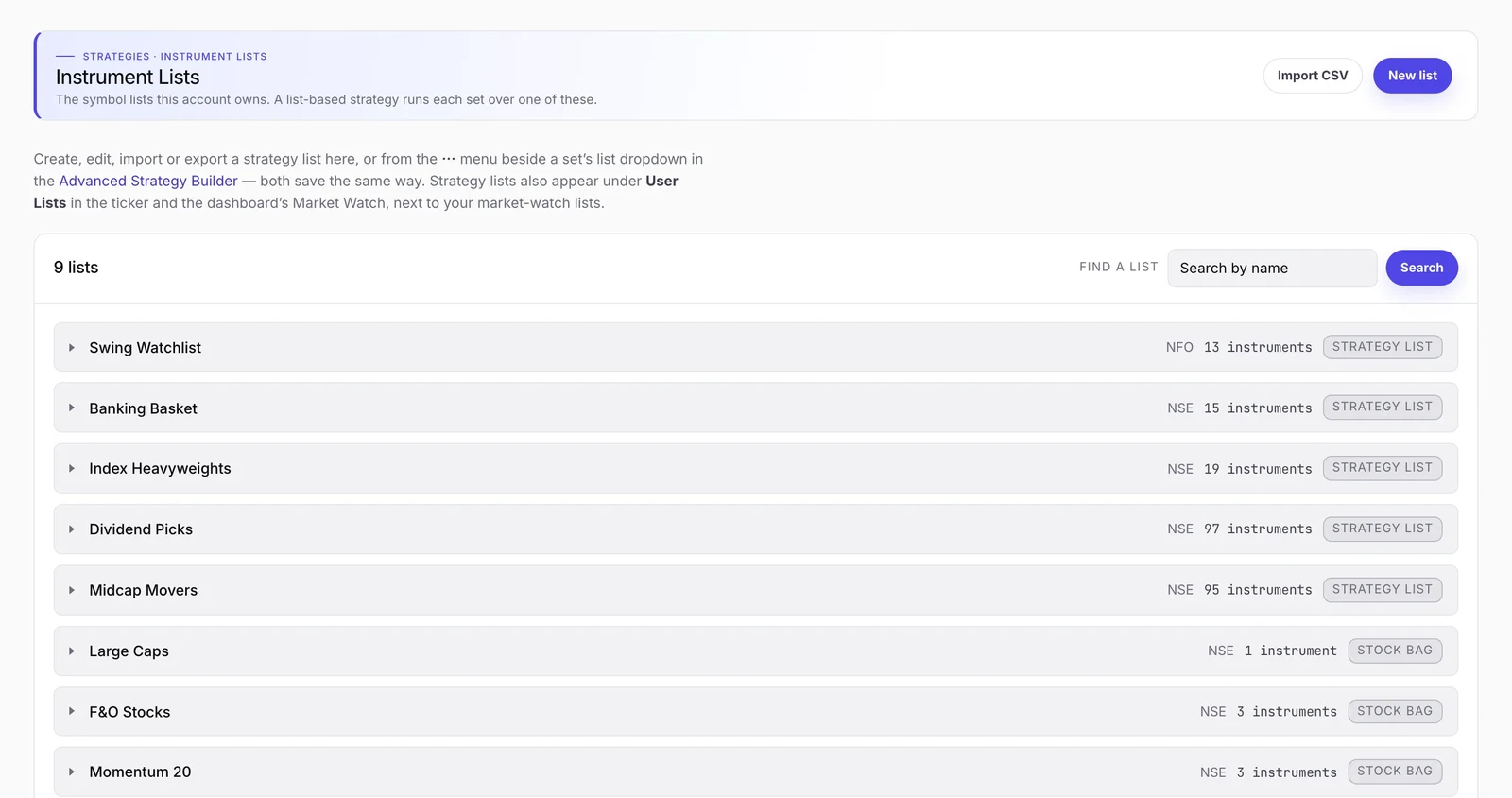 Instrument Lists: each list can drive a list-based set
Attach the list to a set
Once the list exists, select it from the set's list dropdown.
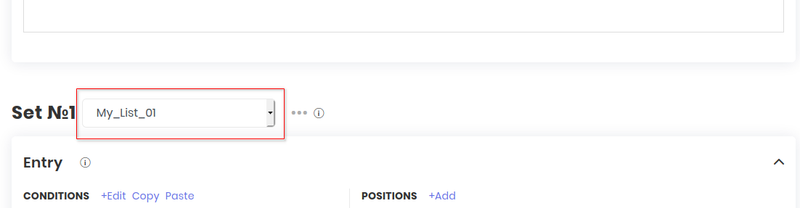 Select the list for the set
The list applies only to the set where you selected it. If your strategy has a second set, for example one that trades the opposite direction, select the list in that set too.
Use the list in your conditions
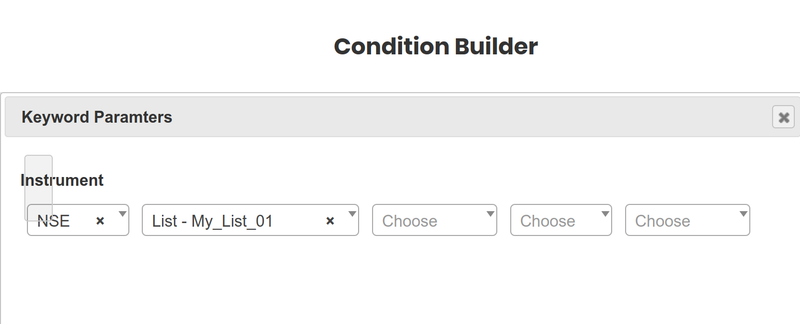
In the condition builder, choose the list instead of a single instrument wherever the condition reads a price or indicator. In written form it appears as the list name between pipes, such as |my_stocks|. When the condition runs, the token is replaced by each instrument in turn, so "LTP of |my_stocks|" means "the LTP of the stock being checked right now".
 Choose the list in the position builder
 Keywords can read the list too
The position builder
With the list selected on the set, the position builder picks it up for execution: one leg definition is used for every instrument in the list.
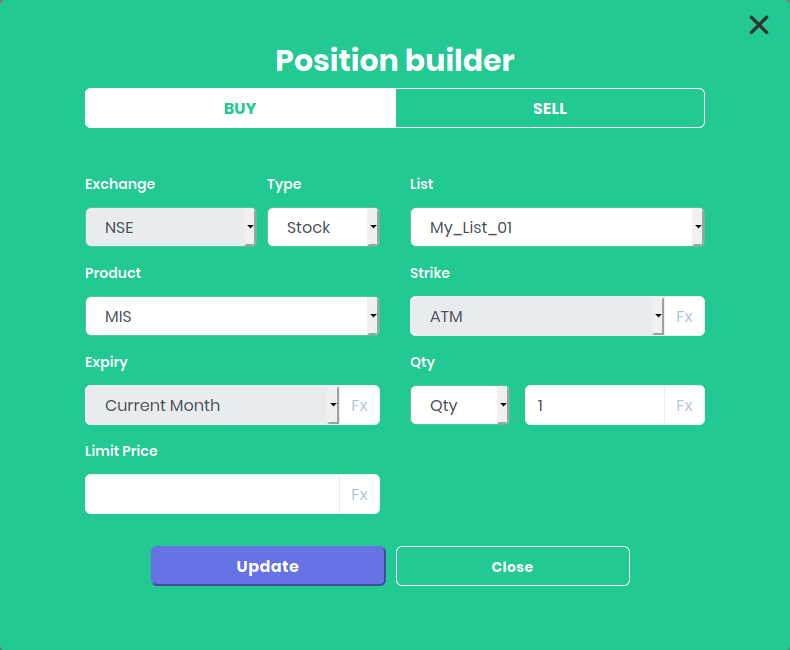 One leg definition, applied to each instrument
Common traps with list-based strategies
| Trap | What happens | What to do |
|---|---|---|
| "Only one position at a time" guard | Several stocks that pass in the same check all enter together, because each sees the same empty book | Expect it when sizing capital, or rank and pick one stock in advanced logic |
| Reading a fixed instrument in the condition | Every stock is judged on that one instrument's price | Use the list token so each stock reads its own data |
| No exit on the set | Positions only close at the Universal Exit, if there is one | Give a list-based set its own Exit condition, plus a Universal Exit as a backstop |
| Too many stocks for your capital | Every stock that triggers wants margin at the same time | Size each position so the whole list can be open at once |
| Duplicate instruments | Double positions | Check the list before saving |
Lists vs Stockbag
Both deal with groups of stocks, but they solve different problems. A List runs a trading rule on each stock separately: each stock enters and exits on its own signal. A Stockbag manages a portfolio of stocks as one basket. If you want to hold and rebalance a basket rather than trade each name on a signal, read the guide to Tradetron Stockbag.
Related: keywords in Tradetron, Repair Once and Repair Continuous and how to deploy a strategy.
Frequently asked questions
What is a List in Tradetron?
A List is a saved group of instruments from one exchange segment. When you attach it to a set, the set's conditions are checked for each instrument in the list, and each one that passes is traded separately.
Can I mix cash stocks and futures in one list?
No. A list holds instruments from one segment only: cash with cash, futures with futures. If you need both, create two lists and use them in separate sets.
Can I limit a list-based strategy to one or two stocks at a time?
Not reliably with a simple open-positions check. All stocks that pass in the same check see the same empty book and enter together. A position count does stop new entries in later checks once positions are open. To pick exactly one stock per check, you need ranking logic, which is an advanced setup.
Can I edit a list after creating it?
You can add or remove instruments in the list. The exchange you chose when creating it is fixed, so for a different segment, create a new list.
Can I backtest a strategy that uses a List?
Yes. The backtest runs the rule on every instrument in the list and shows each trade in the report, so you can see which stocks triggered and when.
Are my lists visible to other users?
No. Lists you create are private to your account, and you can reuse them across your own strategies.