What Is an Index Option Contract? A Guide for US Traders
An index option contract is an option whose underlying is a stock market index, such as the S&P 500 (SPX), Nasdaq-100 (NDX) or Russell 2000 (RUT), instead of a single stock. Because you can't take delivery of an index, these contracts settle in cash: at expiry, the in-the-money amount × the contract multiplier ($100 for SPX) is paid to the holder.
How an index option contract works
Every option has the same parts. For an index option they look like this:
| Part | What it means for an index option |
|---|---|
| Underlying | An index level, such as the S&P 500 at 6,000 |
| Call or put | A call gains as the index rises above the strike; a put gains as it falls below |
| Strike | The index level the option is measured against |
| Expiry | The day the option is settled; SPX has one every weekday |
| Premium | The price, quoted in index points; multiply by the multiplier for dollars |
| Multiplier | $100 per point for SPX and NDX; XSP uses one-tenth of the S&P 500 level, so it is one-tenth the size |
| Settlement | Cash: the in-the-money amount is paid, no shares change hands |
| Exercise style | European: exercised only at expiry |
A worked example
You buy one SPX 6,000 call for 40 points, which costs 40 × $100 = $4,000. At expiry, the settlement value of SPX is 6,120. The call is 120 points in the money, so you receive 120 × $100 = $12,000 in cash. Your profit is $12,000 − $4,000 = $8,000. If SPX settles below 6,000, the call expires worthless and you lose the $4,000.
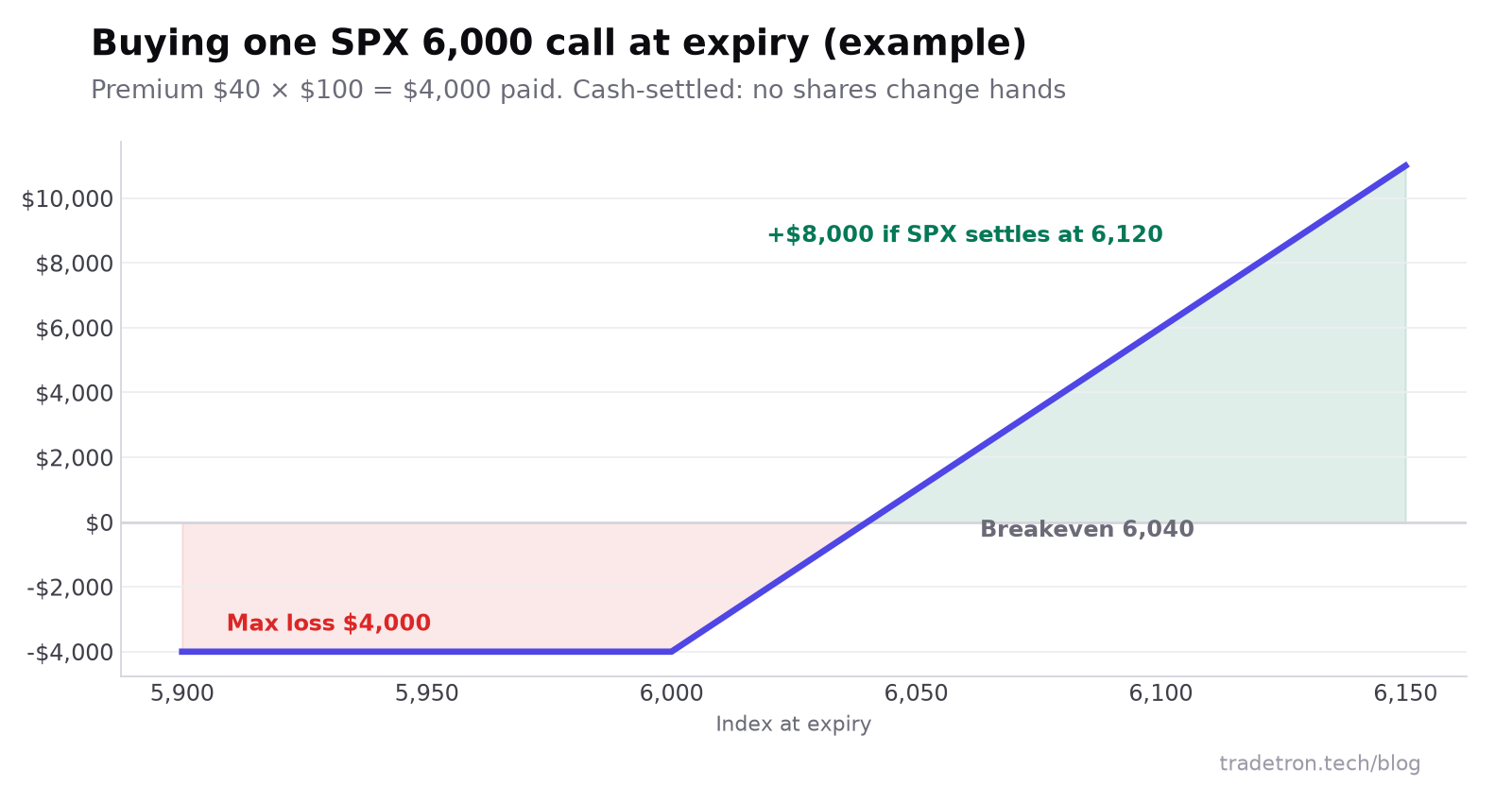 A long SPX call at expiry (example figures)
The main US index options
| Contract | Index | Size | Style | Settlement |
|---|---|---|---|---|
| SPX | S&P 500 | $100 × index | European | Cash |
| XSP (Mini-SPX) | S&P 500 ÷ 10 | $100 × (index ÷ 10) | European | Cash |
| NDX | Nasdaq-100 | $100 × index | European | Cash |
| RUT | Russell 2000 | $100 × index | European | Cash |
| VIX | Cboe Volatility Index | $100 × index | European | Cash, priced off VIX futures |
VIX options behave differently from the rest: they are priced from VIX futures, not the spot VIX number you see quoted, and they expire on Wednesdays. Treat them as their own subject.
Index options vs ETF options (SPX vs SPY)
Many traders choose between SPX options and options on SPY, the ETF that holds the S&P 500.
| SPX (index option) | SPY (ETF option) | |
|---|---|---|
| Settlement | Cash | 100 shares of SPY |
| Exercise | European, only at expiry | American, any time, so early assignment can happen |
| Size | About 10× SPY | Smaller |
| Dividends | None to worry about | Short calls can be assigned early before ex-dividend |
| US tax (taxable accounts) | 60% long-term, 40% short-term, regardless of holding period | Normal short- and long-term rules |
For multi-leg strategies held to expiry, SPX's cash settlement means a short leg can't leave you holding shares you didn't plan for. SPY's smaller size suits smaller accounts. XSP sits in between: cash-settled like SPX, at one-tenth the size.
Why traders use index options
- Directional views on the whole market without picking stocks.
- Hedging a portfolio: buying SPX puts or put spreads to offset losses in a stock portfolio that moves with the index.
- Income strategies: selling credit spreads or iron condors on SPX, with defined risk.
- Event and volatility trades around Fed meetings, inflation data and earnings seasons.
- Short-dated trading: daily SPX expiries allow strategies that open and close on the same day. See the best 0DTE options strategy.
Trading index options systematically
Index options suit rules: time windows, strike distances, stops and time exits can all be written down and tested. A systematic approach usually looks like this:
- Define the view and structure: for example, "sell a 50-point-wide SPX iron condor when the index is range-bound."
- Write every variable: entry conditions, strike selection, size, profit target, stop and time exit.
- Build it on a platform that handles multi-leg positions and cash-settled index options.
- Backtest across calm and volatile periods.
- Run it simulated in live markets, then go live with one contract.
Next, read how US traders automate options or how to automate a 0DTE SPX strategy without coding.
Frequently asked questions
What is an index option contract?
It is an options contract whose underlying is a stock index, such as the S&P 500, rather than a single stock. It gives the buyer the right to the difference between the index level and the strike at expiry, paid in cash.
How are index options settled?
In cash. At expiry, if the option is in the money, the holder receives the in-the-money amount in points multiplied by the contract multiplier ($100 for SPX). No shares or index units change hands.
What is the difference between SPX and SPY options?
SPX options are on the S&P 500 index, cash-settled, European-style and about ten times larger. SPY options are on the SPY ETF, settle in shares, are American-style and can be assigned early.
Can index options be exercised early?
The main US index options (SPX, XSP, NDX, RUT) are European-style, so they can only be exercised at expiry. You can still sell or buy back the option at any time before then.
How are index options taxed in the US?
For US taxpayers, broad-based index options such as SPX are Section 1256 contracts: gains and losses are treated as 60% long-term and 40% short-term, whatever the holding period, and positions are marked to market at year-end. Check with a tax advisor for your situation.
Can I automate index option trading?
Yes. On Tradetron you can build multi-leg index option strategies with entry rules, stops, targets and time exits, backtest them, run them Live Offline, and then trade through a connected US broker.