Backtesting: The Smart Way to Avoid Costly Trading Mistakes
Backtesting helps you avoid costly trading mistakes by running your strategy's rules on historical data before you risk money, so flawed ideas fail on old data instead of in your account. It only works if the test is honest: realistic costs, enough data, no peeking at the future, and no tuning the rules until they fit the past perfectly.

Why backtesting saves you money
Without testing, you find out whether a strategy works by trading it, and every lesson costs real rupees. A backtest compresses years of trading into minutes:
- It reveals the worst case. You see the deepest drawdown and the longest losing streak before you live through them.
- It checks your rules do what you think. A stop that never triggers, or an entry that fires twenty times a day, shows up straight away.
- It compares versions fairly. Two stop-loss levels, two entry times, the same data.
- It builds the confidence to follow the rules. When you've seen a strategy recover from bad stretches in testing, you are less likely to abandon it in the next one.
How to backtest a trading strategy, step by step
- Write the rules completely. Entry, exit, stop loss, target, position size and timing. If a rule needs judgement, it can't be tested.
- Choose the market and timeframe you will actually trade.
- Pick a date range that covers different conditions: a sharp fall, a sideways stretch, a trend.
- Run the test with settings that match how you'll trade (candle frequency, intraday or positional).
- Read the result after costs: drawdown, profit factor, trade count and month-by-month P&L, not just total profit.
- Change one thing at a time, and keep a note of every version you tried.
- Test forward: run the chosen version Live Offline before going live.
The backtesting guide shows exactly how to do this on Tradetron, setting by setting.
The 10 most common backtesting mistakes
1. Overfitting: tuning until the past looks perfect
If you try enough combinations of settings, one of them will look brilliant on past data purely by chance. The simulation below shows how strong this effect is. Each "strategy" is random, with no real edge at all. Pick the best of 50 on one year of data and it shows an excellent Sharpe ratio; run that same strategy on the next year and it returns to nothing.
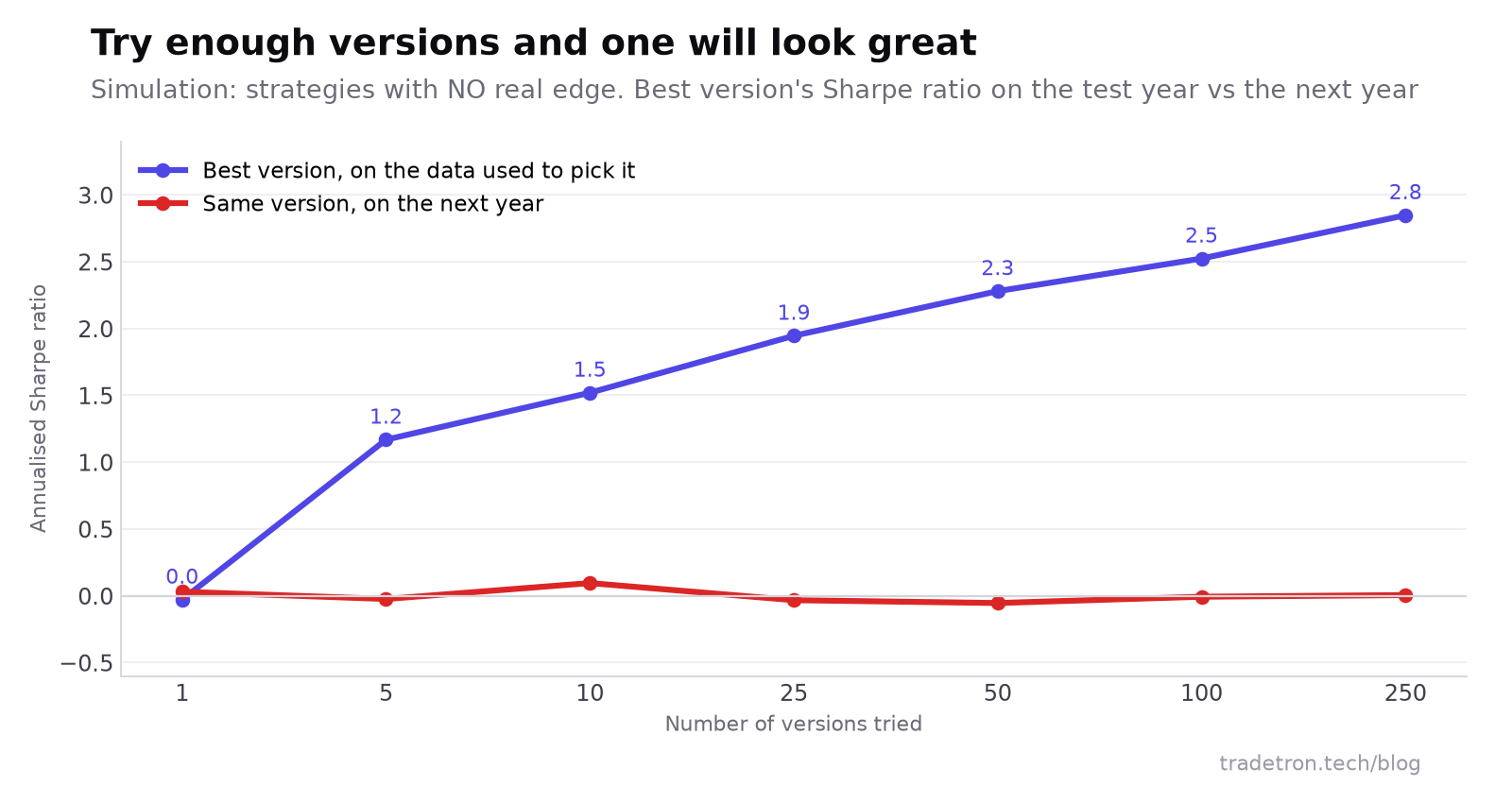 Simulated: the more versions you try, the better the best one looks, and none of it carries forward
How to avoid it: keep the rules simple, limit how many versions you try, prefer settings whose neighbours also work, and always check the chosen version on data you didn't use to choose it.
2. Ignoring costs and slippage
Brokerage, taxes and slippage come out of every trade. A strategy making ₹300 per trade before costs can lose money after them if it pays ₹150 in charges and ₹200 in slippage per round trip. Read understanding slippage and apply realistic costs before judging any result.
3. Look-ahead bias
Using information that wasn't available when the trade was taken. A classic example: a rule that buys at 9:20 if "today's close" is above yesterday's. Today's close isn't known at 9:20. Make sure every condition uses only data that existed at the moment of the trade, such as the previous candle's close, not the current one's.
4. Too few trades
Twenty trades can't tell skill from luck. A coin flipped twenty times can easily land heads fourteen times. Aim for enough trades, across enough months, that one or two outliers don't decide the result.
5. Testing only one kind of market
A short-straddle strategy tested only through calm months has never met a 3% gap. A trend strategy tested only in a rally has never been chopped up in a sideways market. Include different conditions in the date range, and look at how each year did on its own.
6. Ignoring how the market has changed
Contracts change. NIFTY's lot size is 65 now and BANK NIFTY's is 30. NSE's weekly index expiry is NIFTY only, on Tuesday; BANK NIFTY, FINNIFTY and MIDCPNIFTY now have monthly expiries only. A strategy built on weekly Bank Nifty options may have tested well on older data, but it can't be traded the same way today.
7. Wrong settings for the strategy
Running a positional strategy as intraday forces every position closed at day end, and every number is wrong. Using 15-minute candles for a strategy with a 9:20 entry or an LTP-based stop puts the checks at the wrong moments. Match the settings to how the strategy really trades.
8. Judging on total profit alone
Two strategies with the same profit can have very different drawdowns. Look at maximum drawdown, profit factor, average win against average loss, and how results are spread across months. Our guide on evaluating strategy performance explains each one.
9. Confirmation bias
Changing the date range until the result looks good, or explaining away the bad months as "unusual", turns a test into a sales pitch. Decide the date range and the pass criteria before you run the test, and write down every version you tried, including the failures.
10. Going straight from backtest to full size
Even a careful backtest can't see live fills, delays between signal and order, or a logic error that only shows up in real time. Run the strategy Live Offline first, then trade small, and compare live results with the backtest for the same days.
A quick pre-flight checklist
| Check | Why |
|---|---|
| Rules are complete and need no judgement | Only written rules can be tested |
| Every condition uses only past data | Avoids look-ahead bias |
| Date range includes a fall, a range and a trend | Shows how it handles different markets |
| Enough trades for the result to mean something | Separates skill from luck |
| Costs and slippage applied | Shows the result you'd actually keep |
| Chosen settings work on held-back data | Guards against overfitting |
| Settings match the strategy (type, candle frequency) | Avoids results that are simply wrong |
| Tested Live Offline before going live | Catches what history can't |
When a live strategy and its backtest disagree, read nine reasons your backtest doesn't match live trading.
Frequently asked questions
Can I trust backtesting results?
Trust them as a filter, not a forecast. A backtest done with realistic costs, enough data and no overfitting tells you a strategy had an edge in the past. It can't promise the future, so test forward before trading real money.
How much historical data is enough for backtesting?
Enough to include different market conditions and a meaningful number of trades. For intraday strategies, a couple of years is a reasonable minimum; for positional ones, longer. More data only helps if the rules and contracts still apply to it.
What is overfitting in backtesting?
Overfitting is tuning a strategy's settings until they fit past data perfectly, so that the result reflects past noise rather than a real pattern. Overfitted strategies tend to fall apart on new data.
What if my strategy does well in the backtest but fails live?
Check costs and slippage first, then whether the backtest settings matched the strategy, then whether the market has changed. Running the strategy Live Offline before going live catches many of these problems.
Can beginners do backtesting?
Yes. No-code platforms such as Tradetron let you build a strategy from conditions and positions and backtest it without programming. The discipline matters more than the tool: realistic costs, enough data and honest records of what you tried.
Can I backtest crypto strategies on Tradetron?
Tradetron's backtesting engine covers several markets, including crypto (BTC and ETH), alongside NSE, BSE, MCX and US markets.