Algo Trading vs Manual Trading: Where Automation Wins
Algo trading vs manual trading comes down to who executes the rules. In manual trading you watch the market and place every order yourself. In algo trading you write the rules once and software applies them to every price update and places the orders. Automation wins on discipline, speed and testability; manual trading keeps flexibility and judgment for situations no rule anticipated.
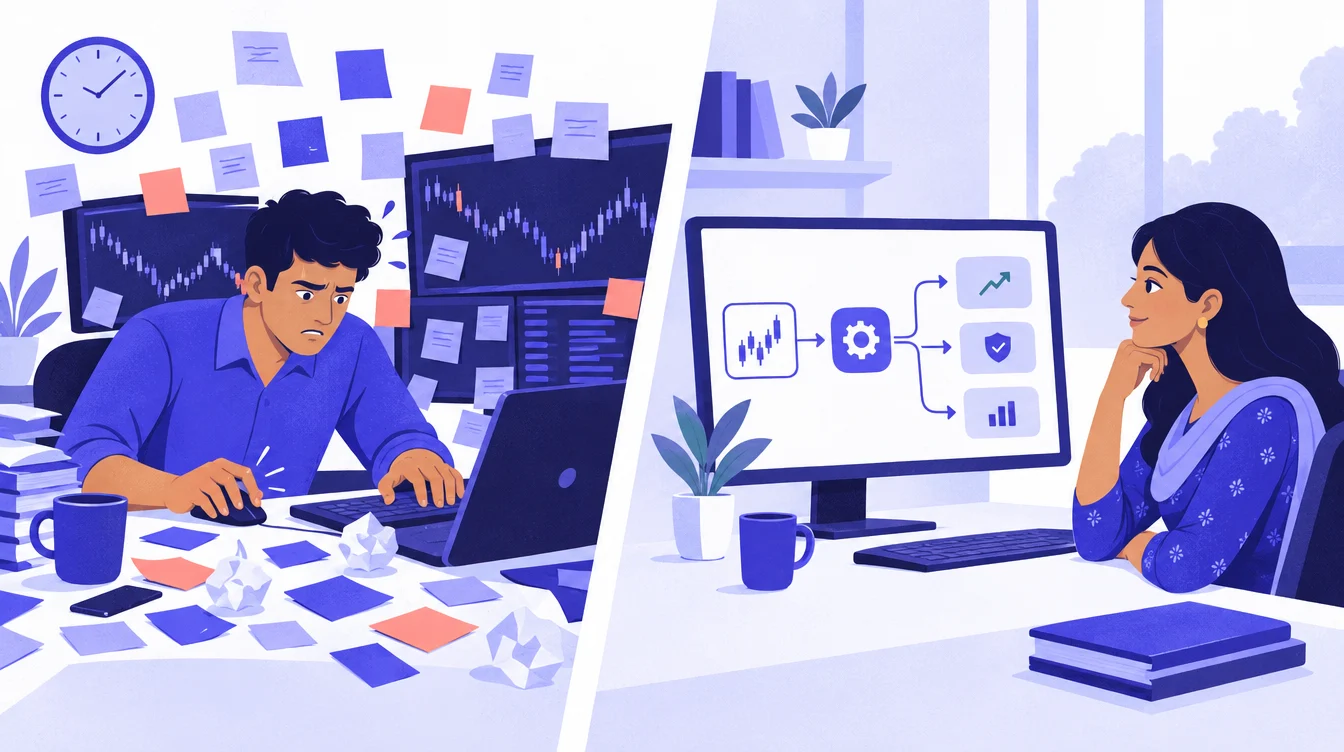
The difference in one example
Your rule: buy NIFTY futures when the price breaks above the first 15 minutes' high, stop loss 0.5% below entry, exit at 3:15 pm.
- Manually, you watch the screen from 9:30, place the order when the break happens (if you're at your desk), set the stop, and remember to exit at 3:15. On a day when the stop is hit right after a losing week, you may be tempted to move it "just a little".
- As an algo, the platform checks the condition on every price update, enters, places the stop at exactly 0.5% from your actual fill, and exits at 3:15 whether you're watching or in a meeting. It never moves the stop.
Same rule, two very different levels of consistency.
Algo trading vs manual trading: side by side
| Manual trading | Algo trading | |
|---|---|---|
| Who places orders | You, one by one | Software, when rules are met |
| Speed | Your reaction time, usually seconds | Fractions of a second after the rule triggers |
| Discipline | Depends on your mood and recent results | Identical on every trade |
| Testing an idea | Looking back at charts, which is easy to bias | Backtest the exact rules on years of data |
| Screen time | Watching through market hours | Set up, then monitor |
| Flexibility | Full: you can react to anything | Only what the rules cover |
| Handling surprises | Judgment can step in | Follows the rules, even when they no longer fit |
| How many strategies | One or two at a time, realistically | Several, across instruments and accounts |
| Typical mistakes | Hesitation, revenge trades, moved stops | Wrong rules, untested edge cases, connection issues |
Where algo trading wins
Discipline that doesn't depend on your mood
The hardest moment in trading is closing a losing trade at the planned stop. An algorithm doesn't feel that moment. It also doesn't double the size after three wins or skip a valid signal after three losses.
Testing before risking money
With manual trading, "testing" usually means scrolling back through charts and remembering the winners. With algo trading you backtest the exact rules on years of data and see every trade, the worst drawdown, and how it behaved in trending and sideways markets. Then you run it on live prices without sending orders before any money is at risk.
Time and scale
A strategy that trades a 9:20 entry and a 3:15 exit doesn't need you at your desk all day. You can run several strategies on different instruments, which is hard to do manually without mistakes.
Precise execution of multi-part rules
Options strategies with four legs, stops on each leg, and adjustments when the market moves are error-prone when typed by hand. Software places all legs from one rule.
Where manual trading still wins
Judgment when something new happens
Rules are written for situations you imagined. A sudden policy announcement, a trading halt, or a broker outage are situations most rules never anticipated. A human trader can step back; an algorithm keeps applying its rules.
Flexibility with unclear setups
Some traders read context: the tone of the market, how price reacts to news, whether a breakout "looks" real. If you can't write a judgement as a rule, you can't automate it. That is also a hint to check whether it's an edge or a feeling.
Fewer moving parts
Manual trading has no API keys, no static IPs, no token renewals, no strategy logs to review. There is less to break, though more to get wrong in the moment.
Which one suits you?
| Your situation | Better fit |
|---|---|
| You have clear, written rules (breakouts, indicator signals, time-based options strategies) | Algo trading |
| You work during market hours | Algo trading |
| You often move or skip your own stops | Algo trading |
| You want evidence from past data before risking money | Algo trading |
| Your edge depends on judgment you can't write down | Manual, for now |
| You're learning how a market behaves for the first time | Manual, for now |
| You make a few investing decisions a year | Manual is enough |
The hybrid approach most traders end up with
In practice it isn't either-or. Most experienced traders combine the two:
- You decide the strategy: which market, which setup, how much risk. That is judgment.
- You write it as rules and backtest them.
- The software executes: entries, stops, targets and time exits.
- You monitor and review: check daily logs, pause the strategy around events you don't trust it with (budget day, major policy announcements), and change rules based on evidence, not on one bad day.
You keep the part humans are good at, and hand over the part humans are bad at.
Read next: building automated trading strategies without coding, the psychology of algorithmic trading and is algo trading profitable in India.
Frequently asked questions
What is the main difference between algo trading and manual trading?
In manual trading you analyse the market and place each order yourself. In algo trading you define the rules in advance and software places orders automatically when those rules are met.
Is algo trading more profitable than manual trading?
Not by itself. Automation executes a strategy more consistently, but a losing strategy automated is still a losing strategy. What automation adds is discipline and the ability to test rules before trading them.
Is algo trading better for beginners?
It can be, if the beginner has clear, tested rules. It helps with discipline and lets you test on past data. But beginners should first understand the market they trade, and should run any algorithm in a simulated mode before trading real money.
Can I combine manual and algo trading?
Yes, and most traders do. You decide the strategy and the risk, let software handle entries, stops and exits, and step in to pause or adjust when something happens that the rules don't cover.
What are the risks of algo trading?
Wrong or incomplete rules, strategies that only worked on past data, broker or connection failures, and running more strategies than you can supervise. Testing, small starting sizes and daily monitoring reduce these.
Is algo trading legal in India for retail traders?
Yes. Orders go through your SEBI-registered broker under SEBI's algo trading framework. See is algo trading legal in India for what the rules require.