Market Hours vs Volatility: Best Time to Trade SPX500

The best time to trade the SPX500 (the S&P 500 index) is usually the first two hours after the 9:30 AM New York open and the last hour or two before the 4:00 PM close. Volume and volatility are highest in those windows, while the midday session is typically quieter and more range-bound. In India, the regular session runs 7:00 PM to 1:30 AM IST in US summer and 8:00 PM to 2:30 AM in winter.

What "SPX500" means and what you can actually trade
SPX is the ticker for the S&P 500 index; "SPX500" or "US500" is the name many CFD and forex platforms give it. The index itself is a number, not something you buy. Traders get exposure through:
- SPX and XSP options (cash-settled index options)
- SPY, VOO or IVV (ETFs that hold the index)
- E-mini and Micro E-mini S&P 500 futures (which trade nearly around the clock, Sunday evening to Friday afternoon New York time)
- CFDs from offshore brokers
US market sessions, in New York time and IST
The S&P 500 index is calculated during the regular session only. Pre-market and after-hours trading happens in stocks, ETFs and futures, with thinner volume.
| Session | New York time | IST (US daylight time, about Mar–Nov) | IST (US standard time, about Nov–Mar) |
|---|---|---|---|
| Pre-market | 4:00–9:30 AM | 1:30–7:00 PM | 2:30–8:00 PM |
| The open | 9:30–11:30 AM | 7:00–9:00 PM | 8:00–10:00 PM |
| Midday | 11:30 AM–2:00 PM | 9:00–11:30 PM | 10:00 PM–12:30 AM |
| Afternoon and close | 2:00–4:00 PM | 11:30 PM–1:30 AM | 12:30–2:30 AM |
| After-hours | 4:00–8:00 PM | 1:30–5:30 AM | 2:30–6:30 AM |
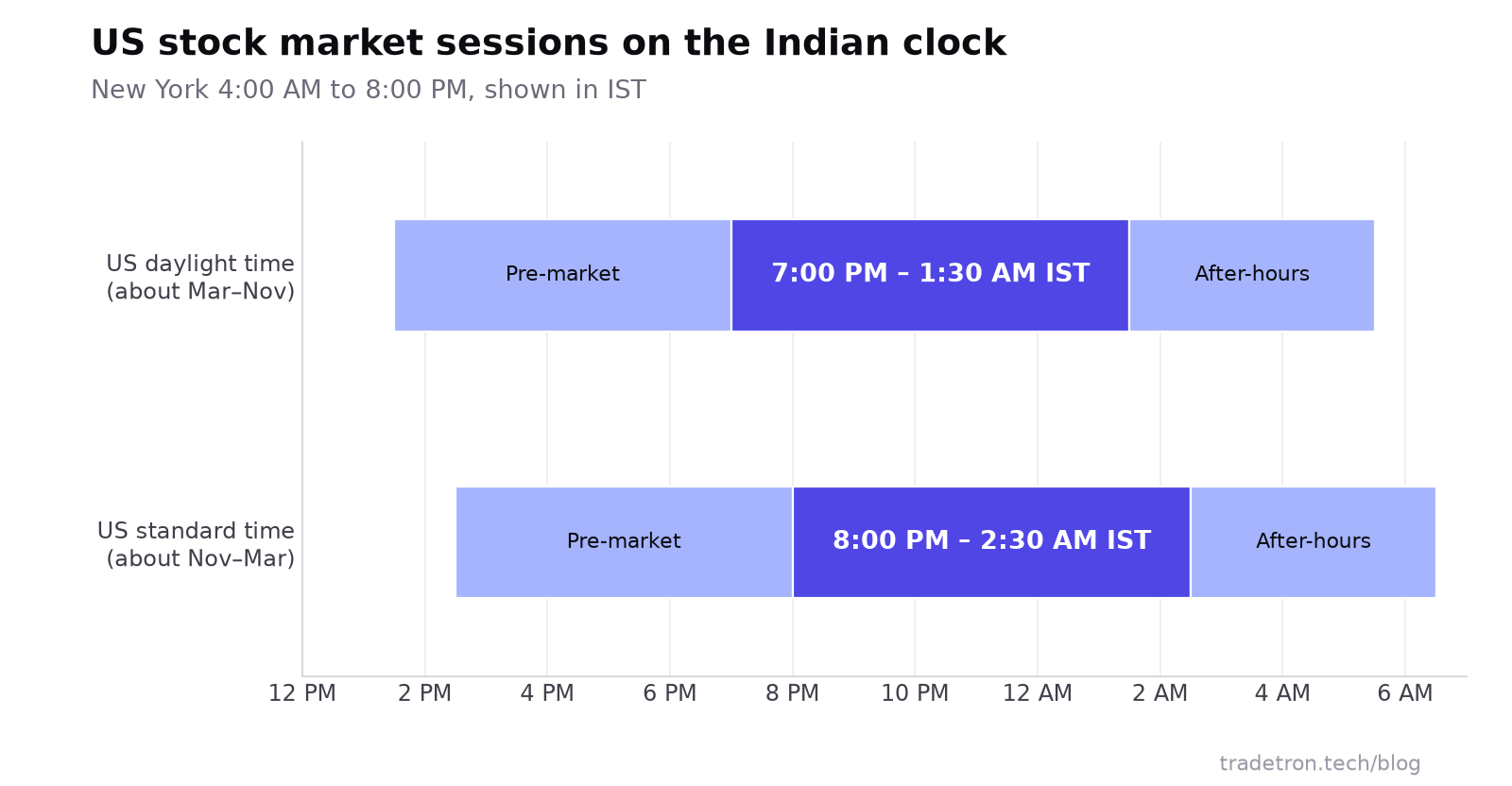 US market sessions on the Indian clock
How volatility changes through the session
The open: 9:30–11:30 AM New York
Overnight news, pre-market economic data and earnings all get priced in during the first minutes. This is usually the most volatile and highest-volume part of the day, with the widest option spreads in the first few minutes.
- Good for: opening-range breakouts, trend-following entries, momentum strategies.
- Watch for: false breakouts in the first 15 minutes, wide spreads on option fills.
Midday: 11:30 AM–2:00 PM New York
Volume typically drops as the morning's moves settle. The index often trades in a narrower range.
- Good for: range-bound and mean-reversion rules, and option-selling strategies that benefit from quiet hours.
- Watch for: breakouts that fizzle for lack of volume.
Afternoon and close: 2:00–4:00 PM New York
Activity picks up into the close as funds rebalance and traders square positions; the final hour is often one of the busiest of the day. On Fed decision days, the statement at 2:00 PM and the press conference after it can reverse the day's direction.
- Good for: trend-continuation entries, closing-hour momentum, and time-based exits.
- Watch for: sharp moves in expiring options, where gamma is highest in the last hour.
Pre-market and after-hours
Lower liquidity and wider spreads. Prices react to earnings released before the open or after the close. Most retail strategies are better off acting on what these sessions reveal than trading inside them.
Event days change the pattern
| Event | Usual timing (New York) | What it does |
|---|---|---|
| CPI, jobs report and other major data | 8:30 AM, before the open | Big moves in futures; the open gaps |
| FOMC rate decision | 2:00 PM, press conference after | Afternoon volatility spike, sometimes reversals |
| Big-tech earnings | After the close or before the open | Gaps in the index the next session |
| Monthly and quarterly option expiries | Third Friday | Heavy volume around the close |
A common systematic rule is to skip new entries, or trade smaller, on scheduled high-impact days. Whatever you choose, write it into the strategy instead of deciding on the night.
Matching the strategy to the window
- 9:30–11:30 AM breakout and trend entries
- 11:30 AM–2:00 PM range and premium-selling rules
- 2:00–4:00 PM momentum into the close, and exits
These are starting points from how sessions usually behave, not promises. Two strategies on the same index can need opposite windows. The way to find yours is to backtest the same rule with different entry windows and compare the results.
Why automation fits SPX trading from India
The problem with the best SPX windows, for an Indian trader, is the clock: the open is at dinner time and the close is past midnight. Trading it manually means either losing sleep or skipping half the session.
Pros
- Entries and exits fire at the times you set, including 1 AM IST
- Stops and time exits are applied without hesitation
- The same rule runs the same way every night, so results are testable
- You can run several time-window strategies at once
Cons
- A bad rule runs just as faithfully as a good one
- You still need to monitor for connection or broker issues
- Clock changes and holidays must be handled in the rules
- Automation doesn't remove market risk
Automation doesn't make a strategy better. It makes it consistent, and consistency is what lets you know whether a strategy works.
Trading SPX options on expiry day? Read the best 0DTE options strategy. Opening a US account from India? See US brokers that accept Indian traders.
Frequently asked questions
What is the best time to trade the SPX500?
For most intraday strategies, the first two hours after the 9:30 AM New York open and the last hour or two before the 4:00 PM close. Those windows have the most volume and the biggest moves. Midday is usually quieter and suits range-bound strategies.
What time does the S&P 500 open in India?
The regular session opens at 7:00 PM IST while the US is on daylight time (roughly March to November) and at 8:00 PM IST the rest of the year. It closes at 1:30 AM or 2:30 AM IST respectively.
Why is the market so volatile at the open?
Everything that happened overnight, including economic data at 8:30 AM New York, earnings and global markets, gets priced in at once. Orders build up before the open and are matched in the first minutes.
Is midday a bad time to trade SPX?
Not for every strategy. Lower volatility hurts breakout strategies but can suit range-bound rules and option selling. Test your rule in each window rather than avoiding midday by habit.
Can I trade SPX options outside regular hours?
SPX options have an extended overnight session in addition to regular hours, and S&P 500 futures trade nearly 24 hours on weekdays. Liquidity outside the regular session is much thinner, so spreads are wider.
How can I trade US market hours from India without staying awake?
Automate the rules. On Tradetron you can set time-window entries, stops and exits for US instruments, backtest them, and run them Live Offline before trading through a connected US broker.