Pushkar Raj Thakur's Double Supertrend Strategy, Built as an Algo
The double Supertrend strategy shared by Pushkar Raj Thakur trades NIFTY only when two Supertrend indicators agree: Supertrend (10, 3) and Supertrend (20, 2) on the daily chart. Both green means go long, both red means go short, and when they disagree you stay out. Below are the full rules and how to run them as an algo.

Where the strategy comes from
Pushkar Raj Thakur, a trader and YouTube educator, presented this approach at Option Symposium 6.0 in Mumbai in 2024. The appeal is its simplicity: no price targets, no pattern reading, just two lines and a colour check. We took his rules and turned them into a strategy that runs on its own, with one or two practical choices of our own, which are marked below.
What a Supertrend shows
Supertrend is a trend-following line built from the Average True Range (ATR), which measures how much price typically moves per candle. It takes two settings:
- Period: how many candles the ATR is averaged over (10 or 20 here).
- Multiplier: how many ATRs away from price the line sits (3 or 2 here).
When price closes above the line, the line sits below price and turns green: uptrend. When price closes below it, the line flips above price and turns red: downtrend. A bigger multiplier keeps the line further from price, so it flips less often.
Using two Supertrends with different settings is a confirmation filter. One line on its own flips back and forth in a sideways market. Requiring both to agree cuts many of those false flips, at the cost of entering a little later.
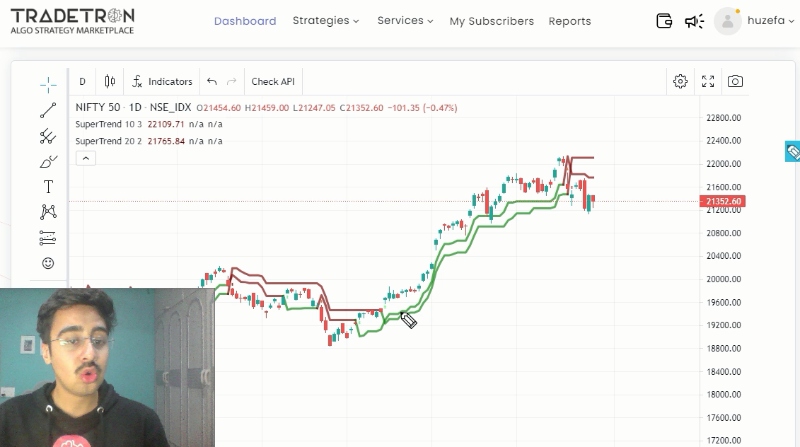 NIFTY daily with Supertrend (10, 3) and (20, 2) on the Tradetron chart
The rules
| Both Supertrends | Signal | Position |
|---|---|---|
| Green | Uptrend confirmed | Long NIFTY futures, 2 lots |
| Red | Downtrend confirmed | Short NIFTY futures, 1 lot |
| One green, one red | No agreement | Flat: close any open position and wait |
Why 2 lots long and 1 lot short?
The strategy is deliberately lopsided. The idea is to lean into uptrends and stay cautious on the short side, where sharp short-covering rallies can hurt a position quickly. This is a sizing choice, not a law: if you trade it, test both sides with equal size as well and see which you are comfortable with.
With NIFTY's lot size at 65, two lots is 130 units and one lot is 65. Every 100-point move in NIFTY is ₹13,000 on the long side and ₹6,500 on the short side.
Timing the entry
The original rule allows entry any time after the market opens. We prefer to wait until 10:00 AM. The first 45 minutes often carry the overnight gap and a burst of volatility, and a signal that appears at 9:20 and disappears by 9:50 is exactly what the second Supertrend is meant to filter out.
Managing the monthly expiry
NIFTY futures expire monthly. If both Supertrends still agree when your contract is about to expire, the strategy closes the current-month position and opens the same position in the next month. Without this rollover step, an automated strategy would simply let the position expire and sit flat until the next fresh signal.
A lower-risk version with option spreads
Not everyone wants to hold directional futures. The same signals can drive defined-risk option spreads instead:
- Both green: a bull call spread. Buy a call near 60 delta and sell a call near 30 delta, same expiry.
- Both red: a bear put spread. Buy a put near 60 delta and sell a put near 30 delta.
The bought option gives you the direction, and the sold option pays for part of it. The trade-off is a capped profit in exchange for a capped loss.
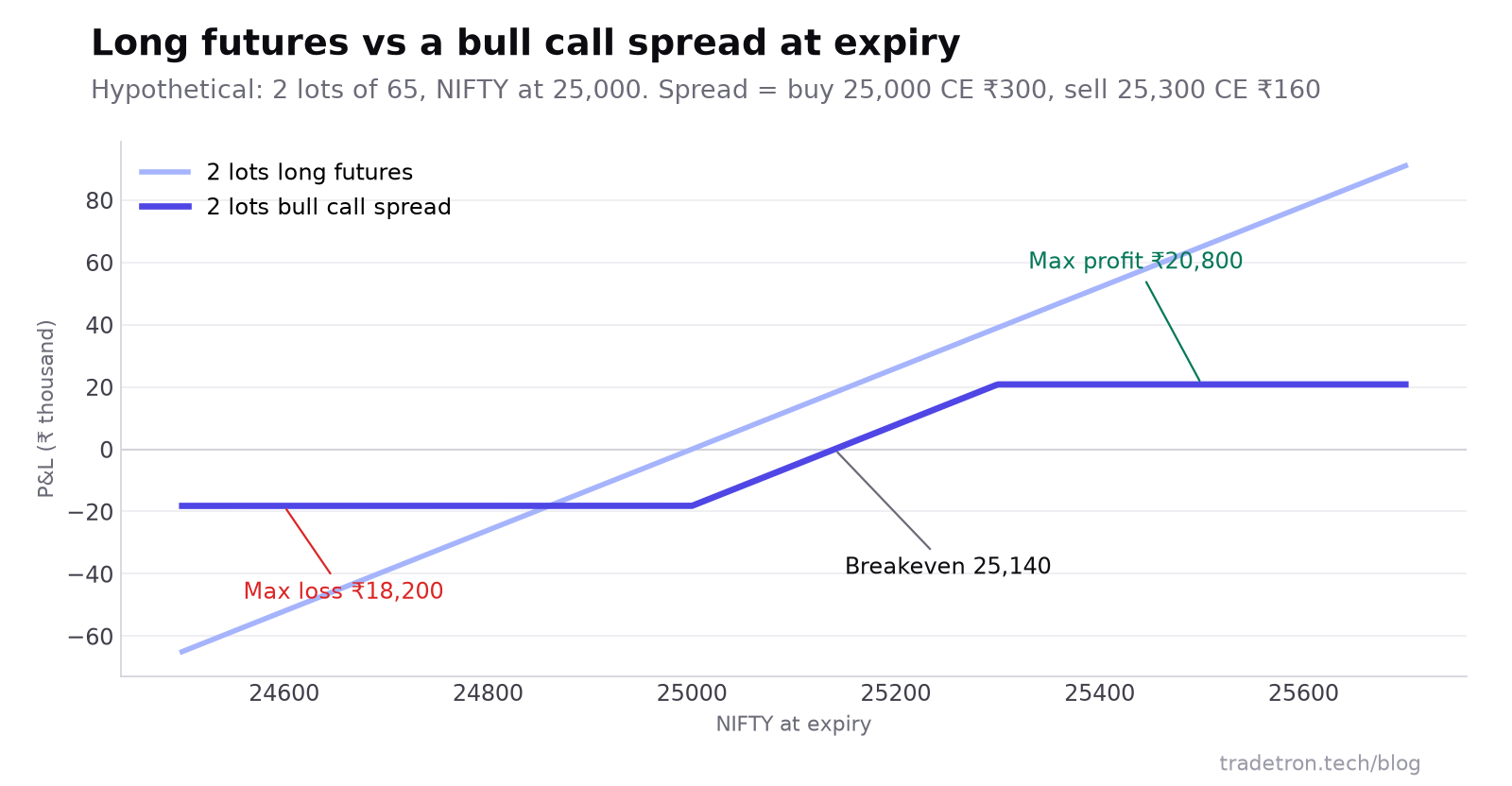 Hypothetical example: futures vs a bull call spread on the same view
Pros
- Simple, objective rules with no discretion
- The second Supertrend filters many false flips
- Works on daily candles, so it needs no screen time once automated
- Can be run with futures or with defined-risk spreads
Cons
- Late entries and exits: by the time both lines agree, part of the move is gone
- Choppy, sideways markets still produce back-to-back small losses
- Futures positions carry overnight gap risk
- The lopsided long/short sizing is a view on the market, not a tested fact
How to automate it on Tradetron
Want the option-spread version to adjust itself? Read about repair conditions. For other trend tools, see Renko charts and the Bollinger Bands strategy guide.
Frequently asked questions
What is the double Supertrend strategy?
It is a trend-following strategy that uses two Supertrend indicators with different settings, here (10, 3) and (20, 2) on daily NIFTY. You go long when both are green, short when both are red, and stay out when they disagree.
What are the best Supertrend settings for NIFTY?
There is no single best setting. (10, 3) is the most common default. This strategy pairs it with (20, 2) as a second opinion. Backtest a few combinations on the timeframe you trade and choose one that holds up across different market phases, not just the best past result.
Which timeframe does this strategy use?
The rules shown here use daily candles, so signals change at most once a day. You can test the same logic on hourly or 15-minute candles, but expect more signals and more whipsaws.
Can I trade the double Supertrend strategy with options instead of futures?
Yes. Replace the long futures with a bull call spread and the short futures with a bear put spread, buying around 60 delta and selling around 30 delta. That caps both the loss and the profit on each trade.
Is the double Supertrend strategy profitable?
No strategy is profitable in every market. Supertrend systems do well in long trends and give back money in sideways markets. Backtest it on your instrument and timeframe, and run it Live Offline before trading real money.