A Range Breakout Trading Strategy on Nifty 50 Stock Options

This trading strategy on Nifty 50 stock options scans every F&O stock in the NIFTY 50 each morning, marks the high and low of its first 15 minutes, and buys a call when a stock breaks above that range or a put when it breaks below. Each trade has a target equal to the range size, a stop at the other side of the range, and a time exit at 3:15 PM.

Why an opening range breakout?
The first 15 minutes of the session absorb the overnight news, the gap and the opening rush of orders. The high and low of that window mark where buyers and sellers first agreed on a price for the day. When a stock leaves that range with conviction, it often keeps going in the same direction for a while. When it doesn't, the range edges give you a natural place for a stop.
Scanning all F&O stocks in the NIFTY 50 instead of one index gives the strategy many chances every day. On a given day, some stocks will be trending while the index itself goes nowhere.
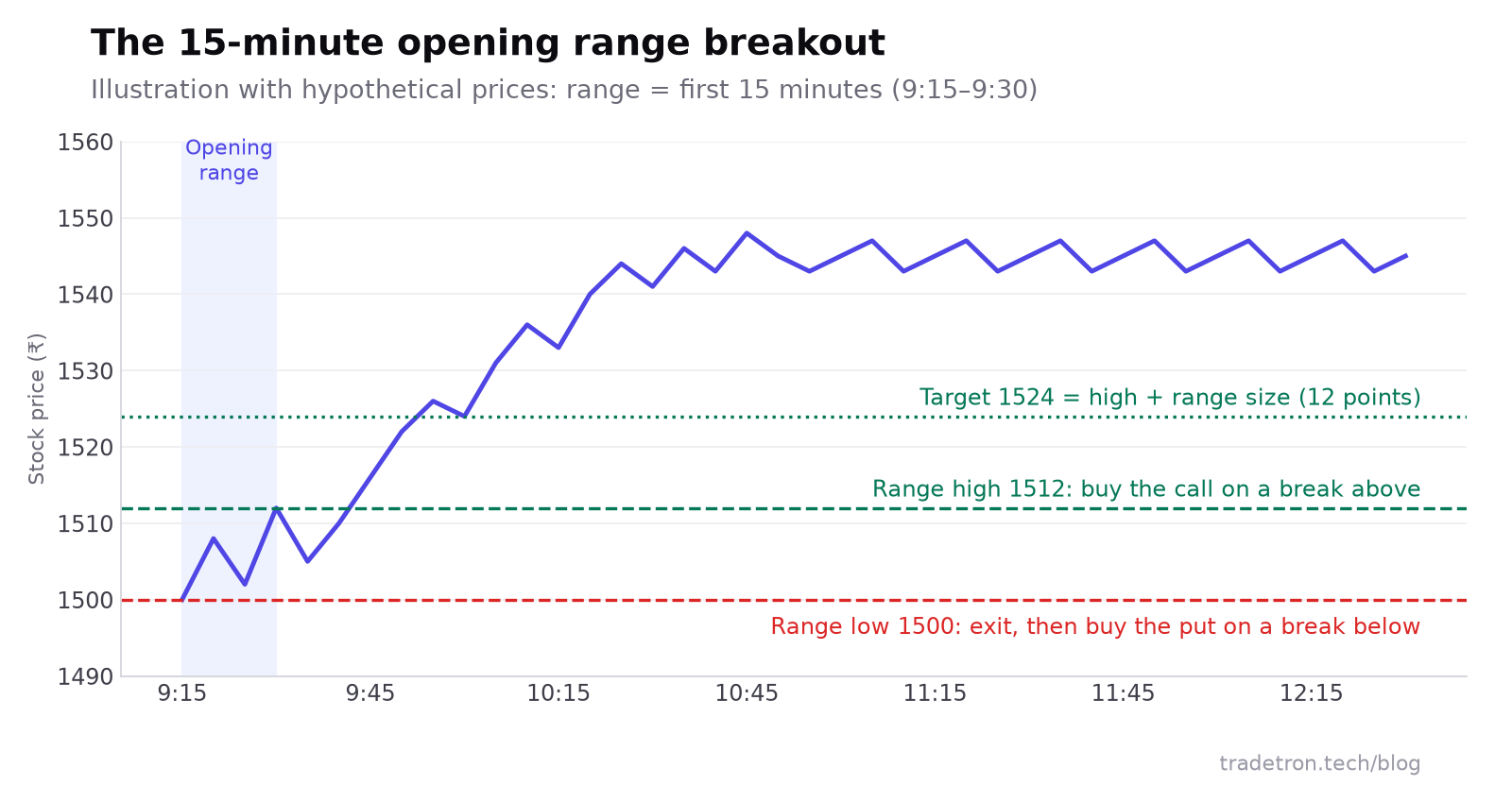 How the range, entry, stop and target relate (hypothetical prices)
The strategy works best on trending days. On a choppy day, a stock can break the high, fall back through the low and whip you in both directions, which is why one entry per side per day is part of the rules.
The rules
Building it on Tradetron, step by step
Here is how each rule maps to Tradetron's no-code builder.
- Pick the instrument list. Choose the Nifty FUTSTK list on the NFO exchange, so one set of conditions is checked for every stock on it.
- Write the long entry. Three conditions joined with AND: Time > 930; LTP of the stock > the high of the first 15-minute candle; and Positions Detail showing no open call on that stock, so you get one call entry per stock.
- Define the position. Buy a call option on the same stock from the list. A second, mirrored entry does the same for puts on a break below the low.
- Add the reversal exit. If LTP falls below the range low, square off the call. The put entry then takes over for the short side.
- Set target and stop. Target on the underlying: range high + (range high − range low). Stop: the range low. Mirror both for puts.
- Advanced settings. A universal exit at 3:15 PM, and limit orders with revision attempts so orders in less liquid stock options keep chasing a fair price instead of sitting unfilled.
- Reactivation and trailing stop. Set the reactivation time (6 hours in the original build) so the strategy resets for the next day, and add a trailing stop that suits your risk.
Choosing the option
The rules say "buy a call" or "buy a put", but which strike and expiry?
| Choice | Effect |
|---|---|
| At-the-money (ATM) strike | Moves most closely with the stock; costs the most |
| Slightly out-of-the-money | Cheaper; needs a bigger move to pay off |
| Current-month expiry | Most liquid; stock options in India have monthly expiries |
| Next-month expiry near expiry week | Slower time decay in the last days of the month |
ATM or one strike in the money is a sensible starting point for a breakout trade, because you are betting on a move today, not on a big move weeks away. Time decay works against option buyers, so a trade that goes nowhere loses value even if the stop isn't hit.
Testing and optimising
Backtest before trading it, and change one thing at a time:
- Range length: 15 minutes vs 30 minutes. A longer range gives fewer, more reliable breakouts.
- Entry cut-off: stop taking new breakouts after a set time, such as 1:00 PM, so late moves with little time left don't trigger trades.
- Target multiple: 1× the range vs 1.5× or 2×, with a trailing stop on the extra.
- Universe: all NIFTY 50 F&O stocks vs a shortlist of the most liquid ones.
Keep an eye on costs. A strategy that trades many stocks a day pays brokerage, taxes and spreads on every leg, so check the backtest net of charges. Our guide to evaluating a strategy's performance covers what to look at beyond total profit.
Pros
- Many opportunities every day across dozens of stocks
- Clear, objective entry, stop and target levels
- Defined risk on each trade when buying options
- Square-off by 3:15 PM means no overnight positions
Cons
- Choppy days cause false breakouts in both directions
- Stock option spreads and costs eat into small moves
- Time decay works against bought options on slow days
- Many simultaneous positions on strongly trending days
For a multi-day version of the same idea, read the 4-day high-low range breakout strategy.
Frequently asked questions
What is an opening range breakout strategy?
It marks the high and low of the first few minutes of the session, usually 15 or 30 minutes, and trades in the direction price breaks out of that range. A break above the high is a buy signal; a break below the low is a sell signal.
Why trade stock options instead of index options for this?
Even on days when the index goes nowhere, some individual stocks trend. Scanning all NIFTY 50 F&O stocks gives more breakout chances. The trade-off is lower liquidity and wider spreads than in NIFTY options.
What time frame is best for the opening range?
15 minutes (9:15 to 9:30) is the most common choice and is what this strategy uses. A 30-minute range filters out more false breakouts but leaves less of the day to trade. Backtest both on the stocks you plan to trade.
Should I buy ATM or OTM options for a breakout?
ATM options track the stock's move most closely, which suits a same-day breakout. OTM options are cheaper but need a larger move and lose value faster if the move stalls.
Can I automate a breakout strategy on many stocks at once?
Yes. On Tradetron, a list-based set checks the same entry and exit conditions on every stock in a list, such as the NIFTY FUTSTK list, and the Positions Detail keyword limits how many positions each stock can have.