What to Do When Your Live Algo Trades Don't Perform as Expected
When a live algo strategy underperforms, don't change the rules first. Work out which of three things went wrong: the strategy did exactly what it should and the market was unkind (normal drawdown), the orders didn't go through as planned (execution), or the strategy never had the edge the backtest suggested (over-fitting or missing costs). Each needs a different fix.
Step 1: Did the strategy do what the rules say?
Before judging the strategy, check the plumbing. Go through each live trade and ask:
- Did every entry happen when the conditions were met, at roughly the expected price?
- Did any order get rejected (margin, price band, freeze quantity, expired broker session)?
- Did stops and targets fire when they should have?
- Were any trades missed because the strategy was paused, the broker was disconnected, or a holiday or expiry change wasn't handled?
If the answer to any of these is "no", the problem is execution or setup, and changing the strategy's logic won't help. On Tradetron, the strategy's logs show what was evaluated and when; our guide on how to debug a strategy explains how to read them.
Step 2: Compare like with like
A common mistake is comparing a month of live trading with the best part of a five-year backtest. Instead, run the backtest over exactly the dates you traded live and compare trade by trade.
| What you see | Likely cause | What to do |
|---|---|---|
| Same trades, worse prices | Slippage, wide spreads, market orders in thin strikes | Measure real slippage, add it to the backtest, use limit orders where liquidity is thin |
| Live trades the backtest doesn't have (or the reverse) | Different data, timing, or a rule that behaves differently live | Check candle timing, data source, and rules that depend on the exact tick |
| Same trades, same prices, still losing | The market period was bad for this strategy | Check whether the drawdown is inside the range seen in testing |
| Costs larger than expected | Charges or trade frequency not modelled | Add full charges to the backtest; consider trading less often |
| Losses far beyond anything in the backtest | Over-fitting, or a market regime the test never covered | Stop, re-test on unseen data, reduce size |
For the full list of reasons tests and live trading differ, see nine reasons your backtest doesn't match live trading.
Step 3: Is this a normal drawdown?
Every strategy has losing streaks, and they are longer than most people expect. This is just probability:
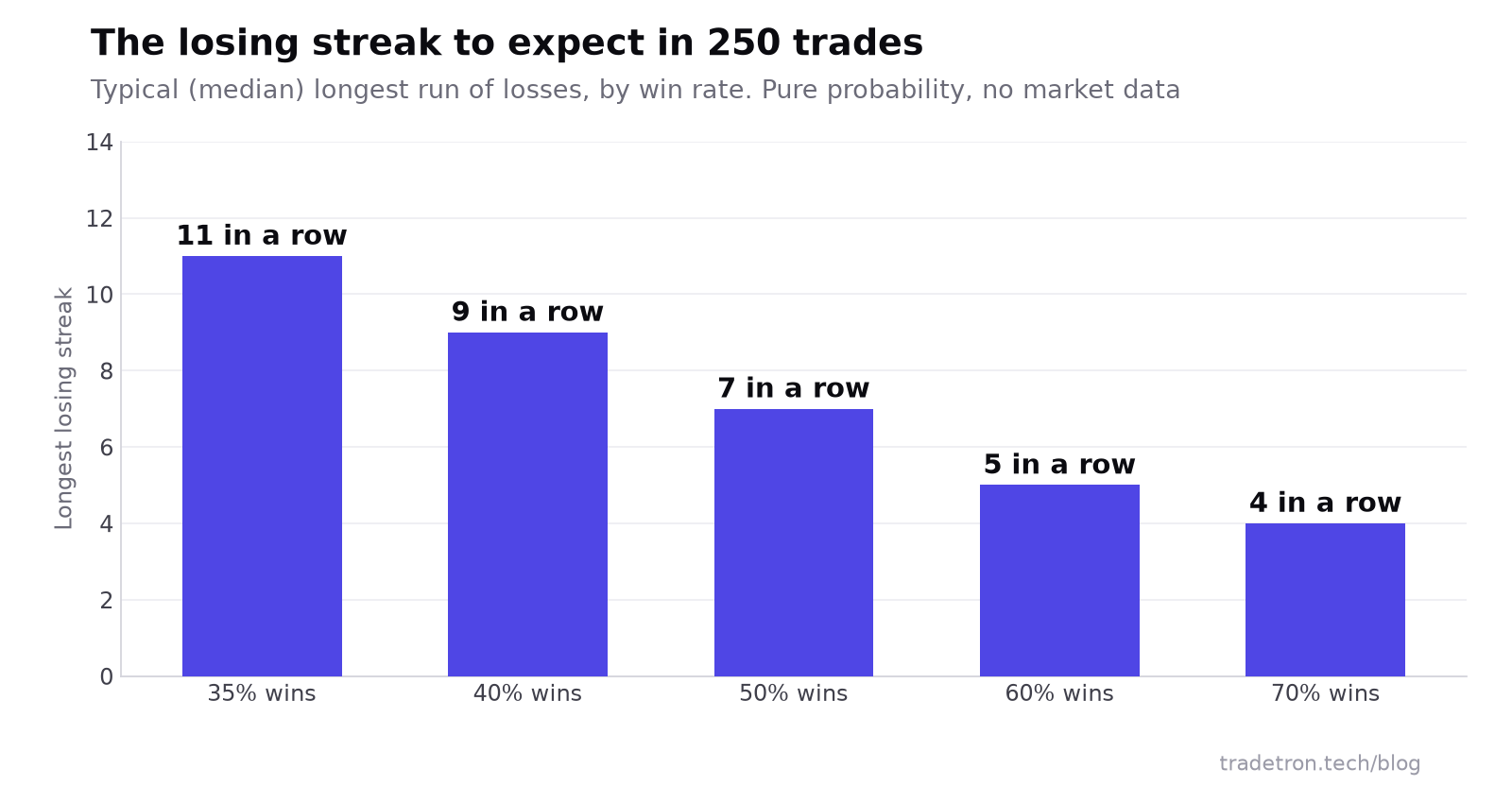 Median longest losing streak over 250 independent trades, by win rate
If your strategy wins 40% of its trades, nine losses in a row is not a sign it has broken; it is the expected worst run in about a year of daily trades. The useful question is whether the current drawdown is within the range you saw in testing.
Step 4: Look for over-fitting and missing costs
If the trades match the rules and the drawdown is outside anything you tested, the strategy itself is the suspect. The usual culprits:
- Over-optimised parameters. Tuned until the backtest looked perfect. Change each parameter slightly and re-test; if results collapse, the edge was never real.
- Costs left out. Brokerage, STT, exchange charges, GST, stamp duty and slippage can erase a strategy that trades often for small gains.
- A changed market. A rule built in a calm year may fail when volatility doubles, or when contract details change (NIFTY lots are now 65 units; NSE weekly expiries moved to Tuesday in 2025; BANK NIFTY no longer has weekly expiries).
- Too few trades in testing. Thirty trades can make a coin flip look like an edge.
See strategy fatigue for how strategies stop working as markets change.
Step 5: Fix one thing, then re-test
- Pick the single most likely cause from the steps above.
- Change only that, for example adding realistic slippage, switching to limit orders, or widening a stop that the market's normal noise keeps hitting.
- Re-run the backtest over the full history, not just the bad month. A fix that only helps recent weeks is curve-fitting.
- Run it Live Offline for a few weeks: the strategy runs on live prices and records every trade, but nothing is sent to the exchange.
- Return to live at a smaller size, and scale up only when live trades match the test again.
Step 6: Reduce risk while you investigate
You don't have to choose between "keep going" and "switch off". While you diagnose:
- Cut position size to the minimum.
- Add or tighten a daily loss limit for the strategy.
- Spread capital across strategies that don't depend on the same market behaviour, for example a trend-following rule alongside an option-selling one. A basket approach can smooth the swings of any single strategy.
More risk controls in seven ways to reduce drawdown.
Habits that prevent most live surprises
- Test with costs and slippage from day one, so live trading has fewer surprises.
- Keep strategies simple. Fewer rules means fewer ways to fit noise.
- Review weekly: rejected orders, slippage, drawdown versus test, any change in lot sizes or expiry days.
- Keep a log of every change you make and why, so you can tell what actually helped.
Frequently asked questions
Why do live algo trades perform worse than backtests?
Usually because of slippage and costs that the test left out, differences in data or timing, rejected orders, or over-fitted parameters. Sometimes the strategy is fine and the live period was simply a normal drawdown.
Should I stop my strategy after a few losing days?
Not automatically. Check whether the trades matched the rules and whether the drawdown is within what you saw in testing. Decide your pause rule before going live, and follow it.
How do I know if my strategy is over-fitted?
Change its parameters slightly and test it on data you didn't use to build it. If small changes or new data turn a profit into a loss, it is probably over-fitted.
How can I reduce slippage in algo trading?
Trade liquid instruments, use limit orders where spreads are wide, avoid the first seconds of the open unless your strategy needs them, and measure your real fills so you can include them in tests.
What is the biggest risk in algo trading?
Weak risk management: no stop-loss, no daily loss limit, or position sizes too large for the account. A good strategy at the wrong size can still do serious damage.
What are basket trading strategies?
Running several strategies or instruments together, so one strategy's bad period is partly offset by others. It reduces dependence on any single edge but doesn't remove market risk.