What is the Best Algorithm for Crypto Trading?

There is no single best algorithm for crypto trading. The right one depends on what the market is doing: trend-following and momentum algorithms suit strong, one-directional moves, mean reversion and grid algorithms suit sideways ranges, and arbitrage needs speed and access to several exchanges. The best algorithm for you is the one that matches the market, your capital and your risk limits, and survives a backtest.

What is a crypto trading algorithm?
A crypto trading algorithm is a fixed set of rules that decides when to buy, when to sell and how much to trade in a cryptocurrency, and then places those orders automatically. The rules use things a machine can measure: price, volume, indicators such as RSI or moving averages, time, and the open position's profit or loss.
A simple example in plain words:
Everything in that sentence is measurable, so a computer can run it without asking you. That is the test of a good algorithm: if two people would read a rule differently, a machine will too.
Why traders use algorithms in crypto
Crypto suits automation more than most markets, for three reasons:
- It never closes. Crypto trades 24 hours a day, seven days a week. You can't watch every move; a rule-based system can.
- It is volatile. Large intraday swings create opportunities and punish slow, emotional exits.
- It is data-rich. Price, volume, funding rates and order books are all available to rules.
An algorithm also removes the two habits that hurt crypto traders most: chasing a coin that has already run, and holding a loser because "it will come back".
The 7 most common crypto trading algorithms
Here is what each algorithm type does, the market it suits, and where it breaks.
1. Trend following
Idea: prices that are moving in one direction tend to keep moving for a while. Typical rule: buy when a fast moving average crosses above a slow one (say the 20 EMA above the 50 EMA), exit on the opposite cross or at a trailing stop. Suits: long, one-directional moves such as a strong Bitcoin rally or sell-off. Breaks: in sideways markets, where it buys high and sells low over and over (whipsaws).
2. Momentum
Idea: a sharp move backed by strong volume often carries on in the short term. Typical rule: buy when the price breaks the highest high of the last 20 candles with RSI above 60; exit on a trailing stop. Suits: breakouts and news-driven moves. Breaks: on false breakouts, which are common in thin altcoins.
3. Mean reversion
Idea: after a stretched move, prices often snap back toward an average. Typical rule: buy when RSI(14) falls below 30 or the price is far below its 20-period average; sell when it returns to the average. Suits: range-bound, sideways markets. Breaks: in a real trend, where "oversold" keeps getting more oversold. A stop-loss is not optional here.
4. Grid trading
Idea: profit from back-and-forth movement by placing layered buy orders below the price and sell orders above it. Typical rule: set price levels 2% apart inside a range; buy at each lower level and sell one level higher. Suits: coins chopping inside a range. Breaks: when the price leaves the range. Below the grid you hold a stack of losing buys; above it you have sold everything and miss the move.
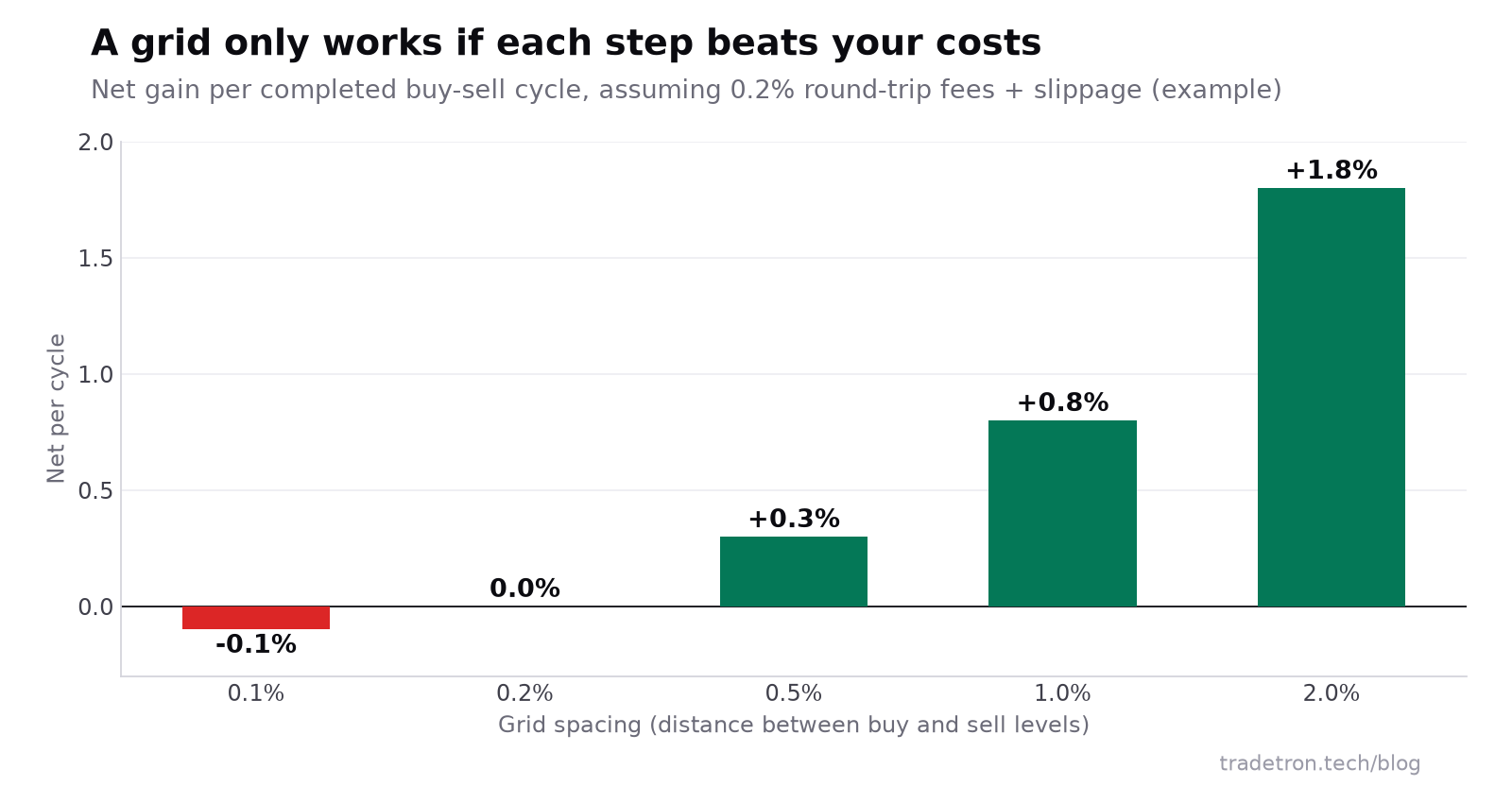 Grid spacing has to be wider than your round-trip costs (example figures)
5. Arbitrage
Idea: the same coin can trade at slightly different prices on two exchanges. Buy on the cheaper one, sell on the dearer one at the same time. Suits: traders with accounts and funds on several exchanges and fast execution. Breaks: when fees, transfer times and slippage are larger than the gap, which is most of the time for retail traders. Gaps that are easy to see are usually closed by faster participants first.
6. Market making and scalping
Idea: place buy and sell orders close to the current price and earn the small spread between them (market making), or take many tiny, quick trades (scalping). Suits: very liquid pairs with tight spreads. Breaks: when costs are high or the market moves sharply against your open orders. Both need low latency and careful cost control.
7. Machine learning models
Idea: a model trained on past price, volume or sentiment data predicts short-term direction. Suits: traders with programming and data skills. Breaks: easily. Models overfit past data, and a pattern that worked in one market phase can disappear in the next. Treat any ML signal as one more input that still needs fixed entry, exit and risk rules.
Which crypto algorithm fits which market?
| Algorithm | Best market | Trade frequency | Main risk | Needs speed? |
|---|---|---|---|---|
| Trend following | Strong trends | Low | Whipsaws in ranges | No |
| Momentum | Breakouts | Medium | False breakouts | Somewhat |
| Mean reversion | Sideways ranges | Medium | Trends that don't revert | No |
| Grid | Tight ranges | High | Price leaves the grid | Somewhat |
| Arbitrage | Any | Very high | Fees, transfer delays | Yes |
| Market making / scalping | Liquid pairs | Very high | Costs, sharp moves | Yes |
| Machine learning | Depends on the model | Varies | Overfitting | Varies |
How to choose the right algorithm for you
- Read the market first. Is your coin trending or ranging on the timeframe you trade? Trend tools fail in ranges and range tools fail in trends.
- Check your capital and costs. High-frequency ideas need tight spreads and low fees. If every round trip costs 0.2%, a grid with 0.2% spacing earns nothing, as the chart above shows.
- Decide your maximum loss first. Set the stop per trade and a daily loss limit for the whole strategy before thinking about profit targets. Crypto can move 5–10% in a day.
- Be honest about speed. Arbitrage and market making compete with professional firms on latency. Trend, momentum and mean reversion do not.
- Keep it simple. A two-rule strategy you understand is easier to test, trust and fix than a ten-rule one.
Backtest before you trust any algorithm
Whatever algorithm you pick, backtest it on historical data before it trades real money. A backtest shows how the rules would have behaved in past markets, including the bad stretches. Use it to tune:
- Entry and exit rules. Does the signal still work if you change the indicator length a little? If small changes destroy the result, the rule is fragile.
- Stop-loss and target levels. Check how often the stop is hit by normal noise.
- Costs. Include realistic fees and slippage. High-frequency strategies live or die here.
- Position size. Make sure the worst losing streak in the test is one you could actually sit through.
- Different market phases. Test across trending and sideways periods, not just the last rally.
A good backtest is not a forecast. It tells you whether the rules make sense, not what they will earn. For more on why results drift once a strategy goes live, see nine reasons your backtest doesn't match live trading.
Want ideas for the entry and exit rules themselves? Read what is the best trading strategy for crypto and why entry and exit rules matter in crypto.
Frequently asked questions
What is the best algorithm for crypto trading?
There isn't one that wins in every market. Trend-following and momentum algorithms tend to suit trending markets, while mean reversion and grid algorithms suit sideways markets. The best choice is the one that fits the current market, your capital and your risk limits, and holds up in a backtest.
Which crypto algorithm is best for beginners?
A simple trend-following rule, such as a moving-average crossover with a fixed stop-loss, is easiest to understand, test and monitor. Avoid arbitrage and market making at first: they depend on speed and very low costs.
Is grid trading profitable in crypto?
It can work in a sideways market if each grid step is wider than your fees and slippage. It struggles when the price breaks out of the range, so a grid still needs a stop below the bottom level.
Is crypto arbitrage still possible?
Price gaps between exchanges still appear, but they are usually small and short-lived. After fees, transfer delays and slippage, most retail arbitrage attempts earn little or nothing. Test it carefully with real costs.
Can I build a crypto trading bot without coding?
Yes. No-code platforms such as Tradetron let you build entry, exit and stop-loss rules from ready-made keywords, backtest them, and run them on a connected crypto exchange.
Are crypto trading algorithms safe?
An algorithm is only as safe as its rules. It follows instructions exactly, including bad ones. Every strategy needs a stop-loss, sensible position sizes and testing before real money is used.