

Guide
How to practice options trading with a replay of a real day
The usual way to practise options is to trade at today's prices without real money, and wait. The market gives you one day per day. You cannot take the same decision twice, and you may wait weeks for a gap-down open or a volatility spike to show up.
A replay turns that around. You pick a session that already happened, trade the option chain exactly as it stood at that minute, and move the clock forward to see how it played out. This guide gives you a routine for doing that properly, five kinds of day worth replaying, and the mistakes that make practice feel useful when it is not. Nothing here is a forecast or a promise of any result. It is a way to learn how options behave.
Why practising at live prices is slow
Practising live has real advantages. The prices are the market's prices today, and you feel the time pass. But it has three limits for a learner.
- One sample a day. You see one session, once. Most days are quiet, so the interesting ones come rarely.
- No second attempt. If you sell a straddle at 9:20 and get stopped out at 10:05, you cannot ask what would have happened if you had waited until 10:30.
- Slow feedback. An expiry-day lesson takes a week to arrive. A volatility spike may take a year.
A replay fixes those three limits. It does not make real trading easier, and it has its own limits, which we cover below. Many traders use both. For the difference between the two in detail, see live virtual trading vs historical replay.
What a replay is
In Tradetron's option simulator, you choose an index and a day, and the chain opens at a minute you pick. You buy or sell any strike at the price it traded at that minute, with Delta, IV, OI and OI change beside it. Then you step the clock a minute, an hour or to the close, and read your P&L, the payoff and the Greeks as they were. Prices are the real ones from that session, in 1-minute steps. If a strike did not trade, you see its last price in grey. We never fill a gap with a model.
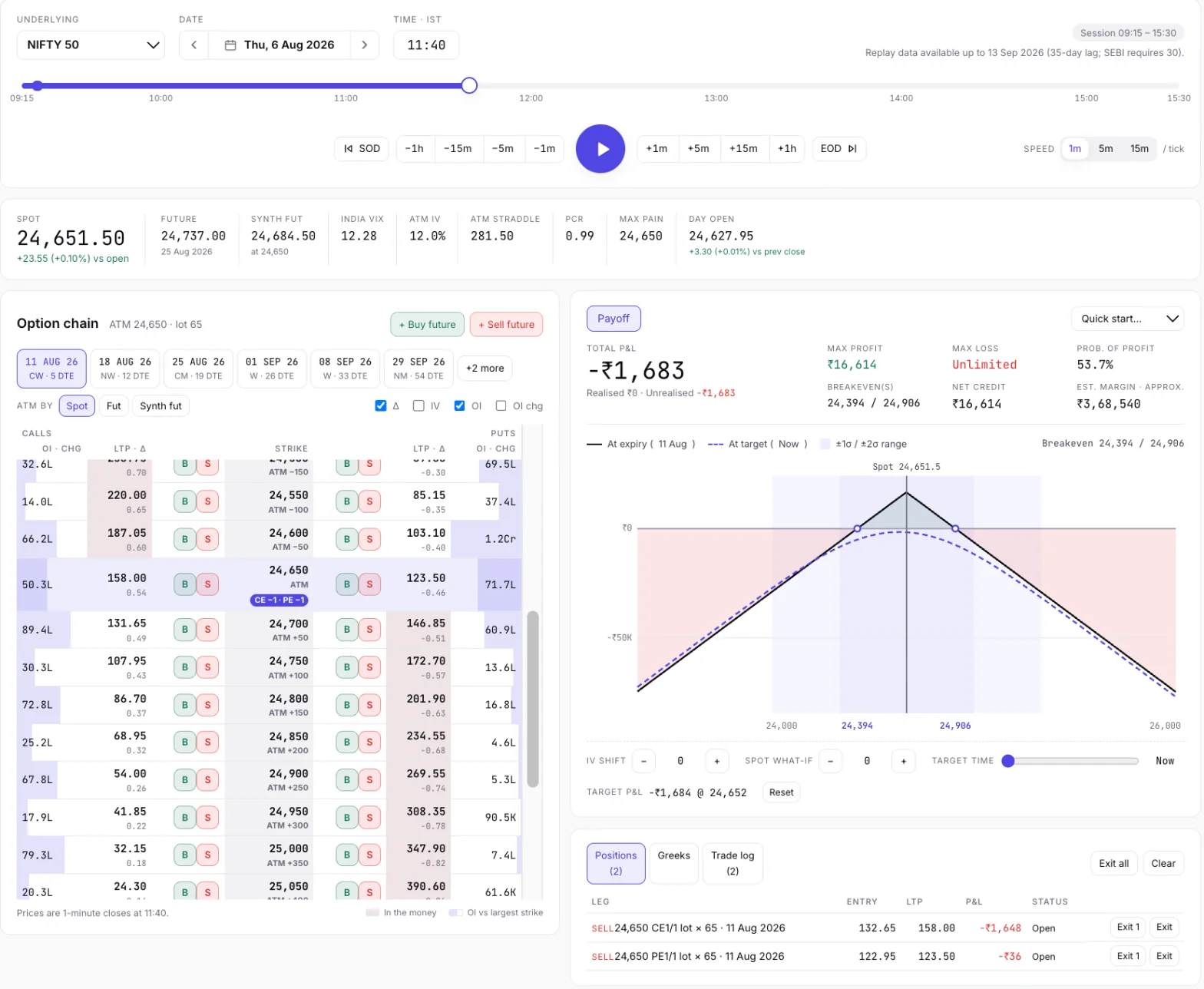
No broker account is needed, nothing places an order, and you can start with the preset days without an account.
A five-step routine
- Choose the day for the lesson, not the outcome. Decide what you want to learn first: time decay, a gap, an expiry, a volatility spike, a trend. Then pick a day that shows it. The next section lists five.
- Write the plan before you open the chain. Four lines: what you will trade, at what time, how much you will risk, and what makes you exit. If you cannot write the exit, you are not ready to enter.
- Trade the chain. Place the legs from the strikes on screen. Look at the premium, the Delta of each leg and the payoff line before you commit.
- Move the clock in steps. Jump a few minutes at a time. Do not skip to the end. When something happens that your plan did not cover, stop and note it.
- Review the trade log. Every entry and exit is recorded. Compare what you did with what you wrote down. The gaps between the two are the lesson.
Trade the chain
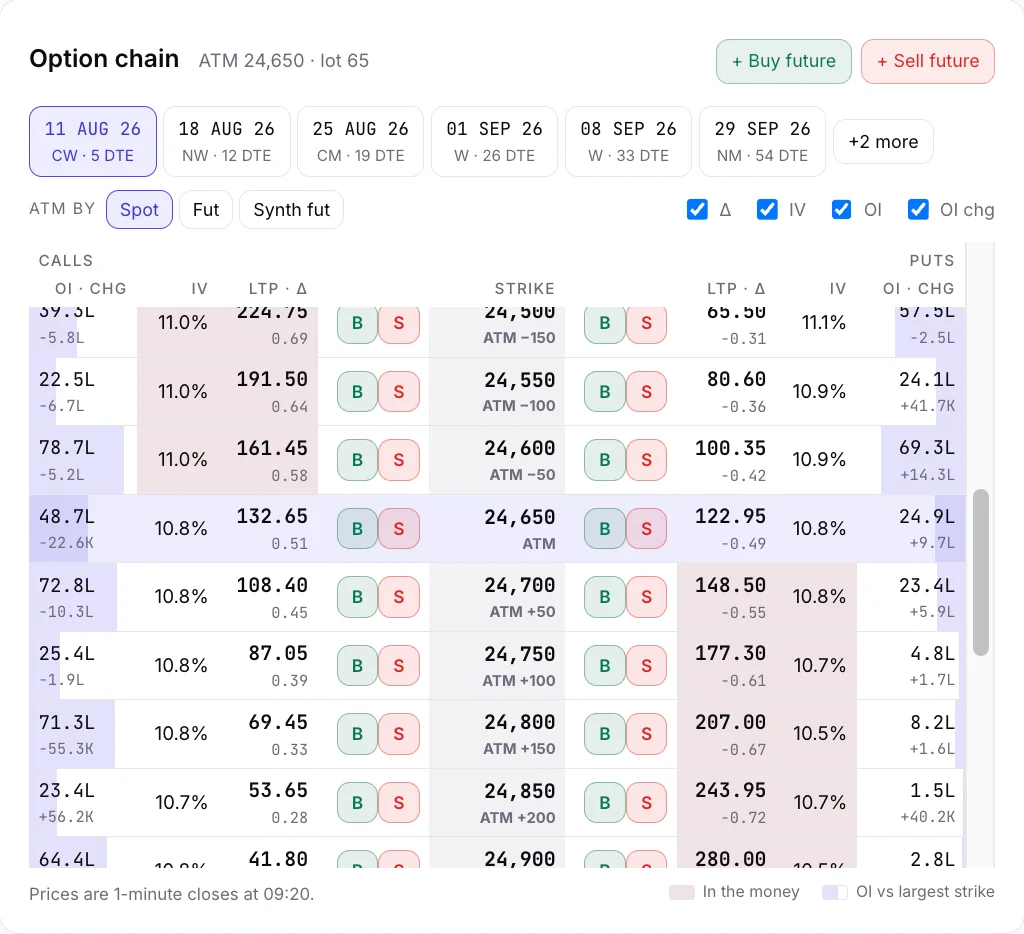
Place each leg from the strikes on screen, with LTP, Delta, IV and OI beside it.
Move the clock in steps

Step a few minutes at a time with the jump buttons.
Review the trade log
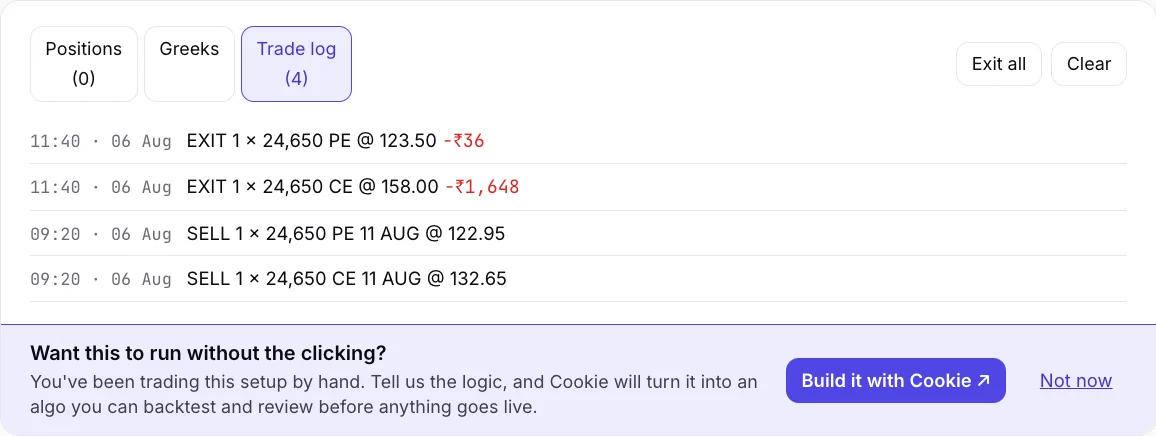
Every entry and exit, with the minute and the price.
Then do the same day again with one change: a different entry time, a different strike distance, a tighter exit. Changing one thing at a time is what makes a replay more useful than a story.
Five kinds of day worth replaying
These are real sessions from the preset list. The figures come from our data and describe the index, not any trade.
- A calm day: NIFTY, 6 Aug 2026. The high-low range was 0.30% and India VIX was 12.1. Practise watching option premiums fade when the index barely moves, and how little room a long option has on a day like this.
- A gap open: NIFTY, 3 Jun 2024. The index opened 3.50% higher, then stayed flat. Practise what a big move priced in at the open does to premiums before you can act.
- An expiry day: NIFTY, 15 May 2025. The range was 2.52% on the day of the weekly expiry. Practise how fast same-day options move as expiry nears.
- A volatility spike: NIFTY, 7 Apr 2025. The index opened 4.82% lower and India VIX rose 66.1% on the day, the largest one-day rise in our data since 2020. NIFTY then recovered 1.99% from the open. Practise reading IV and the payoff line when everything is repriced.
- A trending day: NIFTY, 4 Jun 2024. The index fell 5.00% from open to close, with a high-low range of 8.06%. Practise holding or exiting a position when the move keeps going.

Other indices have their own preset days, listed on the Bank Nifty and SENSEX pages. Index history starts on 1 Jan 2020 for NIFTY and BANKNIFTY, 3 Feb 2021 for FINNIFTY, 7 Aug 2023 for SENSEX and 14 Sep 2023 for MIDCPNIFTY. A free account opens every trading day in the data. The latest day available is 35 days old (35-day lag; SEBI requires 30).
An example drill (illustration)
The numbers here are made up to show the method. They are not from a real day.
Say your plan reads: "Sell one ATM straddle at 9:20 and close it by 15:15. Exit sooner if the combined premium rises by a third from where I sold." Suppose the combined premium at 9:20 is 230. The exit trigger is then about 307. You place the legs, step the clock in ten-minute jumps, and at 11:40 the combined premium reads 312. Your rule says exit. Did you? Did you wait to see if it came back? Whatever happened, write it in one line next to the plan. Run the same day again with a stop at a half instead of a third and compare how the two plans felt, not only how they ended.
This is a drill in following a plan, which is a skill on its own. It is not a test of whether the plan works, and a single day cannot tell you that.
What a replay cannot teach you
- Nerves. Losing real money feels different from losing a number on screen. A replay cannot reproduce that.
- Fills. You trade at a price that traded. In real markets, orders can fill at other prices, especially in thin strikes, and brokerage and taxes apply.
- Hindsight. You know the day's story before you start. Try not to scroll ahead, and avoid picking a day because you already know how it ended.
- Frequency. One good day tells you nothing about how often it happens. Testing a rule over years is a backtest, and that is a separate step.
Keep practice honest and it stays useful. Treat it as a way to rehearse decisions, not to collect good-looking outcomes.
Common mistakes
- Replaying only the days you remember. Memorable days are extreme. Mix in calm ones.
- No written plan. Without one, there is nothing to review.
- Resetting after a bad trade. A mistake you erase is a mistake you repeat. Keep the log.
- Changing five things at once. You cannot tell which one mattered.
- Practising only one structure. Run a long option, a spread and a short straddle on the same day and compare how each behaved.
After you have practised
If you keep doing the same trade with the same entry time, strike distance and exit, you have already written a set of rules without noticing. That is the point where a replay can lead somewhere. Our guide on turning a manual replay into an algo shows how a hand-made trade becomes entry, strike and exit rules, and how Cookie, Tradetron's AI, helps with that. For tools beyond ours, the roundup of option simulators in India sorts them by use case. If you want to see the moment on the screen, replay a past day or try the day below.
Questions traders ask
Is there a way to practice options trading?
Yes. You can practise on days that already happened with a replay simulator, or at live prices with a virtual portfolio. A replay lets you take the same decision more than once. Start with the preset days on the option simulator page; no account or broker is needed.
How to practice F&O trading?
Pick one structure, such as a long call, a spread or a short straddle. Write a plan with an entry time, strikes and an exit. Trade it on a replayed day, move the clock in steps, and review the trade log. Repeat on a calm day, a gap day and an expiry day.
Can I practice options trading for free?
On Tradetron, yes. The preset days open without an account, and a free account opens every trading day in the data. Other tools have their own pricing; the roundup lists what each showed on 15 Oct 2026.
Do I need a broker or demat account to practice?
No. The replay uses past prices and never places an order, so there is nothing to connect.
How long should I practice before trading live?
There is no number that makes you ready. Practise until you can follow your written plan without improvising, then reflect on what a replay cannot show: nerves, fills and costs. Algo and options trading carry risk.
How is practising on a replay different from a backtest?
In a replay you make each decision by hand while the clock moves. A backtest runs written rules over years of history in one go. The first is for learning; the second is the next step once your idea is a set of rules.
Why can't I practice on yesterday's market?
Replay data runs with a 35-day lag; SEBI requires 30. The newest day you can replay is about five weeks old.
Keep reading
- Free NIFTY & Bank Nifty option simulator: replay a real day
- NIFTY option simulator
- Bank Nifty option simulator
- Live virtual trading vs historical replay
- From a manual replay to an algo
- Historical option chain data, explained
Historical replay for education and analysis. Past prices; not investment advice. Nothing here places orders. Algo trading carries risk.