Is Algo Trading Profitable in India? An Honest Answer
Algo trading can be profitable in India, but most traders who try it do not make money. Automation does not create an edge: it carries out your rules faster and more consistently than you can by hand. If the rules have a real edge after costs and slippage, automation helps you keep it. If they don't, it loses money faster.
Is algo trading profitable in India? SEBI's data, the costs maths and how to test a strategy honestly, in 3 minutes. हिन्दी में देखें: क्या India में algo trading profitable है? 3 मिनट में

The honest answer: what the data says
Most people who trade derivatives in India lose money, whether they click buttons or run code. SEBI has studied this several times, and the result has been consistent.
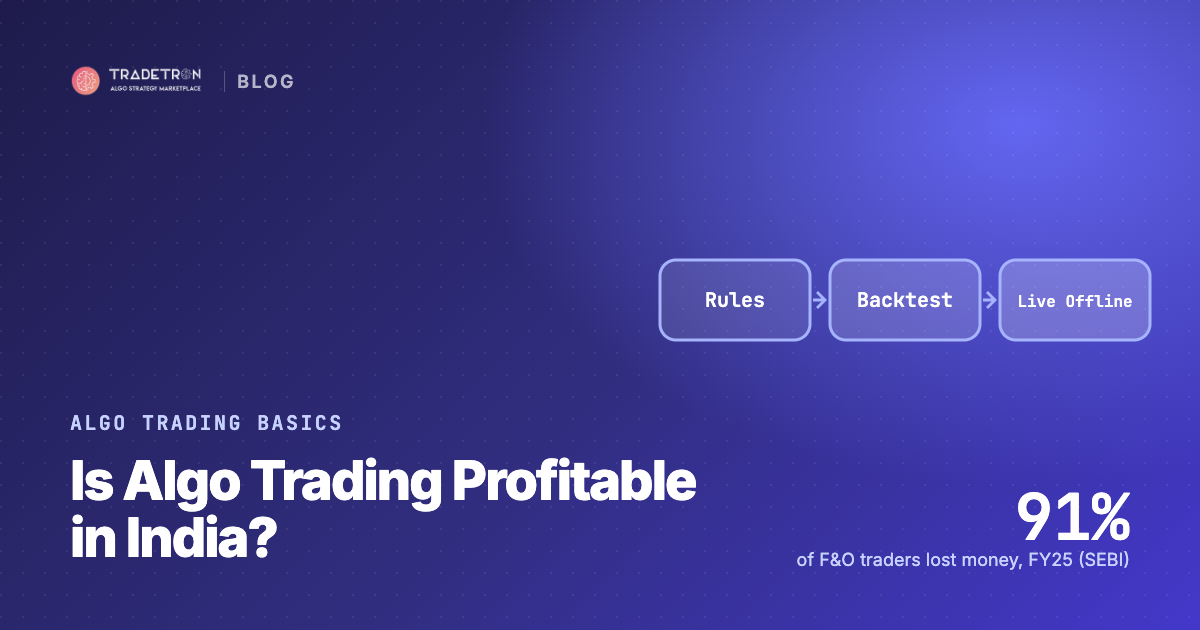
- 91% of individual F&O traders made a net loss in FY25 (SEBI study)
- 9 in 10 roughly the share of losers in each of SEBI's earlier F&O studies
Those numbers include manual traders, algo users and everyone in between. They tell you the starting point: the average retail trader does not have an edge. Algo trading is profitable for the minority whose rules have one, and who keep costs, risk and execution under control.
So the useful question is not "is algo trading profitable?" but "is my strategy profitable after costs, and can I prove it before risking real money?"
What automation changes, and what it doesn't
| Automation helps with | Automation does not fix |
|---|---|
| Entering and exiting exactly when your rules say | A strategy with no edge |
| Never skipping a stop-loss or moving it | Costs that are bigger than your average profit |
| Running several strategies or instruments at once | Leverage that is too high for your account |
| Removing hesitation, fear and revenge trading | A market that stops behaving like your test period |
| Testing the same rules on years of data | Wrong rules typed in correctly |
Five things that decide whether an algo strategy makes money
1. A real edge
An edge is a reason your rules should make money over many trades: a pattern in how prices move, how option premiums decay, or how volatility behaves around events. If you can't say in one sentence why a rule should work, it is probably fitting noise.
2. Costs and slippage
Every trade pays brokerage, exchange charges, STT, stamp duty and GST, and loses a little to slippage (the gap between the price you expected and the price you got). For strategies that trade often for small gains, these costs are usually the difference between a profit and a loss.
Read more in our guide to slippage in trading.
3. The maths of wins and losses
A strategy does not need to win most of its trades. It needs its wins to pay for its losses. The break-even win rate depends on how big your average win is compared with your average loss:
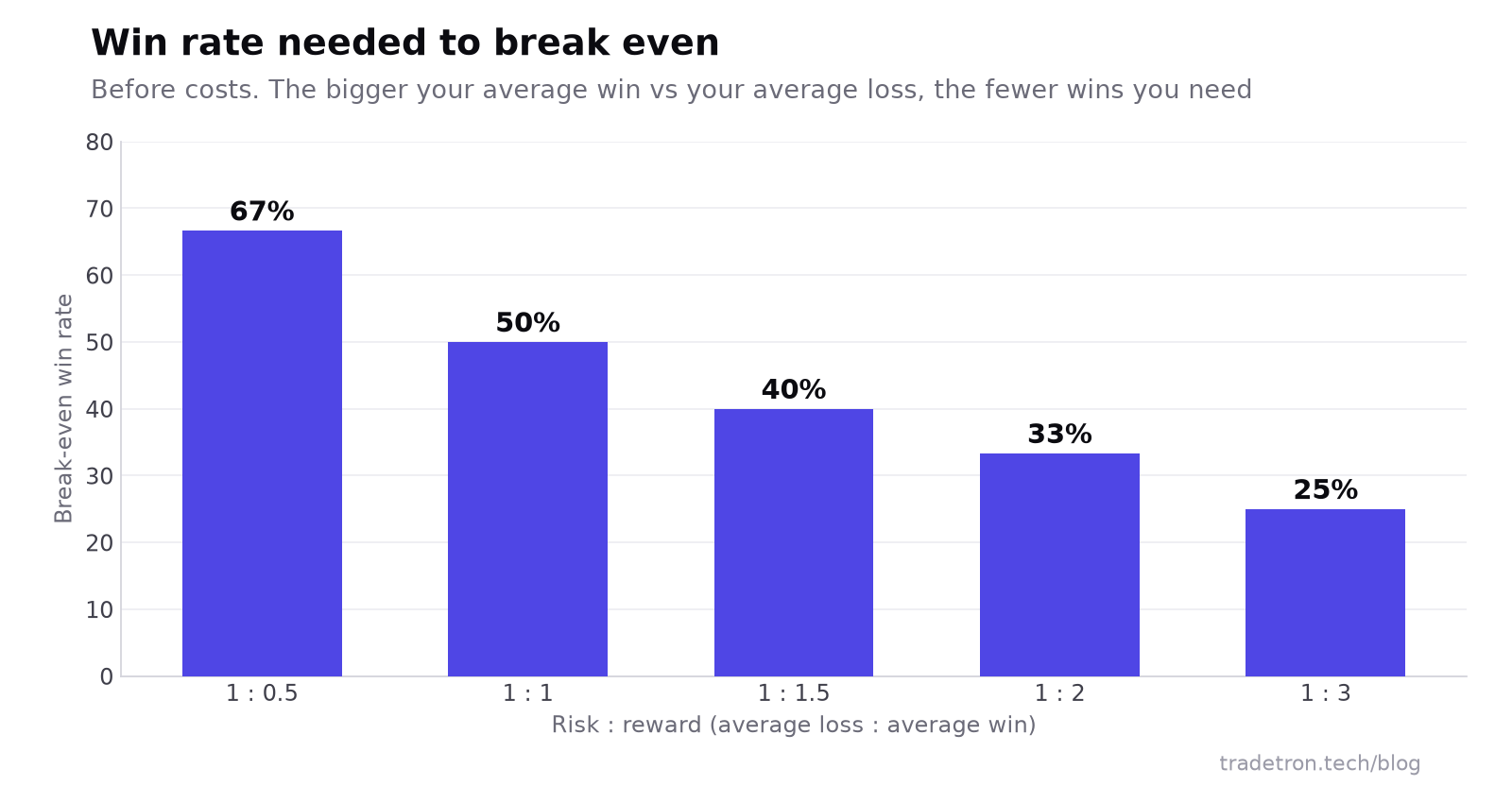 Break-even win rate = 1 ÷ (1 + reward-to-risk ratio), before costs
Option-selling strategies often win most trades but lose more on the losing ones. Trend-following strategies often lose more trades than they win but make more on the winners. Both can work, and both can fail. The win rate on its own tells you very little.
4. Risk management
The strategies that survive are the ones that keep losses small enough to come back from. That means a stop-loss on every position, a maximum loss per day, and position sizes small enough that a bad week doesn't end the account. See seven ways to reduce drawdown.
5. Execution that matches the test
Live results drift from backtests for ordinary reasons: fills, liquidity in far strikes, gaps at the open, order rejections, a broker session that expired. A strategy is only as profitable as its live execution. We list the common causes in nine reasons your backtest doesn't match live trading.
Why the speed advantage is not yours
When people hear that algorithms dominate trading profits, they are usually thinking of high-frequency firms. Those firms place servers next to the exchange (colocation), react in microseconds and earn tiny amounts on very large volumes. A retail strategy that sends orders over the internet through a broker's API cannot compete on that.
That is fine, because most retail edges don't depend on speed. A rule like "sell a hedged NIFTY strangle at 9:20 and exit at 3:15 or at a fixed loss" plays out over hours. What matters is that it is followed every day, not that it is followed a millisecond earlier. We compare the two worlds in low-latency vs high-frequency trading.
Why most retail algo strategies lose
- Over-fitting. Parameters tuned until the backtest looks perfect. The strategy has learned the past, not a pattern.
- Ignoring costs. A backtest without charges and slippage overstates every strategy that trades often.
- Too much leverage. A sound strategy at twice the right size can still blow up the account in a bad month.
- No stop on the strategy. Per-trade stops without a daily or overall loss limit leave the door open to one very bad day.
- Switching off at the worst time. Traders stop a strategy after a normal drawdown, then restart it after the recovery has already happened.
- The market changes. A rule that worked in a low-volatility year may not work in a high-volatility one. This is strategy fatigue.
- Buying a story. Subscribing to a strategy because of a screenshot of past profits, without looking at its drawdowns or how long it has run.
How to check if a strategy could be profitable before risking money
- Write the rules down completely. Entry, exit, stop-loss, position size, time filters, what happens on expiry day. If it isn't written, it can't be tested.
- Backtest on several years of data, including at least one rough period. Include charges and a realistic slippage figure.
- Read the drawdown, not just the return. Ask whether you could sit through the worst losing stretch without stopping the strategy. Our guide to evaluating strategy performance covers the numbers to look at.
- Check that it isn't fragile. Change each parameter a little. If a small change turns a profit into a loss, the edge is probably not real.
- Run it Live Offline for a few weeks. The strategy runs on live prices and records every trade, but nothing is sent to the exchange. Compare its trades with the backtest.
- Go live with the smallest size, then increase only when live results stay close to what you tested.
Is algo trading legal in India?
Yes. Retail traders can use algorithms through their broker's API under SEBI's framework for retail algo trading. Every algo order now carries an exchange-issued identifier, and brokers are responsible for the algos that run through them. The details are in our guide to SEBI's algo trading rules and in what the Algo-ID mandate means for retail traders.
Who algo trading suits
Pros
- Follows your rules without hesitation, every time
- Lets you test an idea on years of data before risking money
- Runs while you work, and can watch many instruments at once
- Makes stop-losses and daily loss limits automatic
Cons
- Does not create an edge where there isn't one
- A wrong rule or a bad parameter can repeat a mistake many times
- Live results can drift from tests because of costs and fills
- Still needs monitoring: broker logins, margins, rejected orders
It suits traders who already have, or are willing to build, a clear rule-based approach, and who will test it honestly. It does not suit anyone looking for a shortcut to income.
For a ground-up introduction, start with what algo trading is, then how to build a robust strategy.
Frequently asked questions
Is algo trading profitable in India?
It can be, for strategies with a real edge after costs, sized sensibly and executed reliably. Most retail derivatives traders lose money, and automation alone doesn't change that. The strategy decides the result; automation only executes it.
Can beginners make money with algo trading?
Some do, but beginners should expect to spend months learning and testing before trading meaningful size. Start with simple rules, backtest them, run them Live Offline, and go live with the smallest position your broker allows.
How much money do I need to start algo trading in India?
There is no fixed minimum. It depends on what you trade: one NIFTY lot is 65 units, so buying an option at ₹100 costs ₹6,500 in premium, while selling options or trading futures needs much more margin. Start with an amount you can afford to lose while you learn.
Is algo trading better than manual trading?
It is better at execution: it follows rules without emotion and never misses a stop. It is not better at finding an edge. A trader with a good rule-based approach usually gains from automation; a trader without one just loses more consistently.
Can algo trading guarantee profits?
No. No strategy, platform or algorithm can guarantee profits, and SEBI does not allow anyone to promise returns. Be wary of any provider that shows only profits and no drawdowns.
Do I need to know coding for algo trading?
No. No-code platforms like Tradetron let you build rules from conditions and keywords. Coding helps for unusual logic, but it is not required to start.
Is algo trading legal in India?
Yes. Retail algo trading through a broker's API is legal under SEBI's framework, which requires algo orders to be tagged and makes brokers responsible for the algos they allow.