Options Trading for Beginners: A Step-by-Step Guide on Tradetron
Options trading for beginners comes down to two contracts. A call gives you the right to buy at a fixed price (the strike) before expiry; a put gives you the right to sell. Buyers pay a premium and can lose only that; sellers collect it and take on bigger risk. Start by buying options or using covered calls and protective puts, with small size and written exits.

What are options?
An option is a contract that gives the buyer the right, but not the obligation, to buy or sell an underlying asset at a set price (the strike price) on or before a set date (the expiry). The buyer pays a premium to the seller (also called the writer) for this right.
In India, options trade on NSE and BSE on indices such as NIFTY 50 and SENSEX, and on individual stocks. They trade in lots: one NIFTY option lot is 65 units, so a premium of ₹100 means ₹6,500 per lot.
| Term | Meaning |
|---|---|
| Call option (CE) | Right to buy at the strike price |
| Put option (PE) | Right to sell at the strike price |
| Strike price | The fixed price in the contract |
| Premium | The price of the option, paid by the buyer to the seller |
| Expiry | The last day the contract is valid |
| Lot size | The minimum number of units per contract |
| In the money (ITM) | A call with strike below the market price, or a put with strike above it |
| Out of the money (OTM) | A call with strike above the market price, or a put with strike below it |
Call options
You buy a call when you expect the price to rise. If the underlying ends above the strike, the call has value. You make money once it is above strike + the premium you paid.
Put options
You buy a put when you expect the price to fall, or to protect shares you already hold. The put has value if the underlying ends below the strike, and you make money once it is below strike − premium.
Four beginner-friendly options strategies
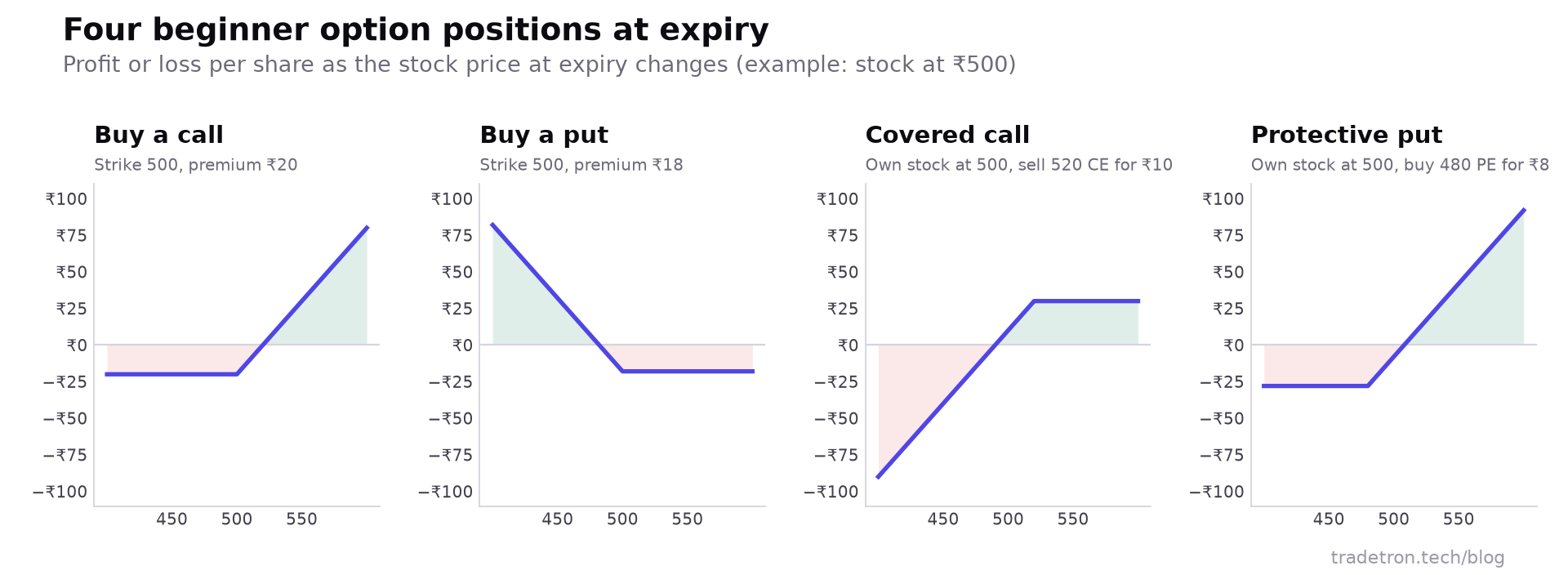 How the four beginner positions pay off at expiry (example prices)
1. Buying a call
View: bullish. Example: a stock trades at ₹500. You buy the 500 call for ₹20.
- If the stock ends at ₹540: the call is worth ₹40, so your profit is ₹40 − ₹20 = ₹20 per share.
- If it ends at or below ₹500: the call expires worthless and you lose the ₹20 premium.
- Breakeven: 500 + 20 = ₹520.
2. Buying a put
View: bearish. You buy the 500 put for ₹18.
- If the stock ends at ₹460: the put is worth ₹40, profit ₹22 per share.
- If it ends at or above ₹500: you lose the ₹18 premium.
- Breakeven: 500 − 18 = ₹482.
3. Covered call
View: neutral to mildly bullish, on shares you already own. You hold the shares (in multiples of the lot size) and sell an out-of-the-money call against them, say the 520 call for ₹10.
- If the stock stays below ₹520, the call expires and you keep the ₹10 on top of whatever the shares do.
- If it rises above ₹520, your gains stop there: the shares would be called away at 520.
- The risk is the same as holding the shares, cushioned by ₹10.
4. Protective put
View: you own shares and want insurance. You buy the 480 put for ₹8.
- If the stock falls to ₹420, the put pays ₹60, so your total loss is capped at (500 − 480) + 8 = ₹28 per share.
- If the stock rises, you keep the upside, minus the ₹8 cost.
Pros of options for beginners
- Buying options has a known maximum loss: the premium
- Protective puts let you insure shares you hold
- Covered calls can add income on shares you already own
- Small capital controls a larger position
Cons
- Time decay works against option buyers every day
- Leverage cuts both ways: a small move can wipe out a bought option
- Selling options without hedges can lose far more than the premium
- Volatility changes can move premiums against you even when you're right on direction
Understand the risks before you place a trade
Options are leveraged instruments, and SEBI's own studies of individual F&O traders have found that most of them lose money. A few rules go a long way:
- Size every trade so the worst case is small. Many traders risk no more than 1–2% of capital on a single trade. If you buy a ₹6,500 option lot, assume all ₹6,500 can go.
- Write the exit before the entry. A stop on the premium (for example, exit if it falls 40%), a target, and a time exit.
- Know what you're paying for. Check how much of the premium is time value. Our guide to calculating option premium shows how.
- Avoid naked option selling at first. If you sell, hedge with a bought option further out, as in an iron condor.
- Respect expiry. Options get very sensitive in the last days. NIFTY weekly options expire on Tuesday; BANK NIFTY options are monthly.
How to build your first options strategy on Tradetron, step by step
Tradetron lets you turn an options idea into rules that run on their own, without code. You can start from a ready-made template in the Option Wizard, or build from scratch in the strategy builder.
- Create a free account and log in.
- Open Create Strategy. Choose the Option Wizard for a template, or the builder to start from a blank strategy.
- Pick the instrument. An index such as NIFTY 50, or a stock with options.
- Choose a structure. The Option Wizard has templates for common structures such as straddles, strangles, iron condors, bull put spreads and bear call spreads.
- Set the entry condition. For example, a time (Time ≥ 9:30) or an indicator signal such as RSI or a moving-average crossover. Conditions are grouped in sets, combined with AND/OR.
- Define the positions (legs). Buy or sell, CE or PE, strike (ATM, a number of strikes away, or by premium), expiry and quantity in lots.
- Add risk rules. A stop-loss and target on each leg (SL and Target triggers), a trailing stop if you want one, and an exit condition such as a fixed time.
- Backtest it. Run the strategy on historical data and read the report: total P&L, drawdown, worst day, and number of trades. See all about backtests on Tradetron.
- Run it Live Offline. The strategy runs and records every trade, but nothing is sent to the exchange. Use this to confirm it behaves the way you expect in today's market.
- Connect your broker and deploy with Live Auto only when you're satisfied, starting with the smallest size. See how to deploy a strategy.
Next steps: our complete options trading in India guide, the best indicators for options trading, and what hedging is.
Frequently asked questions
What are the two basic types of options?
Call options and put options. A call gives the buyer the right to buy the underlying at the strike price; a put gives the right to sell it. Every strategy, however complex, is built from calls, puts and the underlying.
Is options trading good for beginners?
It can be, if you start with defined-risk trades such as buying options, covered calls or protective puts, keep position sizes small and test strategies first. Selling options without hedges is not a good starting point because losses can far exceed the premium.
How much money do I need to start options trading in India?
Buying one option lot costs the premium × lot size. A NIFTY option at ₹100 costs ₹6,500 for one lot of 65. Selling options needs much more because the exchange requires margin. Start with an amount you can afford to lose entirely.
What is a covered call?
A covered call is selling a call option on shares you already own. You collect the premium; in exchange, you give up gains above the strike price. It suits a flat to mildly rising market.
What is the safest options strategy for beginners?
Every strategy carries risk. Buying options and protective puts have a known maximum loss, which makes them easier to manage. Hedged selling strategies such as spreads also cap the loss. Naked selling has the largest potential losses.
Can I practise options trading without real money?
Yes. On Tradetron you can backtest a strategy on historical data and run it Live Offline, where the strategy runs and records every trade but nothing is sent to the exchange.
Can options strategies be automated?
Yes. On Tradetron you define entry, legs, stop-losses and exits as rules once, and the platform executes them, either Live Offline or through your connected broker with Live Auto.