Is Algo Trading Legal in India? What SEBI's Rules Say
Yes, algo trading is legal in India, for retail traders as well as institutions. SEBI regulates it rather than bans it. Since its February 2025 framework, every algorithmic order must go through a SEBI-registered broker, carry an exchange-issued algo identifier, and come from an approved setup. Trading through a properly connected broker and platform keeps you within the rules.
Is algo trading legal in India? What SEBI's February 2025 rules mean for retail traders, in 3 minutes. हिन्दी में देखें: क्या India में algo trading legal है? SEBI के rules, 3 मिनट में

The short answer: legal, with rules
Indian exchanges have allowed algorithmic orders for well over a decade. For years, though, the rules were written mainly for brokers and institutions. Retail traders who connected scripts or third-party platforms to broker APIs sat in a grey zone: nobody was clearly accountable when an automated order misfired.
SEBI closed that gap with its circular on safer participation of retail investors in algorithmic trading, dated 4 February 2025. It did not restrict who can automate. It decided who answers for each automated order, and how the exchange can trace it back to its source. The exchanges then phased the rules in, and the full framework has been in force since April 2026.
What SEBI's algo framework requires
The framework comes down to five rules:
| Rule | What it means for you |
|---|---|
| Broker is the principal | Your broker is answerable to SEBI and the exchange for every algo order it routes, including ones from a third-party platform. |
| Algo providers are agents | Platforms offering algos must be empanelled with the exchanges and onboarded by the broker after due diligence. |
| Every algo order is tagged | Orders carry a unique identifier from the exchange, so any order can be traced to the strategy that sent it. |
| Secure API access | API access is tied to your account with authentication and a registered static IP. Open, unauthenticated APIs aren't allowed. |
| Registration above a speed threshold | A self-built algo that sends orders faster than the exchange-set limit (NSE uses 10 orders per second) must be registered through your broker. |
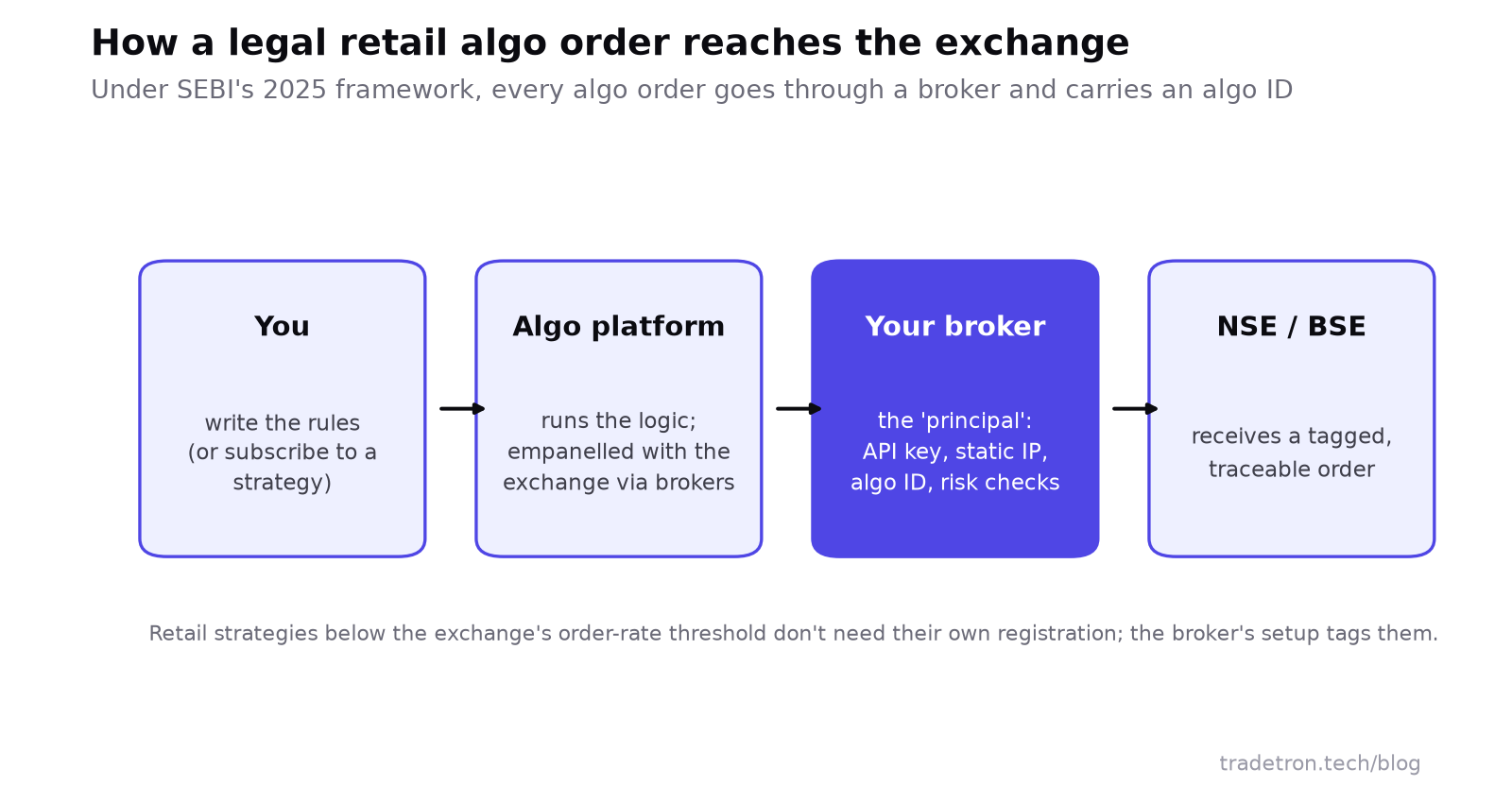 The path of a legal retail algo order under SEBI's 2025 framework
For the operational details, such as the algo-ID timeline and static IP checks, read our explainer on SEBI's algo-ID mandate and the overview of SEBI's algo trading rules.
Who can do algo trading in India?
| You are | Allowed? | What applies |
|---|---|---|
| A retail trader using a broker-connected algo platform | Yes | Your orders are tagged through the broker's and platform's setup. No separate registration at normal order rates. |
| A retail trader running your own code on a broker API | Yes | Static IP and API authentication. Register the algo through your broker only if it crosses the order-rate threshold. |
| Someone selling or sharing a strategy with others | Yes, with conditions | The strategy must be offered through an empanelled provider and broker. If the logic is hidden from users ("black box"), you need a SEBI Research Analyst registration. |
| An institution or high-frequency trader | Yes | Exchange approval for each algo, audits, and the exchanges' colocation rules. |
| Anyone using an unauthorised bot or unofficial API bridge | No | Orders that can't be traced to an approved setup break the rules and can be rejected. |
White box vs black box strategies
The framework draws one line that matters if you follow other people's strategies:
- White box: you can see the full logic, and you could rebuild it yourself. Most strategies traders build on no-code platforms fall here.
- Black box: the logic is hidden from you. Whoever provides it must hold a SEBI Research Analyst registration, because you are effectively following their advice without seeing it.
If you build your own rules, this distinction doesn't affect you. If you subscribe to someone else's strategy, it tells you what to ask them.
How to do algo trading legally: a checklist
- Use a SEBI-registered broker that supports algo trading. Most large Indian brokers now offer API access under the new framework.
- Connect through the official route. Link your broker to your algo platform through the broker's own API login, not a shared password or unofficial bridge.
- Register a static IP if your broker asks for one. It is tied to your API key and is the most common reason orders get rejected.
- Know your order rate. A typical options or indicator strategy places a handful of orders a minute, far below the registration threshold. High-speed scripts are a different case.
- Check any strategy you subscribe to. Ask who the provider is empanelled with and, for hidden logic, for their Research Analyst registration number.
- Keep your own records. Your broker's contract notes and the platform's trade log are your audit trail.
What is still illegal with or without algos
Legal tools can still be used illegally. The rules against market manipulation apply to code exactly as they apply to people:
- Spoofing and layering: placing orders you never intend to fill, to move the price.
- Wash trades: trading with yourself to fake volume.
- Front-running or trading on unpublished price-sensitive information.
- Promising returns: marketing a strategy with a promised income is not allowed under SEBI's rules, for anyone.
The SEBI case against Jane Street in 2025 is a reminder that regulators look at what a strategy does in the market, not at how clever it is. We cover it in SEBI vs Jane Street: the case for ethical algo trading.
Why retail traders automate anyway
The rules add paperwork for brokers and providers. For you, the reasons to automate are the same as before:
Pros
- Rules are followed the same way every time, with no hesitation
- Stops and exits fire even when you are away from the screen
- You can test a rule on years of history before risking money
- Every order is logged, which also helps with compliance
Cons
- A wrong rule loses money faster and more consistently than a human
- Broker API, static IP and connection issues need monitoring
- Backtests can flatter a strategy; live results often differ
- Legal does not mean profitable: most of the risk is still market risk
To set up the connection step by step, see how to connect your broker to Tradetron. If quant strategies are your interest, read is quant trading legal in India.
Frequently asked questions
Is algo trading legal for retail traders in India?
Yes. Retail traders can trade with algorithms as long as orders go through a SEBI-registered broker and an approved setup. SEBI's February 2025 framework made the broker accountable for every algo order and requires each one to carry an exchange identifier.
Do I need SEBI approval to do algo trading?
Not as an individual running a normal-speed strategy. You need a broker that supports algo trading and a proper API connection. An algo you write yourself must be registered through your broker only if it sends orders faster than the exchange's threshold.
Is it legal to use Python or my own code to trade in India?
Yes, through your broker's official API with its authentication and static IP rules. Scripts that bypass the broker's API, share logins, or send orders above the order-rate threshold without registration are not compliant.
Can I sell my trading strategy to other people?
Only through a broker and an empanelled algo provider. If buyers can't see the logic, you need a SEBI Research Analyst registration. You may not promise returns when you market it.
Is high-frequency trading legal in India?
Yes. High-frequency trading by institutions is legal and runs under exchange rules for colocation, order-to-trade ratios and algo approval. It is a different world from retail algo trading, which mostly runs at seconds-to-minutes speed.
Do I pay different taxes on algo trading profits?
No. Tax depends on what you trade and how often, not on whether a person or a program placed the order. Intraday and F&O profits are usually treated as business income; check with a tax professional for your case.
Is algo trading safe?
It is regulated, which is not the same as safe. The framework makes orders traceable and brokers accountable, but your strategy can still lose money. Test every strategy before running it with real capital.