Hybrid Option Spread Strategies: Bull Call Spread + Short Strangle
A hybrid option spread combines a directional spread with a non-directional one in a single position. The example here pairs a bull call spread (a bet on a rise) with a short strangle (a bet on a range): the strangle's premium cuts the cost of the spread, and the result profits most if the index rises moderately and then stays put.
Two building blocks
The bull call spread (directional)
Buy a call at a lower strike and sell a call at a higher strike, same expiry. You pay a net premium. You make money if the index rises past the lower strike, up to a capped maximum at the higher strike. Your loss is capped at the premium paid.
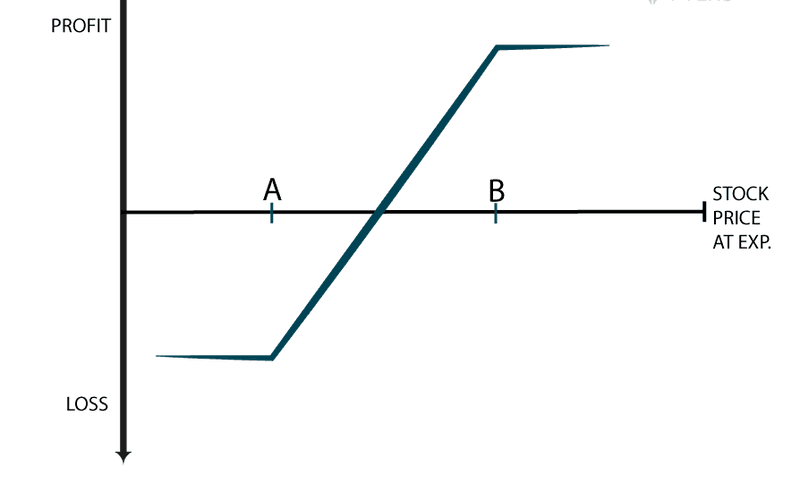 Bull call spread: capped loss below A, capped profit above B
The short strangle (non-directional)
Sell an out-of-the-money call and an out-of-the-money put. You collect premium and keep it if the index stays between the two strikes. Beyond either strike, losses grow without limit.
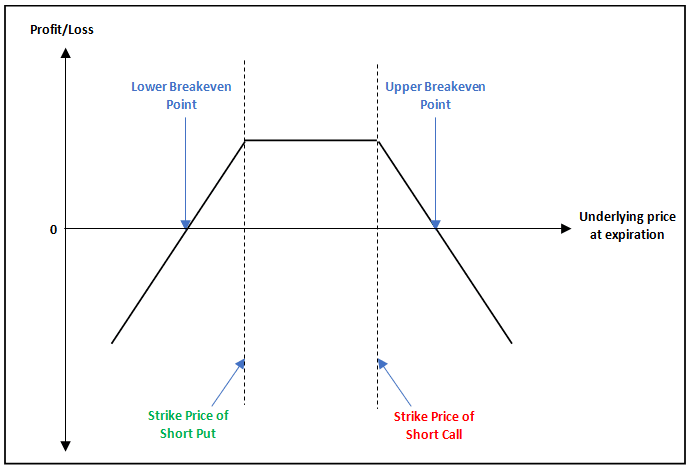 Short strangle: profit in a range, open-ended losses outside it
Putting them together
Here is the hybrid as it was built on NIFTY weekly options in March 2024, with NIFTY near 22,450:
| Leg | Action | Premium (per unit) |
|---|---|---|
| 22,200 call | Buy | ₹255.25 |
| 22,500 call | Sell | ₹87.95 |
| 21,950 put | Sell | ₹40.50 |
| 22,750 call | Sell | ₹21.20 |
| Net | ₹105.60 paid |
The bull call spread alone (22,200/22,500) costs ₹167.30. Selling the 21,950 put and 22,750 call brings in ₹61.70, cutting the net cost to ₹105.60.
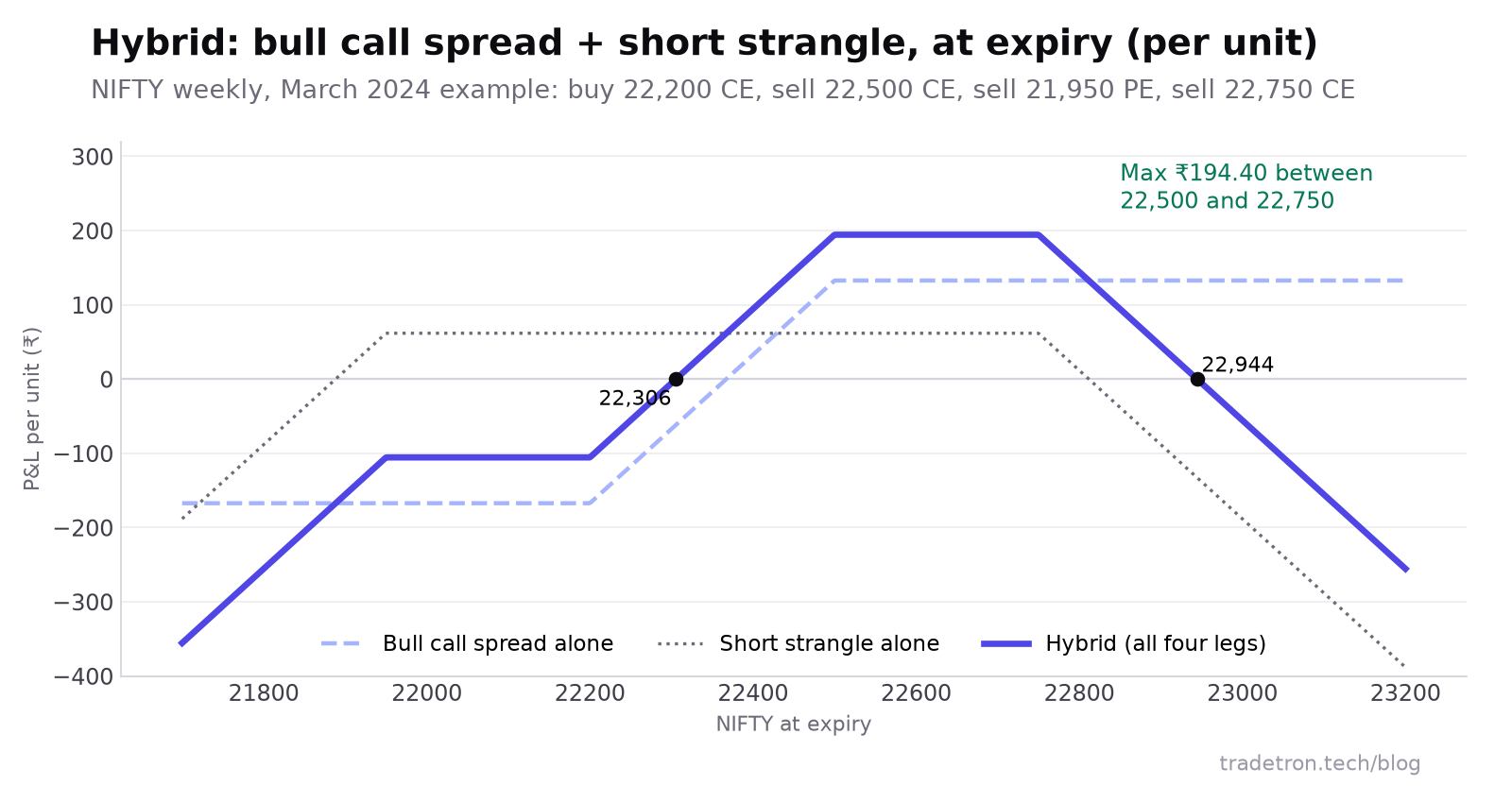 The hybrid (solid) against the bull call spread and short strangle on their own
Compared with the bull call spread alone, the hybrid's best case rises from ₹132.70 to ₹194.40 per unit and its cost falls. In exchange, a fall below 21,950 or a rally past about 22,944 now produces losses with no floor.
The rules
Building it with the Option Wizard
- Open Create → Option Wizard → Create Own Strategy. Name it and choose NIFTY 50 as the underlying.
- Add the four legs: buy the in-the-money call, sell the higher call, sell the out-of-the-money put, sell the far out-of-the-money call. Use ATM-relative strikes so they adjust to the market at entry.
- Set the risk rules: a strategy-level stop loss at the most you are willing to lose, and an exit on expiry day.
- Backtest it over a long period that includes sharp falls and sharp rallies, since those are where the uncovered legs hurt.
- Run it Live Offline for a few expiries before connecting a broker.
Risk management for hybrids
- Know your worst realistic day. Look at the biggest one-day NIFTY moves in your backtest window and what they would have done to the uncovered legs.
- Use a hard strategy-level stop, not just stops on individual legs. The legs interact, so a stop on one leg can leave the rest of the position unbalanced.
- Consider wings. Buying a cheap far-out put and call turns the open-ended losses into capped ones, at the cost of part of the extra premium. See how a hedge also cuts margin.
- Watch margin. Uncovered short options need much more margin than the spread alone.
Pros
- Cheaper than the directional spread alone
- Higher maximum profit when the view is right
- Combines a directional view with time-decay income
- Easy to build and adjust in the Option Wizard
Cons
- Uncovered short options mean open-ended losses at both ends
- Needs a fairly specific outcome to reach the maximum profit
- More legs mean more costs and slippage
- Higher margin than a plain spread
Related: ratio spreads and the Batman strategy, the strangle option strategy and the iron condor guide.
Frequently asked questions
What is a hybrid option strategy?
It combines two option structures with different views, usually one directional (like a bull call spread) and one non-directional (like a short strangle), into a single position with its own payoff.
Why combine a bull call spread with a short strangle?
The strangle's premium lowers the cost of the spread and raises its maximum profit. The position does best if the index rises moderately into the zone between the spread's short strike and the strangle's short call.
What is the maximum loss of this hybrid?
Without extra hedges, it is unlimited. Below the short put or above the far breakeven, the uncovered short options keep losing as the index moves. That is why a strategy-level stop loss is essential.
Can I make the hybrid lower risk?
Yes. Buy a far out-of-the-money put and call as wings. The losses beyond them become capped, the margin drops, and you give up some of the extra premium.
Which index should I use?
The example uses NIFTY weekly options, which expire on Tuesdays. BANK NIFTY, FINNIFTY and MIDCPNIFTY now have monthly expiries only, so a weekly hybrid works on NIFTY or SENSEX.