SPX Gamma Strategy: How to Turn a Complex Idea into a Rules-Based System with Tradetron

SPX Gamma Strategy

If you’ve ever watched the S&P 500 (SPX) grind in a tight range all day, then suddenly explode through a level late in the session, you’ve seen gamma at work—even if you didn’t call it that.

Traders talk about:

  • “Gamma squeezes”

  • “Pinning at big strikes.”

  • “Dealer gamma hedging driving the tape”

And if you’ve been around options long enough, you’ve probably wondered:

“Is there a way to build an SPX gamma strategy I can actually trade in a disciplined way?”

That’s where most people get stuck. They understand the concept of gamma, but they don’t have a practical, repeatable process to trade around it—let alone a way to automate that process.

This is exactly where Tradetron, a no-code, cloud-based algorithmic trading platform, becomes useful. Tradetron doesn’t magically “trade gamma” for you. What it does is let you turn a gamma-aware idea into a concrete set of rules—and then execute those rules consistently, without writing code.

Important: Everything here is for educational purposes only. SPX options and gamma-based strategies are complex and risky. Tradetron is a technology platform, not an advisory service. You’re responsible for your strategies, risk, and results.

First Things First: What Is Gamma in SPX Options?

You don’t need a PhD-level explanation to trade with gamma in mind, but you do need the basics.

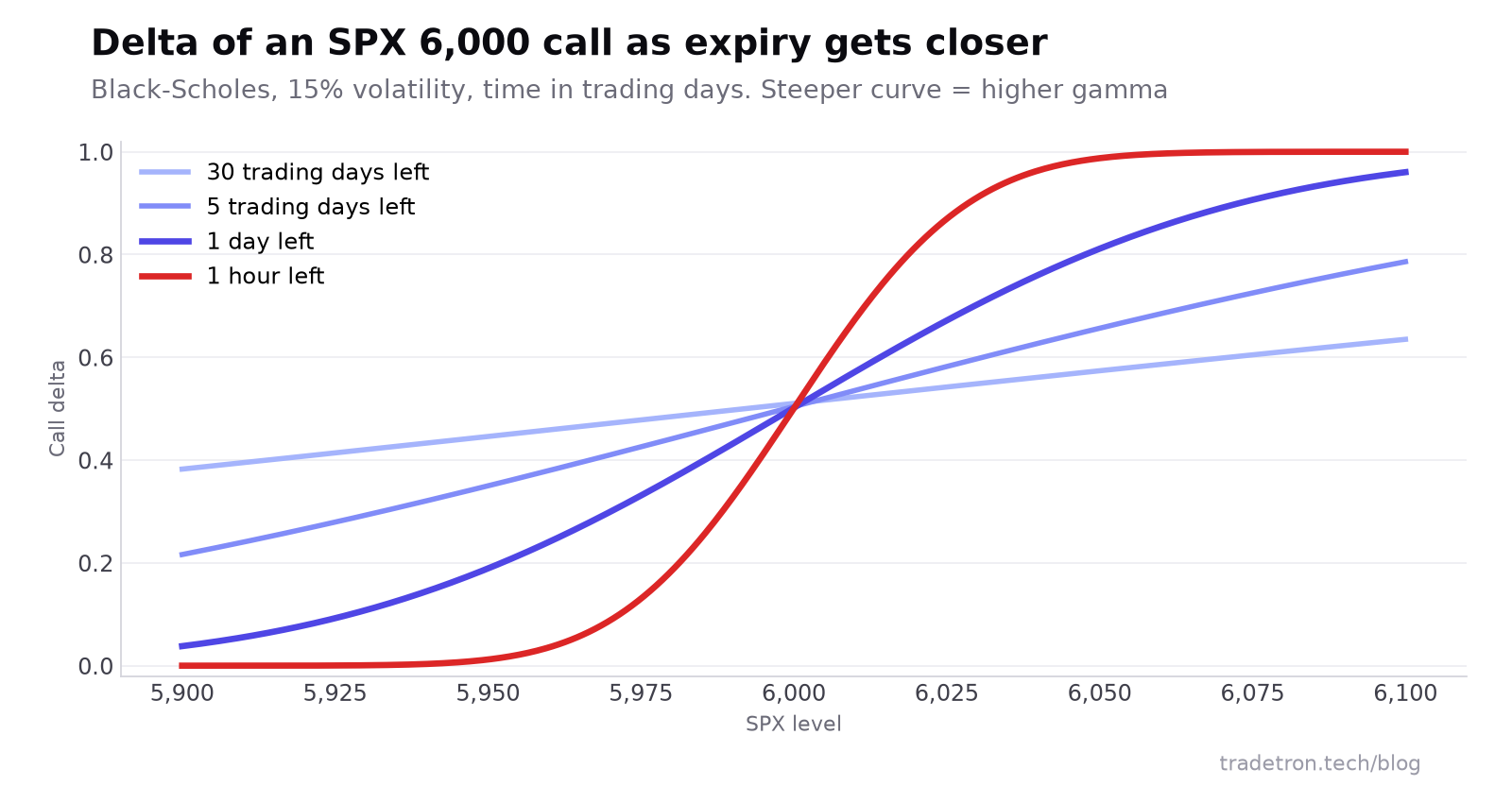
  • Delta tells you how much an option price changes when SPX moves 1 point.

  • Gamma tells you how much that delta changes when SPX moves 1 point.

So:

  • High gamma = deltas change quickly with each move in SPX.

  • Low gamma = deltas change more slowly.

Near expiration—especially with 0DTE (same-day expiry) SPX options—gamma is often very high. That’s why:

  • Small moves in SPX can cause big changes in option behavior.

  • Certain strikes can act like “magnets” or “springs,” depending on how traders and dealers are positioned.

An SPX gamma strategy, broadly, is any structured approach that:

  • Takes a view on how SPX will move (or not move),

  • Chooses options structures with a specific gamma profile (long or short gamma),

  • Manages entries, exits, and risk with that gamma behavior in mind.


What Do Traders Mean by “SPX Gamma Strategy”?

In practice, when someone says they trade an SPX gamma strategy, they usually mean one of two things:

  1. Long gamma/gamma scalping style

    • They own options with high gamma (often near-the-money, near expiry).

    • When SPX moves, they adjust other positions (or take profits) to capture intraday swings.

  2. Short gamma / premium-selling style

    • They sell options or spreads that are short gamma.

    • They aim to profit if SPX stays within a range or behaves more calmly than implied volatility suggests.

    • They need robust risk controls because sharp moves can hurt quickly.

In both cases, discipline is everything:

  • When do you enter?

  • How do you size your trade?

  • When do you adjust or exit?

  • What’s your hard stop on the day?

This is where a platform like Tradetron can help—by turning what’s in your head into specific, testable rules.

The Pillars of a Practical SPX Gamma Strategy

Regardless of whether you lean long or short gamma, a realistic SPX gamma strategy has a few common pillars.

1. A Clear View on “Regime”: Range vs. Trend

Gamma behaves differently depending on how SPX trades:

  • In a choppy, mean-reverting day, long gamma structures (like certain long straddles/strangles) can benefit from repeated swings.

  • In a fast trending day, short gamma structures can be stressed, while long gamma can benefit—if risk is managed.

On Tradetron, you can express “regimes” in rules, for example:

  • Only trade when the intraday range is below/above a certain threshold.

  • Only enter if SPX is near a key level you’ve identified (e.g., around a whole number or an important prior close).

  • Avoid trading on days with known event catalysts (which you filter manually in your routine but enforce via time/volatility rules in your strategy).

You’re not predicting the future perfectly—you’re narrowing down when you’re willing to be exposed to a specific gamma profile.

2. Defined-Risk Structures

Gamma strategies can move quickly against you. Defined risk is almost non-negotiable for most traders.

That often means:

  • Using spreads (buying one option, selling another) so your maximum loss is known.

  • Controlling the distance between strikes to shape your exposure.

  • Keeping sizing modest relative to your account and to typical intraday volatility in SPX.

In Tradetron, you can express this as:

  • “When my entry conditions are met, open a multi-leg SPX spread with predefined strikes and quantities.”

  • “Limit the number of concurrent positions or strategy instances to X.”

The idea is to ensure each trade and each day has a clearly defined worst-case scenario from the start.

3. Rule-Based Adjustments and Exits

Gamma strategies often shine or fail based on how you react to SPX moves.

Some examples of rule types that fit well into Tradetron:

  • “If SPX has moved more than N points from my reference price, take partial profits or adjust the spread.”

  • “If unrealized profit reaches a certain threshold, lock some or all of it.”

  • “If loss on this position hits a hard stop, exit completely—no questions asked.”

  • “If it’s later than a specific time of day, close all open legs, regardless of P&L.”

On Tradetron, these just become:

  • Conditions (SPX move, P&L, time)

  • Followed by actions (close, adjust, stop opening new trades)

You’re effectively encoding your gamma playbook so it executes even when you’re tired, distracted, or stressed.

How Tradetron Helps You Turn SPX Gamma Ideas into Systems

Tradetron doesn’t tell you what SPX gamma strategy to run. What it does extremely well is help you:

  1. Formalize your idea in plain language.

  2. Convert that idea into a set of conditions and actions.

  3. Test and refine the behavior in a risk-controlled environment.

  4. Automate execution so your rules—not your impulses—drive the trading.

Let’s look at how that might look in practice, purely as examples.

Example 1: A Gamma-Aware, Short-Premium SPX Framework (Educational Only)

This is not a recommendation—just an illustration of how a short gamma, range-focused mindset could be structured in Tradetron.

Imagine you believe:

  • Most days, SPX will stay within a certain intraday range.

  • You want to use defined-risk spreads that are short gamma and short premium.

  • You want very firm loss limits and a hard time exit.

You might sketch your rules like this:

Entry idea (sketch):

  • Avoid the first 30–60 minutes of the session while volatility is sorting itself out.

  • Enter only if:

    • Intraday range so far is within your comfort zone.

    • SPX isn’t already making an outsized move relative to the open.

  • Trade a defined-risk spread structure around levels you’re comfortable with (for example, a spread on options expiring that day, at strikes a certain distance away from the current price).

Risk and exit idea (sketch):

  • Set a per-position max loss (e.g., a fixed dollar amount or % of maximum loss).

  • Set a per-position profit target (e.g., capture a portion of the premium).

  • Define a daily loss cap where:

    • All positions close if reached.

    • No new entries are allowed for the rest of the session.

  • Define a hard time exit (e.g., close everything by mid- to late afternoon).

In Tradetron, that becomes:

  • A strategy with:

    • Entry conditions (time, range, no existing open position)

    • Entry actions (open a specific SPX spread with a defined quantity)

    • Exit conditions (P&L thresholds, time thresholds)

    • Exit actions (close all legs, pause further entries for the day)

You now have a short gamma framework that behaves the same every day, with your rules baked in.

Example 2: A Simple Gamma-Conscious Intraday “Long Volatility” Framework

On the other side, imagine you’re more interested in capturing sharp intraday moves and are willing to pay a premium for that.

Again, not advice—just a conceptual template.

You might think in terms of:

  • Entering when SPX is quiet but you expect a potential breakout.

  • Using defined-risk structures that give you long gamma exposure (so that a bigger move helps more than a small move hurts).

  • Taking profits on spikes and flattening by the end of the day.

Your sketch:

Entry idea (sketch):

  • Wait until after the open to see if the day is shaping up as low or high volatility.

  • Look for a compressed range, where SPX has moved relatively little for a period of time.

  • Then, when your time and volatility filters are satisfied, open a defined-risk structure that benefits from a breakout (for example, a carefully chosen spread around current price).

Risk and exit idea (sketch):

  • Define a maximum loss you accept on the structure.

  • Define profit thresholds where you will:

    • Take partial profits, or

    • Close outright if SPX has made the move you were seeking.

  • As with any intraday options approach, set a hard exit time so you’re not stuck into the close.

In Tradetron, this would again be expressed as:

  • Conditions based on:

    • Time of day

    • Range or volatility proxies

    • P&L on the open position

  • Actions:

    • Initiate the long gamma-friendly structure

    • Take partial or full profits as levels are hit

    • Exit at a certain time no matter what

You’re not micro-managing the trades all day—Tradetron is applying your logic systematically.

Why Automation Matters So Much for SPX Gamma Strategies

Gamma-based trading is unforgiving when it comes to hesitation and emotional decision-making.

Common human issues:

  • Closing winners too early because you’re afraid they’ll reverse.

  • Refusing to close losers because “it might bounce.”

  • Oversizing after a string of wins.

  • Taking random trades outside your plan because the market “looks interesting.”

Tradetron helps by:

  • Running in the cloud so your strategy doesn’t depend on you watching every tick.

  • Executing the same rules every day, without second-guessing.

  • Enforcing risk limits and time exits, even when you’re tempted to ignore them.

You still choose:

  • The structure you trade.

  • The level of risk you’re willing to accept.

  • When to go live and how big to trade.

But once you’ve done that thinking, Tradetron is the one pressing the buttons according to your instructions—not your emotions.

Getting Started: From Idea to SPX Gamma Strategy on Tradetron

If you want to explore an SPX gamma strategy using Tradetron, a sensible path looks like this:

  1. Write it down first.

    • Are you aiming to be primarily long gamma or short gamma?

    • What kind of SPX days do you want to be involved in?

    • What’s your maximum acceptable loss per trade and per day?

  2. Translate your thoughts into rules.

    • Turn “I don’t trade before 10 a.m.” into: “If time < 10:00, don’t enter.”

    • Turn “I’m out if I lose more than $X” into: “If P&L < -X, close.”

    • Turn “I want to be flat by the afternoon” into: “If time ≥ cutoff, exit all.”

  3. Build the strategy in Tradetron’s no-code interface.

    • Create your SPX options universe.

    • Use the condition/action builder to encode your entries, exits, and risk controls.

  4. Test in a safe environment.

    • Start in paper or simulation mode.

    • See how your strategy behaves across different kinds of days.

    • Adjust rules as you see patterns—tighten risk, clarify entries, adjust exits.

  5. Go live gradually.

    • Begin with small size, even if testing went well.

    • Consider a semi-automated mode where you confirm orders at first.

    • Only scale size if you’re comfortable with both performance and drawdowns.

This approach is slower than chasing the latest “SPX gamma play” you saw on social media, but it’s far more sustainable.

Conclusion  on SPX Gamma Strategies and Tradetron

An SPX gamma strategy doesn’t have to be mysterious.

At its core, it’s about:

  • Knowing when you want to be long or short gamma,

  • Building defined-risk structures that match that view, and

  • Managing entries, exits, and daily risk with clear rules.

Tradetron’s role is simple but powerful:

  • It lets you turn those rules into a live strategy without writing code.

  • It runs your strategy in the cloud, watching markets for you.

  • It executes based on logic you defined, not on your mood.

Frequently Asked Questions

1. What is an SPX gamma strategy?

An SPX gamma strategy is an options trading approach on the S&P 500 index (SPX) that intentionally uses the behavior of gamma—how quickly option deltas change—as a core part of the plan.

In practice, an SPX gamma strategy usually means:

  • Deciding whether you want to be long gamma (owning options that react strongly to price moves) or short gamma (selling options/spreads that benefit if SPX stays in a range).
  • Choosing SPX option structures (spreads, straddles, etc.) whose gamma behavior fits your outlook.
  • Managing entries, exits, and risk using predefined rules that respond to SPX moves.

Platforms like Tradetron help you turn that gamma-aware idea into a rules-based, automated system.

2. What is gamma in SPX options, and why does it matter?

In SPX options:

  • Delta ≈ how much the option price changes when SPX moves 1 point.
  • Gamma ≈ how much that delta changes when SPX moves 1 point.

High gamma (common in near-expiration, especially 0DTE SPX options) means:

  • Option deltas can change very quickly as SPX moves.
  • Small moves in SPX can trigger big changes in option behavior and hedging flows.

This can lead to:

  • Gamma squeezes (sharp moves as positioning/hedging snowballs).
  • Pinning at big strikes (SPX hovering around popular strike prices near expiration).

gamma-focused SPX strategy tries to benefit from these dynamics—or at least manage risk around them.

3. What’s the difference between long gamma and short gamma in SPX trading?

Long gamma (often “long vol”):

  • You buy options with high gamma (often near-the-money, near expiration).
  • Your position’s delta adjusts in your favor as SPX moves.
  • You typically benefit from larger intraday swings, especially if you can take profits on moves (gamma scalping style).

Short gamma (often premium selling):

  • You sell options or defined-risk spreads that are short gamma.
  • You usually profit if SPX stays within a range or is quieter than implied volatility suggests.
  • Large, sharp SPX moves can hurt quickly, so risk controls are critical.

With Tradetron, you can encode separate rule sets for long gamma and short gamma SPX strategies and choose when each one is allowed to trade.

4. Why are 0DTE SPX options so important for gamma strategies?

0DTE SPX options (same-day expiry) typically have very high gamma:

  • Even small SPX moves can drastically change deltas.
  • This can cause rapid “dealer hedging” flows, intraday pinning or breakouts, and volatile P&L swings.

Many U.S. traders design 0DTE SPX gamma strategies to:

  • Sell defined-risk premium if they believe SPX will stay in a range.
  • Buy gamma (long volatility) if they expect a late-day move or breakout.

Because the risk is concentrated into a single session, automated rules and hard daily loss limits—something Tradetron can enforce—are especially important.

5. How can I turn an SPX gamma strategy into a rules-based system with Tradetron?

With Tradetron’s no-code, cloud-based algorithmic trading platform, you:

  1. Write your idea in plain English

    • Example: “Trade short gamma SPX spreads only after the first 30–60 minutes, with fixed max daily loss and a hard time exit.”
  2. Translate that into conditions and actions

    • Conditions: time of day, SPX price, intraday range, P&L, etc.
    • Actions: open a particular SPX spread, close all legs, stop new entries after a loss cap, exit by a set time.
  3. Use Tradetron’s visual builder

    • No coding required; you choose from menus and logical operators.
  4. Test in paper trading/simulation first, then go live gradually.

This turns your SPX gamma trading idea into a repeatable, rules-based system that trades the same way every day.

Want to join Tradetron ?

Thousands of traders have moved to Algo, what are you waiting for?