How to Invest in the S&P 500 Index: ETFs, Funds and Rules
The simplest way to invest in the S&P 500 index is to buy a low-cost ETF or index fund that tracks it, such as VOO, IVV or SPY, through a brokerage account, and keep adding to it regularly. You can't buy the index itself. More active investors add rules on top: buying on a fixed schedule, a trend filter, or covered calls, which can be tested and automated.
What the S&P 500 is
The S&P 500 is an index of about 500 of the largest US-listed companies, weighted by market value. The biggest companies have the biggest influence, which in recent years has meant a heavy weighting to large technology firms. It is the most widely followed measure of the US stock market, and the benchmark most US fund managers are compared against.
Its ticker as an index is SPX. An index is a calculation, not a security, so to invest you buy something that holds or tracks it.
Ways to invest in the S&P 500
| Route | What you buy | Good for | Watch out for |
|---|---|---|---|
| S&P 500 ETF | VOO, IVV or SPY shares through any broker | Most investors; trades all day like a stock | Pick a low-cost one for long holds |
| Index mutual fund | A fund that tracks the index, bought at end-of-day price | Retirement accounts, automatic monthly investing | Fund minimums at some providers |
| SPX or SPY options | Contracts on the index or the ETF | Hedging, income strategies, short-term views | Leverage and time decay; needs options approval |
| S&P 500 futures | E-mini or Micro E-mini contracts | Active traders and hedgers | Leverage and margin calls |
| From India | NSE-listed US index ETFs, or a US broker funded under LRS | Indian residents | Currency, TCS and tax filing; see below |
SPY vs VOO vs IVV
All three hold the S&P 500. VOO and IVV charge 0.03% a year; SPY charges 0.0945%. SPY trades far more shares a day and has the deepest options market, which matters to traders. For a long-term holder, the lower fee usually wins. Our SPY ETF dividend guide covers the differences in more detail.
Fees matter more than they look
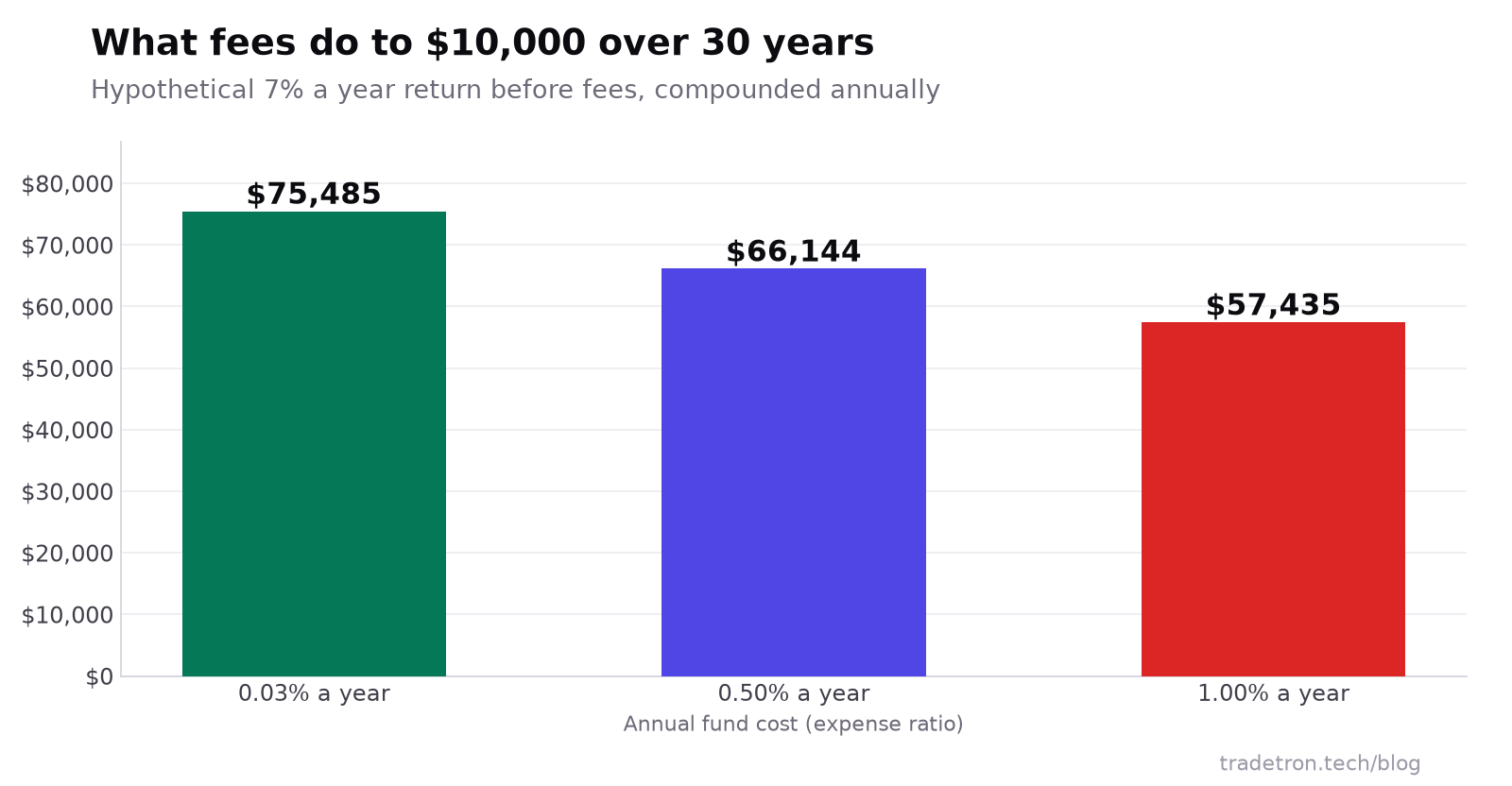 Same index, same years, different fees (hypothetical)
Strategies for investing in the S&P 500
1. Dollar-cost averaging
Invest a fixed amount on a fixed schedule, whatever the price. You buy more shares when prices are low and fewer when they are high.
2. Buy and hold, with rebalancing
Hold the index as part of a mix (for example with bonds), and rebalance back to your target mix once a year or when it drifts by a set amount. The rule decides when you trim and add, not the headlines.
3. Trend filter
Hold the index while it is above its 200-day moving average and move to cash or bonds when it closes below. The aim is to sidestep long declines. The cost is being whipsawed in choppy markets and sometimes missing sharp rebounds. Test it over several decades before relying on it.
4. Covered calls
Own 100 shares of SPY and sell a call option against them each month. You collect the option premium, but give up gains above the strike. It changes the shape of your returns rather than adding free money.
5. Hedging with puts or inverse ETFs
Buy SPX or SPY puts, or a short-term inverse ETF position, when a rule says risk is high. See inverse SPY ETFs for how they behave.
Investing in the S&P 500 from India
Indian residents have two routes:
- NSE-listed ETFs and Indian funds that track US indices, bought in rupees through your Indian broker. Check the ETF's price against its iNAV before buying.
- A US broker account funded under the RBI's Liberalised Remittance Scheme, which lets you buy VOO, IVV or SPY directly. See US brokers that accept Indian traders for the steps, taxes and costs.
Frequently asked questions
What is the easiest way to invest in the S&P 500?
Buy a low-cost S&P 500 ETF such as VOO, IVV or SPY through a brokerage account, or an S&P 500 index mutual fund, and add to it regularly.
Can you buy the S&P 500 index directly?
No. The index is a calculation, not a security. You invest through a fund or ETF that holds its stocks, or trade derivatives such as SPX options or S&P 500 futures.
Which is better: SPY, VOO or IVV?
They track the same index. VOO and IVV charge less (0.03% a year vs 0.0945% for SPY), which favours long-term holders. SPY has more trading volume and a deeper options market, which favours active traders.
Is the S&P 500 good for beginners?
It is a common starting point because one purchase spreads your money across about 500 large companies. It can still fall sharply in bad years, so invest money you won't need for a long time.
How can I invest in the S&P 500 from India?
Either buy NSE-listed ETFs or Indian funds that track US indices, or open an account with a US broker, fund it under LRS, and buy an S&P 500 ETF directly.
Can I automate S&P 500 investing?
Yes. Many brokers offer automatic recurring purchases. For rule-based approaches such as trend filters or covered calls, Tradetron lets you build the rules without code, backtest them and run them on a connected US broker.