Option Strategy Tester: Options Backtesting Software in India
An option strategy tester runs an options strategy's rules (which strikes, which expiry, when to enter, where the stop is) on real historical option prices, so you can see how it would have performed before you trade it. A good one handles multi-leg positions, replays actual premiums rather than a theoretical model, and is honest when a run can't produce a valid result.

Payoff tools vs backtests: two different questions
Options traders often use "strategy tester" to mean two different things.
| Payoff / strategy analysis tool | Backtest | |
|---|---|---|
| Question it answers | What is this position worth at different prices at expiry? | What would my rules have done over the past N years? |
| Input | One position, today's premiums | Entry, exit, strike selection and stop rules |
| Output | Payoff chart, breakevens, max profit and loss, Greeks | P&L over time, drawdown, every trade |
| Includes the path the market took? | No | Yes: stops hit, adjustments, gaps |
A payoff diagram is the right tool for understanding a structure before you enter it:
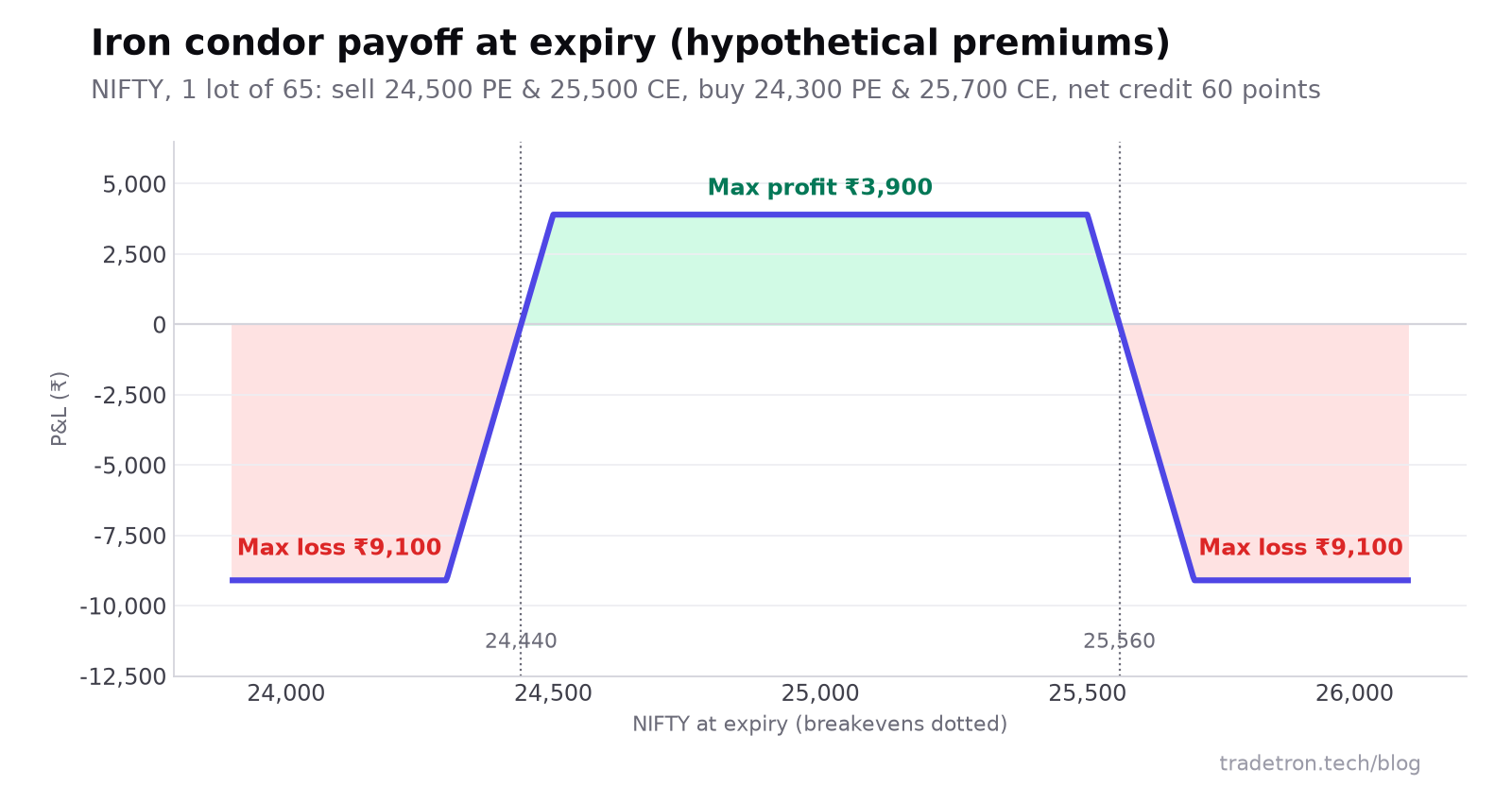 A payoff diagram shows the end state, not the journey
What the payoff diagram can't tell you is how often NIFTY moved enough to hit your stop before expiry, how bad the worst week was, or whether a 9:20 entry beat a 10:00 entry. That needs a backtest.
Why test an options strategy at all?
Options have more moving parts than stocks: strike, expiry, volatility, time decay and direction all matter at once. Testing on history helps you:
- see the real drawdown of a strategy that "usually" wins, such as short straddles;
- check whether your stop loss and adjustment rules help or hurt;
- compare variations (strike distance, entry time, stop size) on the same data;
- build discipline from evidence rather than from the last few trades you remember.
What a good option strategy tester must do
- Use real historical option prices. Premiums modelled from a formula (such as Black-Scholes) can be far from what actually traded, especially around events and on expiry day.
- Handle multi-leg strategies. Straddles, strangles, spreads, iron condors and ratio spreads, with a stop or target on each leg and on the whole position.
- Select strikes the way you would live. ATM, a fixed distance from spot, or by premium, chosen at the moment of entry.
- Cover more than one market regime. A strategy tested only in a calm year has never met a gap.
- Account for costs. Brokerage, taxes and slippage hit option strategies hard because they trade often.
- Be honest about invalid runs. A report that looks complete but contains no real fills is worse than an error message.
- Lead somewhere. Ideally, the strategy you tested is the same one you can run live, so nothing is lost in translation.
Pitfalls that make an options backtest look better than reality
Our guide to nine reasons your backtest doesn't match live trading goes deeper.
How the main options testing tools in India compare
Different tools are built for different jobs. Verify current features and pricing on each platform's own site before choosing; they change.
| Tool | Built mainly for | Systematic backtesting | Path to automated live trading |
|---|---|---|---|
| AlgoTest | Options strategy backtesting | Yes, options-focused | Available |
| Zerodha Streak | Indicator-based strategies, closest integration with Zerodha | Yes, indicator-based | Semi-automated |
| Sensibull | Options analysis, payoff and virtual trading | No; its own help documentation says it has no backtesting feature (Sensibull Help) | Not an automation platform |
| Tradetron | No-code strategy building, backtesting and automation across markets | Yes, multi-leg options and more | Built in, same platform |
If your only need is deep options-only testing, a purpose-built options backtester is a strong fit. If you want the strategy you test to run automatically on your broker afterwards, testing and running in one place saves rebuilding it. For a feature-level comparison, see Tradetron vs AlgoTest.
How to test an options strategy on Tradetron
- Build the strategy in the no-code builder: an entry condition (for example, Time ≥ 9:20), and positions such as "sell NIFTY ATM call and put, current weekly expiry".
- Add risk rules: an SL trigger on each leg, a target, a time exit, and if you like a trailing stop loss on the whole strategy.
- Run a backtest. Pick the date range, 1-minute candles for time-based options strategies, the trade price, and positional or intraday with the right expiry type. The backtest guide explains each setting.
- Read the report: P&L curve, drawdown, month-wise results and every trade. Apply brokerage and slippage in the report's cost section.
- Compare variations with a sweep (for example, stop at 20%, 25% and 30%), and use the hold-back period to check the winner on data it hasn't seen.
- Run it Live Offline: the strategy runs and records every trade, but nothing is sent to the exchange. Then go Live Auto on your broker at a small size.
Tradetron's backtesting runs on its FastBT engine, which covers NSE F&O and cash, BSE, MCX, crypto and US markets. When a run can't produce a valid result, it tells you rather than returning an empty-looking report. Details are on the FastBT page.
Frequently asked questions
What is an option strategy tester?
It is a tool that simulates how an options strategy would have performed on historical data: which strikes it would have traded, when it would have entered and exited, and what it would have made or lost. Some people also use the term for payoff tools that show a position's value at expiry.
Is a payoff diagram the same as a backtest?
No. A payoff diagram shows the profit or loss of one position at different prices at expiry. A backtest applies your entry, exit and stop rules to real past prices over months or years, including everything that happened before expiry.
What is the best options backtesting software in India?
It depends on what you need. For options-only testing, purpose-built backtesters are strong. If you want to test and then automate the same strategy on your broker, a platform that does both, such as Tradetron, avoids rebuilding it. Check each tool's current features and pricing on its own site.
Can I backtest options strategies without coding?
Yes. On Tradetron you build the strategy from conditions and positions in a visual builder, then run the backtest from the strategy page. No code is needed.
Why don't my options backtest results match live trading?
Common causes are slippage and charges, illiquid strikes, moves inside a minute that the test didn't see, and changes in lot sizes or expiry days since the tested period. Apply realistic costs and run the strategy Live Offline before trading real money.
How far back should I backtest an options strategy?
Long enough to include different conditions: a sharp fall, a sideways market and a trend, which usually means a few years. Make sure the period also reflects how the contract trades today, since expiry schedules and lot sizes have changed.